Fundamentals of Digital Image and Video Processing (Coursera)

Fundamentals of Digital Image and Video Processing (Coursera)

In this class you will learn the basic principles and tools used to process images and videos, and how to apply them in solving practical problems of commercial and scientific interests. Digital images and videos are everywhere these days – in thousands of scientific (e.g., astronomical, bio-medical), consumer, industrial, and artistic applications. Moreover they come in a wide range of the electromagnetic spectrum - from visible light and infrared to gamma rays and beyond.

Class Deals by MOOC List - Click here and see Coursera's Active Discounts, Deals, and Promo Codes.

The ability to process image and video signals is therefore an incredibly important skill to master for engineering/science students, software developers, and practicing scientists.
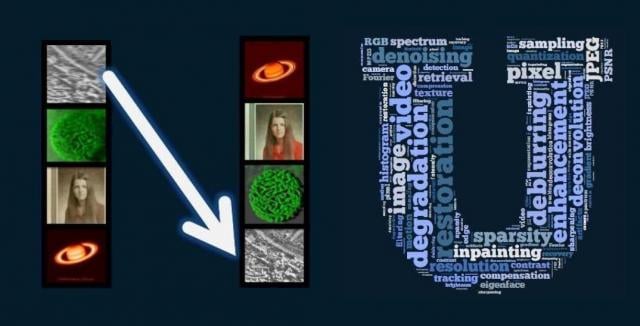
Digital image and video processing continues to enable the multimedia technology revolution we are experiencing today. Some important examples of image and video processing include the removal of degradations images suffer during acquisition (e.g., removing blur from a picture of a fast moving car), and the compression and transmission of images and videos (if you watch videos online, or share photos via a social media website, you use this everyday!), for economical storage and efficient transmission.
This course will cover the fundamentals of image and video processing. We will provide a mathematical framework to describe and analyze images and videos as two- and three-dimensional signals in the spatial, spatio-temporal, and frequency domains. In this class not only will you learn the theory behind fundamental processing tasks including image/video enhancement, recovery, and compression - but you will also learn how to perform these key processing tasks in practice using state-of-the-art techniques and tools. We will introduce and use a wide variety of such tools – from optimization toolboxes to statistical techniques. Emphasis on the special role sparsity plays in modern image and video processing will also be given. In all cases, example images and videos pertaining to specific application domains will be utilized.

Syllabus

WEEK 1
Introduction to Image and Video Processing
In this module we look at images and videos as 2-dimensional (2D) and 3-dimensional (3D) signals, and discuss their analog/digital dichotomy. We will also see how the characteristics of an image changes depending on its placement over the electromagnetic spectrum, and how this knowledge can be leveraged in several applications.

WEEK 2
Signals and Systems
In this module we introduce the fundamentals of 2D signals and systems. Topics include complex exponential signals, linear space-invariant systems, 2D convolution, and filtering in the spatial domain.

WEEK 3
Fourier Transform and Sampling
In this module we look at 2D signals in the frequency domain. Topics include: 2D Fourier transform, sampling, discrete Fourier transform, and filtering in the frequency domain.

WEEK 4
Motion Estimation
In this module we cover two important topics, motion estimation and color representation and processing. Topics include: applications of motion estimation, phase correlation, block matching, spatio-temporal gradient methods, and fundamentals of color image processing

WEEK 5
Image Enhancement
In this module we cover the important topic of image and video enhancement, i.e., the problem of improving the appearance or usefulness of an image or video. Topics include: point-wise intensity transformation, histogram processing, linear and non-linear noise smoothing, sharpening, homomorphic filtering, pseudo-coloring, and video enhancement.

WEEK 6
Image Recovery: Part 1
In this module we study the problem of image and video recovery. Topics include: introduction to image and video recovery, image restoration, matrix-vector notation for images, inverse filtering, constrained least squares (CLS), set-theoretic restoration approaches, iterative restoration algorithms, and spatially adaptive algorithms.

WEEK 7
Image Recovery : Part 2
In this module we look at the problem of image and video recovery from a stochastic perspective. Topics include: Wiener restoration filter, Wiener noise smoothing filter, maximum likelihood and maximum a posteriori estimation, and Bayesian restoration algorithms.

WEEK 8
Lossless Compression
In this module we introduce the problem of image and video compression with a focus on lossless compression. Topics include: elements of information theory, Huffman coding, run-length coding and fax, arithmetic coding, dictionary techniques, and predictive coding.

WEEK 9
Image Compression
In this module we cover fundamental approaches towards lossy image compression. Topics include: scalar and vector quantization, differential pulse-code modulation, fractal image compression, transform coding, JPEG, and subband image compression.

WEEK 10
Video Compression
In this module we discus video compression with an emphasis on motion-compensated hybrid video encoding and video compression standards including H.261, H.263, H.264, H.265, MPEG-1, MPEG-2, and MPEG-4.

WEEK 11
Image and Video Segmentation
In this module we introduce the problem of image and video segmentation, and discuss various approaches for performing segmentation including methods based on intensity discontinuity and intensity similarity, watersheds and K-means algorithms, and other advanced methods.

WEEK 12
Sparsity
In this module we introduce the notion of sparsity and discuss how this concept is being applied in image and video processing. Topics include: sparsity-promoting norms, matching pursuit algorithm, smooth reformulations, and an overview of the applications.


Go to Class
MOOC List is learner-supported. When you buy through links on our site, we may earn an affiliate commission.

Related Courses

Sampling People, Networks and Records (Coursera) Coursera
University of Michigan

Sampling People, Networks and Records (Coursera)

Good data collection is built on good samples. But the samples can be chosen in many ways. Samples can be haphazard or convenient selections of persons, or records, or networks, or other units, but one questions the quality of such samples, especially what these selection methods mean for drawing good conclusions about a population after data collection and analysis is done. Samples can be more carefully selected based on a researcher’s judgment, but one then questions whether that judgment can be biased by personal factors.

Jul 13th 2026
5-12 Weeks
Introduction to advanced tomography (Coursera) Coursera
Technical University of Denmark - DTU

Introduction to advanced tomography (Coursera)

In this course you get the chance to get teaching and hands-on experience with the complete workflow of high-resolution tomography analysis. You will get introduced to data acquisition, 3D reconstruction, segmentation and meshing and, finally, 3D modelling of data to extract physical parameters describing mechanical and flow properties. The teaching and the exercises will take place in close interaction with top experts in the field. Exercises will require some basic programming skills, and will be carried out in a common python environment.

Aug 3rd 2026
4 Weeks
Managing, Describing, and Analyzing Data (Coursera) Coursera
University of Colorado Boulder

Managing, Describing, and Analyzing Data (Coursera)

In this course, you will learn the basics of understanding the data you have and why correctly classifying data is the first step to making correct decisions. You will describe data both graphically and numerically using descriptive statistics and R software. You will learn four probability distributions commonly used in the analysis of data. You will analyze data sets using the appropriate probability distribution. Finally, you will learn the basics of sampling error, sampling distributions, and errors in decision-making.

Jul 20th 2026
5-12 Weeks
Image Segmentation, Filtering, and Region Analysis (Coursera) Coursera
MathWorks

Image Segmentation, Filtering, and Region Analysis (Coursera)

In this course, you will build on the skills learned in Introduction to Image Processing to work through common complications such as noise. You’ll use spatial filters to deal with different types of artifacts. You’ll learn new approaches to segmentation such as edge detection and clustering. You’ll also analyze regions of interest and calculate properties such as size, orientation, and location.

Jul 20th 2026
4 Weeks
Análise de Segmentação de Mercado (Coursera) Coursera
FIA Business School

Análise de Segmentação de Mercado (Coursera)

Nossas boas-vindas ao Curso Análise de Segmentação de Mercado. Neste curso, você aprenderá que as organizações estão adotando tecnologias de Big Data como parte de sua estratégia de negócios e em um mercado orientado a dados, trabalhar com a segmentação de forma eficiente é um grande desafio para a maioria das empresas. Uma segmentação eficaz consiste em agrupar seu público-alvo conforme a característica de cada indivíduo, reduzindo esforços e direcionando corretamente ao objetivo desejado.

Jul 20th 2026
4 Weeks
Getting started in cryo-EM (Coursera) Coursera
Caltech

Getting started in cryo-EM (Coursera)

This class covers the fundamental principles underlying cryo-electron microscopy (cryo-EM) starting with the basic anatomy of electron microscopes, an introduction to Fourier transforms, and the principles of image formation. Building upon that foundation, the class then covers the sample preparation issues, data collection strategies, and basic image processing workflows for all 3 basic modalities of modern cryo-EM: tomography, single particle analysis, and 2-D crystallography.

Jul 27th 2026
5-12 Weeks
Digital Signal Processing 3: Analog vs Digital (Coursera) Coursera
École Polytechnique Fédérale de Lausanne

Digital Signal Processing 3: Analog vs Digital (Coursera)

Digital Signal Processing is the branch of engineering that, in the space of just a few decades, has enabled unprecedented levels of interpersonal communication and of on-demand entertainment. By reworking the principles of electronics, telecommunication and computer science into a unifying paradigm, DSP is a the heart of the digital revolution that brought us CDs, DVDs, MP3 players, mobile phones and countless other devices.

Jul 20th 2026
4 Weeks
Cluster Analysis, Association Mining, and Model Evaluation (Coursera) Coursera
University of California, Irvine

Cluster Analysis, Association Mining, and Model Evaluation (Coursera)

Welcome to Cluster Analysis, Association Mining, and Model Evaluation. In this course we will begin with an exploration of cluster analysis and segmentation, and discuss how techniques such as collaborative filtering and association rules mining can be applied. We will also explain how a model can be evaluated for performance, and review the differences in analysis types and when to apply them.

Jul 13th 2026
4 Weeks
Image and video processing: From Mars to Hollywood with a stop at the hospital (Coursera) Coursera
Duke University

Image and video processing: From Mars to Hollywood with a stop at the hospital (Coursera)

In this course, you will learn the science behind how digital images and video are made, altered, stored, and used. We will look at the vast world of digital imaging, from how computers and digital cameras form images to how digital special effects are used in Hollywood movies to how the Mars Rover was able to send photographs across millions of miles of space.

Jul 13th 2026
5-12 Weeks