Understanding Food Labels and Portion Sizes (Coursera)

Understanding Food Labels and Portion Sizes (Coursera)

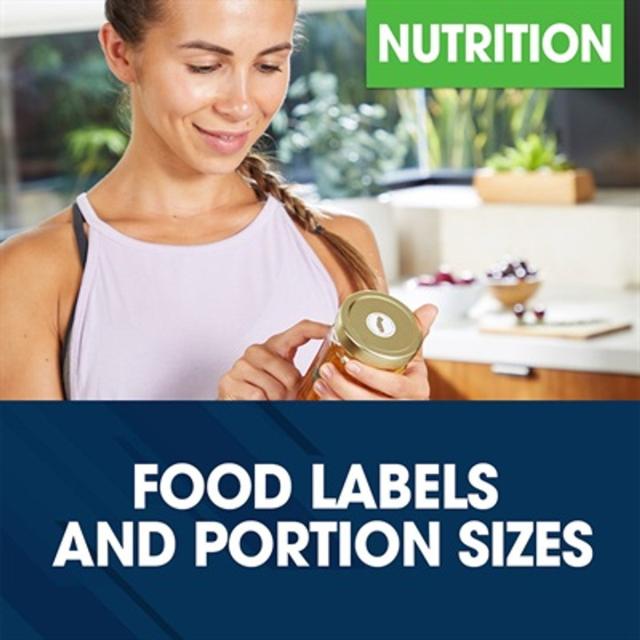
All of us have struggled to decipher the long list of ingredients and recommendations on our food labels. This course provides a deeper understanding of labeling standards and methods for estimating food portions essential for informed decision-making and healthy eating behaviors. You will learn the foundations of reading food labels (including supplement facts labels) as well as common obstacles faced when portioning food.
Class Deals by MOOC List - Click here and see Coursera's Active Discounts, Deals, and Promo Codes.

With over 30 years as a leader in fitness and wellness education, the National Academy of Sports Medicine (NASM) has built its reputation on providing an evidence-based curriculum that is both relevant and applicable for those seeking the skills and knowledge required to promote optimal health.
Course 3 of 5 in the Nutrition Education for the Consumer Specialization.

What You Will Learn

  • Discover how to compare ingredient lists, percent daily value, and macronutrient makeup when comparing similar food options.
  • Differentiate between serving and portion sizes when preparing and plating meals.
  • Learn how to read food and supplement labels required to make informed decisions on which to purchase and/or consume.
  • Compare US measuring and portion sizes with the UK and EU.

Syllabus

WEEK 1
NASM's Understanding Food Labels and Portion Sizes
All of us have struggled to decipher the long list of ingredients and recommendations on our food labels. This course provides a deeper understanding of labeling standards and methods for estimating food portions essential for informed decision-making and healthy eating behaviors. You will learn the foundations of reading food labels (including supplement facts labels) as well as common obstacles faced when portioning food.
Go to Class
MOOC List is learner-supported. When you buy through links on our site, we may earn an affiliate commission.

Related Courses

Nutrition Hot Topics and Controversies (Coursera) Coursera
National Academy of Sports Medicine

Nutrition Hot Topics and Controversies (Coursera)

Within the ever-changing nutrition landscape, it becomes difficult to understand current trending topics. Without a doubt, your friends and neighbors will have questions regarding these nutrition hot topics. Most people want to know what to believe or discard from what they hear, but they often lack the tools or the knowledge (or the time) to research topics as they become popular. This course has been designed to take an in-depth approach to explain the science behind many nutrition hot topics and controversies faced by discerning readers today including organic vs. conventionally farmed foods, grass-fed, GMOs, gluten, sweeteners vs. nonnutritive sweeteners in addition to the myths behind detoxes and cleanses.

Nov 9th 2026
1 Week
Genomics: Decoding the Universal Language of Life (Coursera) Coursera
University of Illinois at Urbana-Champaign

Genomics: Decoding the Universal Language of Life (Coursera)

What is a genome? A genome contains all of the information that a cell needs to develop, function, and reproduce itself, and all the information needed for those cells to come together to form a person, plant, or animal. Genomes contain an organism’s complete set of genes, and also the even tinier genetic structures that help regulate when and how those genes are used. The ability to regrow a torn ligament, the clues that might predict the onset of mental illness, the nutritional potential of crops, and even the history of life itself, are all encoded in genomes. By taking this course, you will discover how scientists are deciphering the language of genomes to learn how to develop sustainable food and fuel supplies, improve disease treatment and prevention, and protect our environment.

Nov 23rd 2026
5-12 Weeks
Actualización en el manejo del paciente con diabetes mellitus tipo 2 (Coursera) Coursera
Universidad Nacional Autónoma de México

Actualización en el manejo del paciente con diabetes mellitus tipo 2 (Coursera)

Este curso está diseñado para ofrecer información actualizada sobre el manejo del paciente con diabetes mellitus tipo 2, con la finalidad de mejorar su atención médica. El curso está dirigido a médicos y profesionales sanitarios que tienen contacto con pacientes diabéticos; con ello, se busca disminuir la morbimortalidad de esta enfermedad y mejorar la calidad de vida de quienes la padecen.

Nov 23rd 2026
4 Weeks
Understanding Obesity (Coursera) Coursera
University of Edinburgh

Understanding Obesity (Coursera)

In this course, we’ll look at the facts and misconceptions around obesity and discuss key physiological and psychological concepts around the brain’s control of appetite and body weight. We’ll consider the biological and environmental pressures that make it easy to gain weight (and hard to lose it!). Most importantly, we'll give you the opportunity to reflect on your own knowledge and assumptions around the subject.

Nov 2nd 2026
4 Weeks
Life 101: Mental and Physical Self-Care (Coursera) Coursera
University of California, Irvine

Life 101: Mental and Physical Self-Care (Coursera)

This course will cover various topics that would teach students healthy lifestyle choices, the importance of mental and physical health and self-care. For each topic, an evidence-based lecture that would include scientific evidence will be presented and then students will be provided practical methods to practice what they have learned from the lectures. One of the main goals of this course is to inspire students to adopt a healthy lifestyle.

Nov 9th 2026
5-12 Weeks
Edible Insects (Coursera) Coursera
National Taiwan University

Edible Insects (Coursera)

This English language course covers the science and sociology of insects as food and feed. Increasing media, investment, and public policy attention has been given over the years to the role insects may play in the future of food. Can eating insects really save the world from famine and environmental destruction? Are there health costs or benefits to adding insects to the diet? Will all people accept insects as food? Can we feed them to livestock? Should we be promoting edible insects at all, and if so, how best do we do it? What species will we eat and how shall we raise them?

Nov 9th 2026
4 Weeks
Sustainable Food Production Through Livestock Health Management (Coursera) Coursera
University of Illinois at Urbana-Champaign

Sustainable Food Production Through Livestock Health Management (Coursera)

Learn about the impact of infectious disease on sustainable animal-based food production by understanding the science of growth, immunity, and infection and by learning the problem-solving skills needed to advance animal health and food production through optimal management practices. In this course we will explore the effect of infectious disease on sustainable animal-based food production. The content and learning outcomes of this new course will be designed to be relevant across different food production sectors (i.e., beef, dairy, poultry, and pigs).

Nov 2nd 2026
5-12 Weeks
Nutrition and Lifestyle in Pregnancy (Coursera) Coursera
Ludwig-Maximilians-Universität München

Nutrition and Lifestyle in Pregnancy (Coursera)

Nutrition and Lifestyle in Pregnancy offers an overview of the latest research findings and international recommendations on a variety of nutrition-related aspects and outcomes of pregnancy. Ensuring a healthy nutritional status and lifestyle prior to and during pregnancy is one of the best ways to help support the healthy growth and development of the unborn child. We will look at how a healthy diet and lifestyle should ideally be achieved prior to conception and provide recommendations for pre-conception counselling of women.

Nov 16th 2026
4 Weeks
Public Health Perspectives on Sustainable Diets (Coursera) Coursera
Johns Hopkins University

Public Health Perspectives on Sustainable Diets (Coursera)

What we eat and how we produce that food have significant effects on human health and the sustainability of our planet. But what is a ‘sustainable’ diet? A sustainable diet, as defined by the FAO, promotes health and well-being and provides food security for the present population while sustaining human and natural resources for future generations. This short course looks at the urgent need to address the sustainability of our food systems, including better understanding the complex relationship between diet and climate change. We’ll explore current research on dietary shifts needed in high, middle, and low-income countries to achieve both sustainability and food security goals and discuss evidence-based strategies to promote sustainable diets.

Nov 2nd 2026
3 Weeks
Building a Healthy Plate (Coursera) Coursera
Tufts University

Building a Healthy Plate (Coursera)

In a world of conflicting nutrition messages, how do we know which foods are good for us? What are the components of a healthy dietary pattern and why does it matter? Throughout this mini course, we explore the relationship between diet and health by examining the eating patterns that have been shown to prevent chronic diet-related conditions.

Nov 23rd 2026
4 Weeks
The People, Power, and Pride of Public Health (Coursera) Coursera
Johns Hopkins University

The People, Power, and Pride of Public Health (Coursera)

The People, Power, and Pride of Public Health provides an engaging overview of the incredible accomplishments and promise of the public health field. The first module includes interviews with legendary public health figures whose work led to millions of lives saved with vaccines, air bags and car seats, and the federal Women Infants and Children (WIC) nutrition program.

Nov 2nd 2026
3 Weeks