Co-design for All: doing co-design in practice (Coursera)

Co-design for All: doing co-design in practice (Coursera)

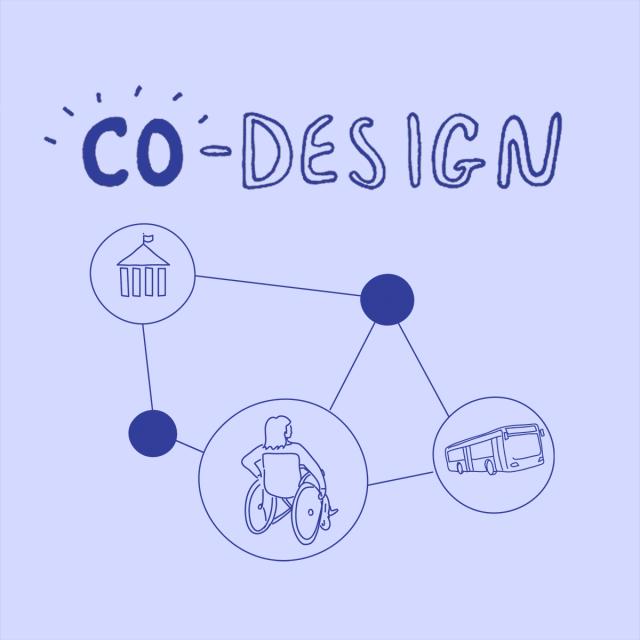
The Co-design for All course is a free online programme on how to put together a case study proposal using a co-design approach. It is aimed at anyone who is interested in learning about co-design methods and how to apply them in any real life scenario. By the end of the course, you will have learned how to put together a case study proposal using co-design. This will be achieved by learning how to adapt and apply these methods to your chosen real life scenario and by producing materials contextualized to it.

Class Deals by MOOC List - Click here and see Coursera's Active Discounts, Deals, and Promo Codes.

This course is a direct outcome from the EU funded TRIPS project (grant number 875588) and builds on the experiences of creating case studies for accessible public transport. The main aim of the TRIPS project is to design, describe and demonstrate practical steps to empower people with mobility challenges to play a central role in the design of inclusive digital mobility solutions.

Syllabus

WEEK 1: Welcome and introduction to the course
WEEK 2: The co in co-design
WEEK 3: A process informed by research
WEEK 4: Identity and vision
WEEK 5: Set a target
WEEK 6: Understanding decision landscapes
WEEK 7: How to come up with change propositions as a group
WEEK 8: Communicating your work
WEEK 9: Visual note taking
Because we consider visual note taking as a learnable skill we also put sketchning forward as an extra module in this course.
Go to Class
MOOC List is learner-supported. When you buy through links on our site, we may earn an affiliate commission.

Related Courses

Population Health: Syndemics (Coursera) Coursera
Leiden University

Population Health: Syndemics (Coursera)

Do you wish to contribute to breaking cycles of ill-health in disadvantaged populations? And explore co-occurrence of diseases, such as substance abuse, infectious and chronic disease, and the relation with social factors (disparities)? Are you disappointed in the poor effectiveness of interventions for combined social and medical problems? Then this syndemics course might provide you with some answers.

Aug 17th 2026
4 Weeks
Social Norms, Social Change I (Coursera) Coursera
University of Pennsylvania

Social Norms, Social Change I (Coursera)

This is a course on social norms, the rules that glue societies together. It teaches how to diagnose social norms, and how to distinguish them from other social constructs, like customs or conventions. These distinctions are crucial for effective policy interventions aimed to create new, beneficial norms or eliminate harmful ones. The course teaches how to measure social norms and the expectations that support them, and how to decide whether they cause specific behaviors.

Aug 3rd 2026
4 Weeks
Promote your Scientific Results (Coursera) Coursera
Institut Mines-Telecom

Promote your Scientific Results (Coursera)

Whether you are a member of the natural or human science community, if you are a PhD student, professor, part of an academic department or international research team, or self-employed and you wish to showcase your work to a wider audience then this is the perfect course for you. You will learn how to promote your work to professional peers, the general public, as well as the media.

Aug 10th 2026
5-12 Weeks
Uncertainty and Research (Coursera) Coursera
Johns Hopkins University

Uncertainty and Research (Coursera)

This course teaches the fundamentals of scientific research. We approach the research process as a means of systematically reducing uncertainty and demonstrate how conducting a scientific investigation can be posed as an exercise in Bayesian uncertainty quantification. We begin by exploring the scientific landscape to understand the different types of research, where they are conducted, how they are supported, and why each of these types of research is important.

Aug 3rd 2026
5-12 Weeks
User Research and Design (Coursera) Coursera
University of Minnesota

User Research and Design (Coursera)

In this course you will learn and practice techniques of user research and early UI design exploration. First, you will learn and practice several techniques for user research, including in-person research and survey and log-analysis techniques. Then, you will learn to analyze and deliver user research in forms that support UI design, including personas, use cases, tasks, and scenarios. Finally, you will learn and practice ideation techniques that start from user research and broadly generate potential design ideas.

Jul 27th 2026
4 Weeks
Research for Impact (Coursera) Coursera
University of Cape Town,Oxfam International

Research for Impact (Coursera)

In this course, you will learn more about the Research for Impact approach - a set of principles and practices that will help you to make your research more impactful. Traditionally, the goals and outcomes of research projects were to contribute knowledge and communicate this knowledge through academic publications and journal articles. But If we truly want our research to have an impact, we need to do research differently. Research that influences change in policy, practice, behaviour and attitudes.

Aug 24th 2026
5-12 Weeks
Population Health: Study Design (Coursera) Coursera
Leiden University

Population Health: Study Design (Coursera)

Health care professionals increasingly have to make clinical decisions in aging and diverse populations. Also, they have to deal with rising health care costs, fragmented health care supply and advancing medical technologies and IT systems. These developments go beyond every day practice and will require new skills. In this course we will walk you through key steps in designing a research study, from formulating the research question to common pitfalls you might encounter when interpreting your results.

Aug 3rd 2026
4 Weeks
Understanding Medical Research: Your Facebook Friend is Wrong (Coursera) Coursera
Yale University

Understanding Medical Research: Your Facebook Friend is Wrong (Coursera)

How can you tell if the bold headlines seen on social media are truly touting the next big thing or if the article isn't worth the paper it's printed on? Understanding Medical Studies, will provide you with the tools and skills you need to critically interpret medical studies, and determine for yourself the difference between good and bad science. The course covers study-design, research methods, and statistical interpretation. It also delves into the dark side of medical research by covering fraud, biases, and common misinterpretations of data. Each lesson will highlight case-studies from real-world journal articles.

Aug 10th 2026
5-12 Weeks
Research kitchen (Coursera) Coursera
Ludwig-Maximilians-Universität München

Research kitchen (Coursera)

The research kitchen is a unique format that we have developed extra for you: curious learners interested in competitive strategy and organization design yearning for a first glimpse into the world of research. It is voluntary and "just for fun" - so please, go on and have a look! Different to other courses of our specialization Competitive Strategy and Organization Design it is comprised of brief paper sessions rather than modules. For a change, you will experience the instructor Tobias Kretschmer at the whiteboard of his very own institute at LMU Munich. Here he will summarize key findings of recent research papers on topics relating to the three courses Competitive Strategy, Advanced Competitive Strategy and Strategic Organization Design. Topics that researchers today are working on to enhance the knowledge of tomorrow. We hope you enjoy this innovative format and possibly even find some inspiration and motivation for your own future research.

Jul 27th 2026
1 Week
Research Instruments and Research Hypotheses (Coursera) Coursera
Queen Mary University of London

Research Instruments and Research Hypotheses (Coursera)

This course concentrates on the design and development of different research instruments. In this vein, the focus will be placed on the development of an instrument design strategy, scales of measurement and the components of the research report. The course begins by looking at the questionnaire development process with a focus on questionnaire design, question type and wording, pretesting and revising.

Aug 3rd 2026
4 Weeks
Researcher Management and Leadership Training (Coursera) Coursera
University of Colorado System

Researcher Management and Leadership Training (Coursera)

This course is for early career researchers and mentors who believe that modern scientific careers require management skills and want to be research leaders. This curriculum gives you skills to effectively implement funded projects, thereby enhancing your career success. Research leaders take on a number of new roles, rights, and responsibilities--as scientific leaders, financial administrators, managers, and mentors. In this course, we explain how to optimize the people, teams, projects, and finances for which you are responsible.

Aug 3rd 2026
5-12 Weeks
Understanding Research Methods (Coursera) Coursera
University of London,SOAS University of London

Understanding Research Methods (Coursera)

This MOOC is about demystifying research and research methods. It will outline the fundamentals of doing research, aimed primarily, but not exclusively, at the postgraduate level. It places the student experience at the centre of our endeavours by engaging learners in a range of robust and challenging discussions and exercises befitting SOAS, University of London's status as a research-intensive university and its rich research heritage.

Jul 27th 2026
4 Weeks