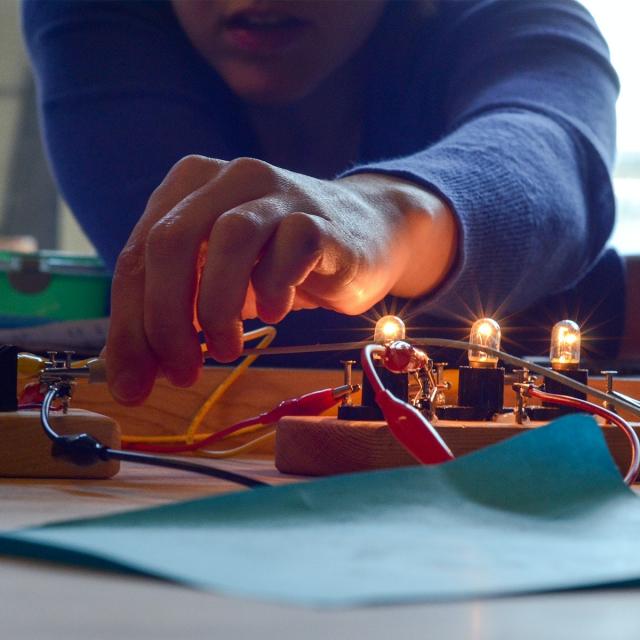
Niños y Adolescentes en la cultura audiovisual y digital (Coursera)

Niños y Adolescentes en la cultura audiovisual y digital (Coursera)

Le damos la más cordial bienvenida al MOOC “Niños y Adolescentes en la cultura audiovisual y digital”, desarrollado por la Facultad de Comunicaciones de la Pontificia Universidad Católica de Chile.
Este curso está enfocado en mostrar el rol que tienen los medios de comunicación y las tecnologías frente a los niños y los adolescentes que en la actualidad crecen en una cultura audiovisual y digital.

Class Deals by MOOC List - Click here and see Coursera's Active Discounts, Deals, and Promo Codes.

Abordaremos la problemática social de la relación que los niños y los adolescentes establecen a diario con los medios de comunicación y con las tecnologías en el contexto de la cultura audiovisual y digital. Este fenómeno ocurre no sólo en América Latina, sino a nivel global y no siempre es acompañado por la orientación adecuada de los adultos.
Por medio del curso podrá aprender sobre herramientas para apoyar y orientar a los más jóvenes en el buen uso de los medios de comunicación y las tecnologías disponibles, y para que hagan un uso responsable como ciudadanos de la sociedad digital y del conocimiento.
¡Le deseamos mucho éxito!

What You Will Learn

  • Aplicar estrategias de orientación para que los niños y adolescentes hagan un uso adecuado de los medios de comunicación y de las tecnologías.

Syllabus

WEEK 1
¿Cómo abordar la relación de los niños y adolescentes (6-12 años) con los medios y las tecnologías?
En este módulo, te invitamos a reflexionar sobre las características de la cultura digital y sus implicancias en los niños y los adolescentes. Además, planteamos la necesidad de una educación mediática.

WEEK 2
Niños y adolescentes como sujetos activos y creativos en su relación con los medios: oportunidades y riesgos a equilibrar
En este módulo conocerás cómo la forma en que los niños y los adolescentes utilizan los medios de comunicación y las tecnologías cambia según la etapa de desarrollo en la que se encuentran. También podrás distinguir que pueden relacionarse con los medios como receptores activos, de manera interactiva o ser creadores y comunicadores. Asimismo, conocerás las oportunidades que ofrecen los medios y las tecnologías, así como los posibles riesgos.

WEEK 3
Criterios para analizar y evaluar contenidos y prácticas de uso de medios y tecnologías a los que acceden los niños y los adolescentes
En este módulo aprenderás a distinguir algunos criterios para analizar y evaluar los contenidos a los que acceden los niños y los adolescentes, y las prácticas de uso de los medios y de las tecnologías. Verás cómo se enfocan los audiovisuales en el contexto digital y transmedia, cuál es el potencial de la televisión en los espacios educativos y cómo se puede utilizar este medio en las aulas de clase.

WEEK 4
¿Qué rol jugamos como adultos en este nuevo escenario? Importancia de la mediación positiva
En este módulo podrás aprender pautas para tomar decisiones y orientar a los niños y adolescentes al consumir contenidos y utilizar los medios y las tecnologías. Conocerás la importancia de la mediación adulta, los estilos de mediación y aspectos a considerar para mediar de forma adecuada.
Go to Class
MOOC List is learner-supported. When you buy through links on our site, we may earn an affiliate commission.

Related Courses

Assessing Achievement with the ELL in Mind (Coursera) Coursera
Arizona State University

Assessing Achievement with the ELL in Mind (Coursera)

In this course, you will learn how to design assessments around the needs of your ELL students and their language level. You will learn how to incorporate language and content requirements for both formative and summative assessment types. You will learn to assess your ELL students through the use of project and task-based assignments.

Aug 10th 2026
5-12 Weeks
Inclusive Online Teaching Teach-Out (Coursera) Coursera
Johns Hopkins University

Inclusive Online Teaching Teach-Out (Coursera)

In this course, higher education faculty will examine students’ barriers to learning, including unconscious bias, physical impairments, and lack of motivation. Participants will explore and discuss how inclusive pedagogy and Universal Design for Learning (UDL) can help to address those barriers and improve student learning outcomes.

Aug 10th 2026
2 Weeks
ADHD: Everyday Strategies for Elementary Students (Coursera) Coursera
University at Buffalo,The State University of New York

ADHD: Everyday Strategies for Elementary Students (Coursera)

This course will provide an overview of ADHD diagnosis and treatment. Course participants can expect to learn about ADHD as a developmental disorder that begins early in childhood, and participants will also learn about evidence-based approaches for diagnosing ADHD. Following that, two evidence-based treatment approaches (the Daily Report Card and Parenting Strategies) will be introduced. (Note these course activities are informational and are not intended to replace working with a licensed/trained professional).

Aug 3rd 2026
4 Weeks
Teaching Children with Visual Impairment: Creating Empowering Classrooms (Coursera) Coursera
University of Cape Town

Teaching Children with Visual Impairment: Creating Empowering Classrooms (Coursera)

In the education of children with visual impairment, there is at present a global movement away from segregated special schooling, and towards inclusive neighbourhood schools. Inclusion provides an opportunity for everyone, teachers as well as learners, to become more acquainted about life with visual impairment and to overcome some of the barriers of difference which have existed in the past. But if it is to be successful, teachers and others require key skills and insights in order to create classroom environments which fully accommodate the learning needs of children with visual impairment.

Aug 10th 2026
4 Weeks
Children Acquiring Literacy Naturally (Coursera) Coursera
University of California, Santa Cruz

Children Acquiring Literacy Naturally (Coursera)

In this short course you will explore the possibility that children might acquire written language in a way that is similar to how they acquire spoken language—without instruction. You will encounter various aspects of behavioral science and technology that are relevant to this proposition. You will have the opportunity to learn the the perceptual, cognitive, and neurological capacities of children during their first years of life. You will advance your understanding of children and how they learn language. You will also be more attuned to current advances in the technology of human machine interactions, and what these phenomena imply for learning to read at an early age.

Aug 3rd 2026
3 Weeks
Disability Awareness and Support (Coursera) Coursera
University of Pittsburgh

Disability Awareness and Support (Coursera)

The goal of this course is to promote equal opportunity and the full participation of students with disabilities in higher education by helping participants advance their awareness of the meaning of accessibility in education. Participants will gain competence and confidence in working with students by focusing on legislation, universal design, and assistive technologies. Thank you to Abbas (Bobby) Husain Quamar, Graduate Student Researcher in the Department of Rehabilitation Science and Technology at the University of Pittsburgh, for his contributions to the course.

Aug 3rd 2026
4 Weeks
Understanding China, 1700-2000: A Data Analytic Approach, Part 1 (Coursera) Coursera
The Hong Kong University of Science and Technology - HKUST

Understanding China, 1700-2000: A Data Analytic Approach, Part 1 (Coursera)

The purpose of this course is to summarize new directions in Chinese history and social science produced by the creation and analysis of big historical datasets based on newly opened Chinese archival holdings, and to organize this knowledge in a framework that encourages learning about China in comparative perspective. Our course demonstrates how a new scholarship of discovery is redefining what is singular about modern China and modern Chinese history.

Aug 3rd 2026
5-12 Weeks
Planning & Design of Sanitation Systems and Technologies (Coursera) Coursera
École Polytechnique Fédérale de Lausanne

Planning & Design of Sanitation Systems and Technologies (Coursera)

Do you want to learn how to plan affordable and context-specific sanitation solutions? Do you want to be updated on the newest developments in urban sanitation planning and programming? Do you want to get insights about best practices examples of urban sanitation systems in low- and middle-income countries? If yes, this course is for you! This course provides you with an introduction to integrated sanitation planning, both on a citywide scale and for specific contexts such as informal settlements.

Aug 10th 2026
5-12 Weeks
Uncommon Sense Teaching (Coursera) Coursera
Deep Teaching Solutions

Uncommon Sense Teaching (Coursera)

Do your students spend too much (or too little) time learning, with disappointing results? Do they procrastinate in their study because it’s boring and they’re easily distracted? Are you working to make your teaching even more inclusive? Uncommon Sense Teaching will give you practical new insights that will help you solve these goals and challenges, and many more.

Aug 10th 2026
4 Weeks
Usos didácticos del cine: Introducción al análisis (Coursera) Coursera
Universidad Nacional Autónoma de México

Usos didácticos del cine: Introducción al análisis (Coursera)

¡Hola! Bienvenido al MOOC "Usos Didácticos del Cine: Introducción al Análisis", ofrecido por la UNAM. A lo largo de este curso, te presentaremos varias formas de usar películas en tus clases para mejorar el rendimiento de tus estudiantes. Además, podrás acceder a una variedad de herramientas y marcos conceptuales referentes a la teoría del cine válidos para poder usar con más conocimientos cualquier obra cinematográfica en el aula.

Aug 10th 2026
5-12 Weeks