Tinkering Fundamentals: Circuits (Coursera)

Offered by Exploratorium,
Tinkering Fundamentals: Circuits (Coursera)

The Tinkering Fundamentals course will offer educators and enthusiasts an opportunity to develop a practice of tinkering and making. We see tinkering as a serious endeavor -- one that is generalizable across content and especially good at interweaving disciplines in a way that leads to complex projects and individualized learning opportunities.

Class Deals by MOOC List - Click here and see Coursera's Active Discounts, Deals, and Promo Codes.

Tinkering has recently been introduced into the educational field as a potential driver of creativity, excitement, and innovation in science learning. It is seen by many as an effective means to engage in exploring STEM concepts, practices and phenomena. Tinkering typically blends the high and low tech tools of science along with a strong aesthetic dimension that supports children’s (and adults) self expression.
For over a decade, the Exploratorium has been developing science-rich tinkering activities for both children and adults. We see tinkering as a fun yet serious endeavor—spanning many disciplines and content areas and fostering connections between art, science, and technology. Learners follow their own path to understanding by investigating tools and materials and exploring questions that interest them. This opens up a wide range of possible answers rather than any “right” one, particularly for teaching STEM (Science, Technology, Engineering, Math) subjects in the classroom. This course centers on circuit-related activities, which offer a wealth of opportunities for thinking through making.
In this course, we won’t just show you how we develop tinkering activities; we’ll also delve into why. We’ll focus on three important aspects: activity design around specific materials, facilitation strategies, and environmental organization. We’ll also share some guiding principles and learning indicators we’ve developed that can help you integrate tinkering into your elementary and middle-school science program. Whether you’re new to making or a seasoned tinkerer, we hope this course will help you take the next step!

Syllabus

WEEK 1
Introduction to Tinkering
What is tinkering? What does it mean to you? Is it different from engineering or other forms of making? We'll explore these questions in the readings and forums while getting a sneak preview of the activities we'll be sharing over the following modules.

WEEK 2
Initial Explorations
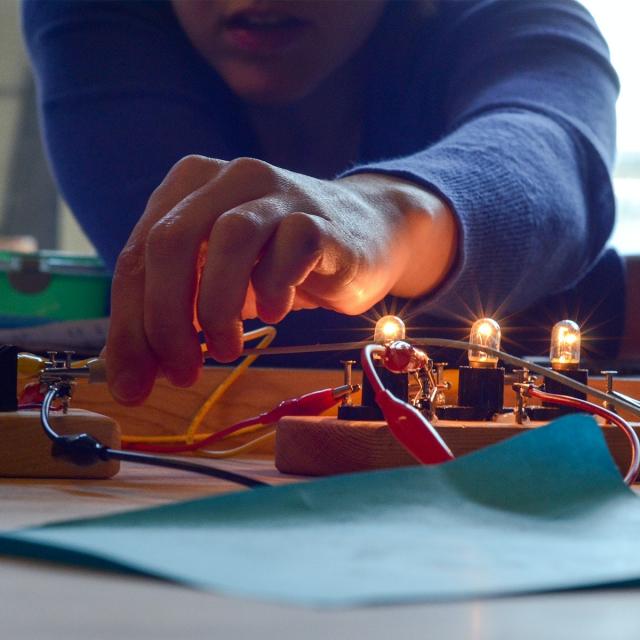
Tinkering is all about making, so let's get started. In this module we begin with a basic circuit board activity, which helps learners make physical and conceptual connections between electrical components. You will learn how to build your own set to play with and why we designed it this way.

WEEK 3
Learning Dimensions
In this module, we'll explore erratic motion and art-making with an activity called Scribbling Machines. We'll also investigate how tinkering maps on to different indicators of learning.

WEEK 4
Tinkering Tenets and Personal Expression
We'll explore the aesthetic dimensions of tinkering with a full rundown of our Paper Circuits and Sewn Circuits activities, including key design elements and important principles.

WEEK 5
Coding, Computation and Facilitation Strategies
A look at the high-tech side of tinkering. In this module, we'll also explore strategies for facilitation and deep engagement.

WEEK 6
Putting It All Together
It's your turn! How will you take what you've learned in this class and apply it to your own life and practice? We'll help you come up with a detailed action plan and get feedback from other students in the class. By the end of this module you'll complete your project, your peer assessments and review other people's work.

Go to Class
MOOC List is learner-supported. When you buy through links on our site, we may earn an affiliate commission.

Related Courses

Literacy Teaching and Learning: Aims, Approaches and Pedagogies (Coursera) Coursera
University of Illinois at Urbana-Champaign

Literacy Teaching and Learning: Aims, Approaches and Pedagogies (Coursera)

This course opens with an exploration of the social context and aims of literacy teaching and learning. It goes on to describe a range of historical and contemporary approaches to literacy pedagogy, including didactic, authentic, functional, and critical approaches. The course takes has a 'Multiliteracies' perspective, which aims to expand the definition of literacy to encompass today's multimodal communications, and the diversity of literacies across different social and culltural contexts.

Aug 10th 2026
4 Weeks
Mindshift: Transforma tu mente para superar obstáculos en el aprendizaje y descubrir tu potencial oculto (Coursera) Coursera
McMaster University

Mindshift: Transforma tu mente para superar obstáculos en el aprendizaje y descubrir tu potencial oculto (Coursera)

Mindshift es un curso diseñado para ayudarte a impulsar tu carrera profesional y tu vida personal en el mundo de cambios acelerados que vivimos hoy en día. Cualquiera que sea tu edad o etapa de formación, Mindshift te enseñará técnicas para aprovechar al máximo tu experiencia de aprendizaje en línea, estrategias para conseguir y trabajar con mentores, secretos para evitar estancamientos (y catástrofes) en tu carrera profesional, y reflexiones sobre el valor de la ignorancia selectiva y la competencia general.

Aug 17th 2026
4 Weeks
Making Sense of the News: News Literacy Lessons for Digital Citizens (Coursera) Coursera
University of Hong Kong,The State University of New York

Making Sense of the News: News Literacy Lessons for Digital Citizens (Coursera)

Never before has the need for News Literacy been more urgent. As news consumers are bombarded with a constant stream of fake news, propaganda, hoaxes, rumors, satire, and advertising — that often masquerade as credible journalism — it is becoming more and more difficult to distinguish fact from fiction. While the public’s faith in the news media erodes, purveyors of misinformation have helped give rise to troubling cultural trends and alarming political movements.

Aug 10th 2026
5-12 Weeks
THINK GLOBAL: TEACHERS TRAINING COURSE (IDP-ICE) (Coursera) Coursera
University of Barcelona

THINK GLOBAL: TEACHERS TRAINING COURSE (IDP-ICE) (Coursera)

A group of seven European partners from Catalonia, Belgium, and Wales worked together on the Erasmus+ funded ‘Think Global’ project on global competence. The project seeks to address the following research question through development and piloting of practical classroom activities: What is global competence, and how can it be learned effectively?

Aug 17th 2026
5-12 Weeks
Tinkering Fundamentals: Motion and Mechanisms (Coursera) Coursera
Exploratorium

Tinkering Fundamentals: Motion and Mechanisms (Coursera)

The Tinkering Fundamentals course will offer educators and enthusiasts an opportunity to develop a practice of tinkering and making. We see tinkering as a serious endeavor—one that is generalizable across content and especially good at interweaving disciplines in a way that leads to complex projects and individualized learning opportunities.

Aug 17th 2026
5-12 Weeks
e-Learning Ecologies: Innovative Approaches to Teaching and Learning for the Digital Age (Coursera) Coursera
University of Illinois at Urbana-Champaign

e-Learning Ecologies: Innovative Approaches to Teaching and Learning for the Digital Age (Coursera)

For three decades and longer we have heard educators and technologists making a case for the transformative power of technology in learning. However, despite the rhetoric, in many ways and at most institutional sites, education is still relatively untouched by technology. Even when technologies are introduced, the changes sometimes seem insignificant and the results seem disappointing. If the print textbook is replaced by an e-book, do the social relations of knowledge and learning necessarily change at all or for the better?

Aug 10th 2026
4 Weeks
Cultures et pédagogies (Coursera) Coursera
University of Geneva

Cultures et pédagogies (Coursera)

Dans ce cours, nous explorons des alternatives pédagogiques qui s'inscrivent dans des contextes historiques, culturels et politiques différents. Vous découvrirez des pédagogies et des pédagogues qui opèrent une rupture avec les approches pédagogiques dominantes de notre société. Nous verrons ensemble les fondements pratiques et théoriques des apports de pédagogues à portée internationale, tels que P. Freire (Brésil) ou J. Krishnamurti (Inde).

Aug 17th 2026
5-12 Weeks
Aboriginal Worldviews and Education (Coursera) Coursera
University of Toronto

Aboriginal Worldviews and Education (Coursera)

Intended for both Aboriginal and non-Aboriginal learners, this course will explore indigenous ways of knowing and how they can benefit all students. Topics include historical, social, and political issues in Aboriginal education; terminology; cultural, spiritual and philosophical themes in Aboriginal worldviews; and how Aboriginal worldviews can inform professional programs and practices, including but not limited to the field of education.

Aug 10th 2026
5-12 Weeks
What future for education? (Coursera) Coursera
University of London,UCL Institute of Education

What future for education? (Coursera)

Through this course you will start to critically examine your own ideas about education, teaching and learning. The critique will be developed through engagement with theories and ideas developed through educational research. You will be encouraged to use these ideas to challenge or support your own ideas about education. Each week we will focus on one key question, using video lectures, key readings and challenges to explore some commonplace notions about education.

Aug 17th 2026
5-12 Weeks
Innovative Teaching with ChatGPT (Coursera) Coursera
Vanderbilt University

Innovative Teaching with ChatGPT (Coursera)

Despite what you may have heard, ChatGPT offers exciting possibilities for supporting innovative teaching and personalized education. This course provides practical techniques that any educator, from K-12 to higher education, can use to help support their teaching. No experience with ChatGPT, prompt engineering, or Generative AI is required.

Aug 17th 2026
1 Week
Disability Inclusion in Education: Building Systems of Support (Coursera) Coursera
University of Cape Town

Disability Inclusion in Education: Building Systems of Support (Coursera)

Worldwide millions of children are not able to fully participate in schooling, and this is especially a problem for children with disabilities. In this course, we explore the support that teachers need in order to meet the needs of children with severe to profound hearing, visual and intellectual disabilities. We consider how this can be done by talking with a range of experts (from teachers to activists) about inclusive education as well as sharing experiences of education.

Aug 17th 2026
5-12 Weeks