FUN

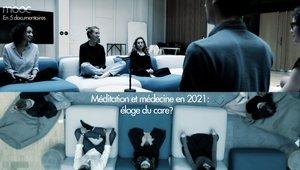
Méditation et médecine en 2021 : éloge du care ? (FUN)

Offered by Université de Paris,
Méditation et médecine en 2021 : éloge du care ? (FUN)

Un parcours en 5 semaines pour Cultiver le prendre soin - S'interroger, Se nourrir, Ressentir, Respirer. Etudiantes en médecines, nous avons rencontré la méditation de pleine conscience comme une manière de rentrer en résonance, un moment avec soi, un souffle, une respiration, une manière de prendre soin de nous, pour mieux prendre soin des autres. Touchées par la vie, la mort, l’humain, l’impermanence, le doute, la peur, l'échec…Aujourd’hui femmes, médecins, nous l’avons transmis aux étudiants par l'enseignement.

What you will learn
At the end of this course, you will be able to:

  • Comprendre le besoin de care en santé à partir des challenges de la formation médicale en 2021.
  • Définir la méditation de pleine conscience en vous rapprochant de l'expérience, de déconstruire les croyances autour de la méditation et de percevoir sa place dans le soin.
  • D'appréhender la démarche scientifique interdisciplinaire des recherches sur le sujet de la méditation, donner envie, vous interroger.
  • Découvrir les éthiques du care et le lien entre méditation et care.
  • Saisir le lien entre prendre soin de soi, de l’autre et du monde. Comprendre en partie l’interdépendance et la notion d’expérience sensible.

Parce que la médecine se transforme, les étudiants d’aujourd’hui seront les médecins de demain. Parce que cultiver le sens du soin de soi, des autres et du monde est un essentiel, la faculté se questionne.
Dans ce MOOC, vous allez découvrir ce chemin du soin à la méditation, ou de la méditation au soin, à partir de l'expérience d'étudiant(e)s en médecine.
Ainsi, nous explorerons épisodes après épisodes

  • Comment prendre soin de soi pour prendre soin des autres à une époque où la santé mentale des soignants est mise à mal et le système hospitalier ébranlé ?
  • Comment passer d'une culture du pansement à une culture du care qui prend soin des ressources du vivant ?
  • Comment nourrir le sens du soin, particulièrement en médecine, individuellement et collectivement ?

Format
Ce MOOC propose chaque semaine, pendant 5 semaines, le visionnage de documentaires pédagogiques (une trentaine de minutes). Comme un voyage nous écouterons la voix d’être humains, étudiants, soignants, philosophes, enseignants, directeurs de soin, professeurs d’universités, ingénieurs, aumônier, méditants, chercheurs, artistes…
Des ressources variées, interdisciplinaires, (articles scientifiques, bibliothèque littéraire, poésies, …) sont mises à votre disposition et des activités réflexives (écriture, méditation, débat, défis) balisent votre avancée dans le MOOC.
Des événements, diffusés en direct sous forme de webinaires, permettront de rencontrer l'équipe pédagogique et les intervenants du MOOC pour approfondir certains aspects du chemin.

Course plan

Cette mini-série du Care se compose de 5 épisodes
Épisode 1: La méditation de pleine conscience et le corps sensible
Episode 2: « Un soignant est un être humain », les challenges de la formation, la rencontre avec la méditation à l’université
Épisode 3: La méditation de pleine conscience et la recherche interdisciplinaire
Episode 4: La culture du care - « prendre soin »
Épisode 5: Prendre soin de soi, de l’autre et du monde - ressources et interdépendance

Go to Class
MOOC List is learner-supported. When you buy through links on our site, we may earn an affiliate commission.

Related Courses

Santé sexuelle pour tous (partie 1) (FUN) FUN
Université Sorbonne Paris Cité

Santé sexuelle pour tous (partie 1) (FUN)

Ce MOOC s’inscrit dans une stratégie nationale de santé sexuelle agenda 2030 pour la France et l’international. De plus il s’inscrit dans les Objectifs du Développement Durable 2030 des N.U. notamment les cibles 3.3 Mettre fin aux épidémies du VIH/sida et des IST, 3.4 Promouvoir la santé mentale et le bien être sexuel, 3.7 Assurer l’accès, pour tous, aux services de soins de santé sexuelle et procréative, à l’information et à l’éducation, en lien avec les 16 autres objectifs.

No sessions available
5-12 Weeks
Leading Healthcare Quality and Safety (Coursera) Coursera
George Washington University

Leading Healthcare Quality and Safety (Coursera)

Ensuring patient safety and healthcare quality is critical and should be a key focus of everyone in healthcare practice. This course provides healthcare practitioners and others with an introduction to the knowledge and skills needed to lead patient safety and quality improvement initiatives at the micro and macro levels. Participants will explore the foundations of health care quality and the science underlying patient safety and quality improvement, design and select effective health care measures, analyze patient safety problems and processes using tools such as human factors analysis, apply systematic approaches including the Plan-Do-Study-Act (PDSA) model to address quality improvement challenges, and learn strategies to lead a culture of change

Sep 28th 2026
5-12 Weeks
Clinical Terminology for International and U.S. Students (Coursera) Coursera
University of Pittsburgh

Clinical Terminology for International and U.S. Students (Coursera)

Understanding the clinical terms and abbreviations commonly used in U.S. hospitals is challenging. Adaptation to clinical language can be difficult for U.S. students entering the clinical area and even more so for international students whose primary language is not English. This course is designed to help both groups of students understand the terms and abbreviations commonly encountered during the first three months of clinical work on a U.S. hospital unit.

Sep 28th 2026
5-12 Weeks
Doping : Sports, Organizations and Sciences (Coursera) Coursera
University of Lausanne

Doping : Sports, Organizations and Sciences (Coursera)

The objective of this course is to encourage a critical understanding of doping. To achieve this goal, this course will rely on a multidisciplinary approach that allow you to see how different disciplines get into a single object, in different perspectives and in often complementary ways. This approach will also allow us to appreciate the complexity of a subject like doping. Doping in sports is a complex practice whose definition and identification is the result of socially and historically constructed norms. This course offers to shed light on the processes that led to the use and prohibition of doping substances.

Sep 28th 2026
4 Weeks
Understanding Clinical Research: Behind the Statistics (Coursera) Coursera
University of Cape Town

Understanding Clinical Research: Behind the Statistics (Coursera)

If you’ve ever skipped over`the results section of a medical paper because terms like “confidence interval” or “p-value” go over your head, then you’re in the right place. You may be a clinical practitioner reading research articles to keep up-to-date with developments in your field or a medical student wondering how to approach your own research. Greater confidence in understanding statistical analysis and the results can benefit both working professionals and those undertaking research themselves.

Sep 28th 2026
5-12 Weeks
An Introduction to Global Health (Coursera) Coursera
University of Copenhagen

An Introduction to Global Health (Coursera)

This course will provide you with an overview of the most important health challenges facing the world today. You will gain insight into how challenges have changed over time, we will discuss the likely determinants of such changes and examine future projections. Successful international strategies and programs promoting human health will be highlighted and global health governance structures will be mapped and the role of the key actors explored.

Sep 28th 2026
5-12 Weeks
Take the Lead on Healthcare Quality Improvement (Coursera) Coursera
Case Western Reserve University

Take the Lead on Healthcare Quality Improvement (Coursera)

In this course you will learn about the importance of quality in healthcare and how you can contribute by implementing a quality improvement (QI) project to improve processes of care and patient outcomes. You will learn about powerful tools to add to your QI ‘toolbox’ during short lectures and reflective exercises. You will apply these tools to the implementation of a QI project in your own practice setting or an area of personal improvement. At the completion of the course, you will have a storyboard that captures your QI project success to share with others.

Sep 28th 2026
5-12 Weeks
Maladie de Parkinson (FUN) FUN
Université de Nantes

Maladie de Parkinson (FUN)

Le MOOC maladie de Parkinson vise à mieux faire connaître cette maladie qui, en France, touche environ 1% des personnes âgées de plus 70 ans. Cette seconde session, totalement remaniée et enrichie de nouveaux contenus s’adresse au grand public, aux patients et à leurs aidants, ainsi qu’aux étudiants en biologie/santé et aux soignants.

No sessions available
5-12 Weeks
The New Nordic Diet - from Gastronomy to Health (Coursera) Coursera
University of Copenhagen

The New Nordic Diet - from Gastronomy to Health (Coursera)

The New Nordic Diet is a new food culture developed in 2009-13 with key emphasis on gastronomy, health, and environment. Major research in its effect on acceptability, behaviour and learning skills, and disease prevention have been conducted by the OPUS centre at the University of Copenhagen and the people behind the award-winning restaurant Noma in Copenhagen. This course will give the participants the opportunity to experience a healthy and palatable new food and eating concept diet “The New Nordic Diet” and an understanding of how food and diets can affect mental and physical health and ensure the foundation for a healthier life style for future generations with a regional based diet and food culture.

Sep 28th 2026
5-12 Weeks
Soul Beliefs: Causes and Consequences - Unit 3: How Does It All End? (Coursera) Coursera
Rutgers University

Soul Beliefs: Causes and Consequences - Unit 3: How Does It All End? (Coursera)

Throughout history, the vast majority of people around the globe have believed they have, however defined, a “soul.” While the question of whether the soul exists cannot be answered by science, what we can study are the causes and consequences of various beliefs about the soul and its prospects of surviving the death of the body. Why are soul and afterlife beliefs so common in human history? Are there adaptive advantages to assuming souls exist?

Sep 28th 2026
5-12 Weeks
Contrôler une épidémie de maladies infectieuses émergentes (FUN) FUN
Centre Virchow-Villermé

Contrôler une épidémie de maladies infectieuses émergentes (FUN)

Ce MOOC est destiné à former les participants, à partir d’une étude de cas, à la surveillance des maladies infectieuses émergentes, mais aussi à la prévention et au contrôle des épidémies. Les maladies infectieuses émergentes nécessitent une approche interdisciplinaire mobilisant l’épidémiologie et les biomathématiques, la virologie, l’immunologie, la santé publique humaine et animale, l’entomologie, la recherche clinique sur les maladies infectieuses, la sociologie, la médecine, les sciences politiques et de communication sur le risque, et des éléments d’économie de la santé.

No sessions available
5-12 Weeks