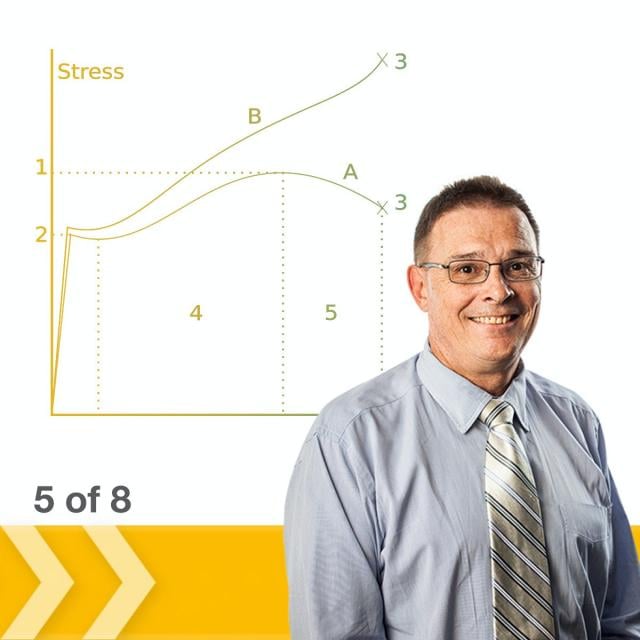
Mechanics of Materials I: Fundamentals of Stress & Strain and Axial Loading (Coursera)

Mechanics of Materials I: Fundamentals of Stress & Strain and Axial Loading (Coursera)

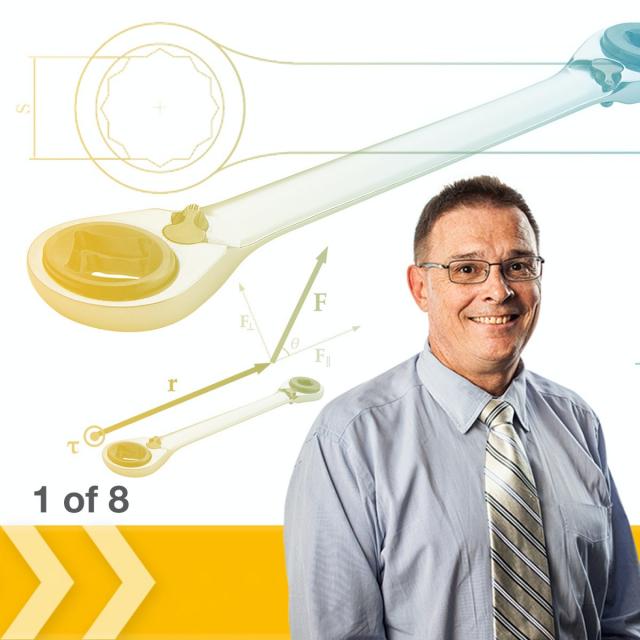
This course explores the topic of solid objects subjected to stress and strain. The methods taught in the course are used to predict the response of engineering structures to various types of loading, and to analyze the vulnerability of these structures to various failure modes. Axial loading with be the focus in this course.

Class Deals by MOOC List - Click here and see Coursera's Active Discounts, Deals, and Promo Codes.

Syllabus

WEEK 1
Welcome
Stress and Strain Fundamentals
In this section, we will study the fundamentals of stress and strain as applied to Mechanics of Materials.

WEEK 2
Stress-Strain Diagrams, Material Properties, and Shear Stress and Strain
In this section, we will develop stress-strain diagrams, discuss material properties, and look more in depth at shear stress and strain.

WEEK 3
Stresses on Inclined Planes
In this section, we will develop the stress transformation equations for inclined planes and introduce Mohr’s Circle for Plane Stress

WEEK 4
Stress concentrations, Mohr’s Circle for Plane Strain, and measuring strains
In this section, we will learn about stress concentrations, and discuss plane strain, develop Mohr’s Circle for Plane Strain, and explore methods of measuring strain.

WEEK 5
Generalized Hooke’s Laws, Factor of Safety, Non-linear behavior and Plasticity, Statically Indeterminate Structures, and Thermal Effects
In this section, we will conclude the course by discussing the topics of the generalize Hooke’s Laws for Isotropic materials, factors of safety, nonlinear behavior and plasticity, statically indeterminate structures, and thermal effects in mechanics of materials.
Go to Class
MOOC List is learner-supported. When you buy through links on our site, we may earn an affiliate commission.

Related Courses

Engineering of Structures: Shear and Bending (Coursera) Coursera
Dartmouth College

Engineering of Structures: Shear and Bending (Coursera)

This course deals with shear and bending. Shear is a set of parallel, non-collinear forces acting across an element and bending is the curved form taken by a slender element when subjected to loads perpendicular to the element. These forces are easy to understand. You will study how stress and bending force acts for different structures and also, identify what role these forces play in their designs.

Jun 8th 2026
3 Weeks
Systems Thinking In Public Health (Coursera) Coursera
Johns Hopkins University

Systems Thinking In Public Health (Coursera)

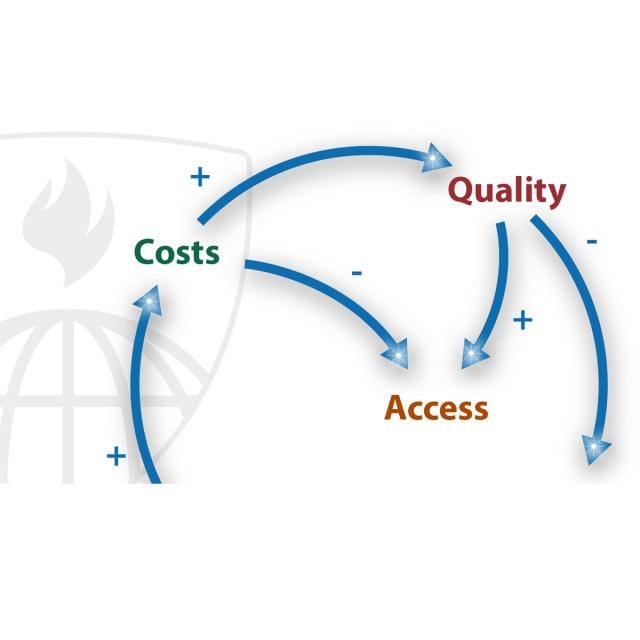
This course provides an introduction to systems thinking and systems models in public health. Problems in public health and health policy tend to be complex with many actors, institutions and risk factors involved. If an outcome depends on many interacting and adaptive parts and actors the outcome cannot be analyzed or predicted with traditional statistical methods. Systems thinking is a core skill in public health and helps health policymakers build programs and policies that are aware of and prepared for unintended consequences.

May 18th 2026
4 Weeks
Speak English Professionally: In Person, Online & On the Phone (Coursera) Coursera
Georgia Institute of Technology

Speak English Professionally: In Person, Online & On the Phone (Coursera)

Do you want to speak better English? This course will help you reach that goal. Speak English Professionally: In person, Online and On the Phone will boost your English speaking skills. In this 5 week course, you will learn how to identify and make a strong personal introduction. You will develop and demonstrate the speaking skills for group discussions: how to agree or disagree, how to clarify, restate and summarise. You will develop and demonstrate the speaking skills for group discussions: how to agree or disagree, how to clarify, restate and summarize.

Jun 8th 2026
5-12 Weeks
Mechanics: Motion, Forces, Energy and Gravity, from Particles to Planets (Coursera) Coursera
UNSW Sydney - University of New South Wales

Mechanics: Motion, Forces, Energy and Gravity, from Particles to Planets (Coursera)

Most of the phenomena in the world around you are, at the fundamental level, based on physics, and much of physics is based on mechanics. Mechanics begins by quantifying motion, and then explaining it in terms of forces, energy and momentum. This allows us to analyse the operation of many familiar phenomena around us, but also the mechanics of planets, stars and galaxies.

May 25th 2026
5-12 Weeks
Stress First Aid for Healthcare Workers: A Peer Support Tool (Coursera) Coursera
Duke University

Stress First Aid for Healthcare Workers: A Peer Support Tool (Coursera)

Stress First Aid (SFA) is a peer support toolkit designed to preserve life, prevent further harm, and promote recovery. Stress First Aid offers a flexible menu of options for recognizing and addressing stress reactions. It can be used for self-care, to help co-workers with stress reactions, or to help someone seek other types of support. Stress First Aid is a framework of practical actions that can help reduce the likelihood that stress reactions will develop into more severe or long-term problems.

May 25th 2026
4 Weeks
Understanding Research Methods (Coursera) Coursera
University of London,SOAS University of London

Understanding Research Methods (Coursera)

This MOOC is about demystifying research and research methods. It will outline the fundamentals of doing research, aimed primarily, but not exclusively, at the postgraduate level. It places the student experience at the centre of our endeavours by engaging learners in a range of robust and challenging discussions and exercises befitting SOAS, University of London's status as a research-intensive university and its rich research heritage.

Jun 1st 2026
4 Weeks
Organic Solar Cells - Theory and Practice (Coursera) Coursera
Technical University of Denmark - DTU

Organic Solar Cells - Theory and Practice (Coursera)

The goal of the course is to give students awareness of the largest alternative form of energy and how organic / polymer solar cells can harvest this energy. The course provides an insight into the theory behind organic solar cells and describes the three main research areas within the field i.e. materials, stability and processing.

Jun 1st 2026
5-12 Weeks
Particle Dynamics (Coursera) Coursera
Korea Advanced Institute of Science and Technology - KAIST

Particle Dynamics (Coursera)

This course teaches dynamics, one of the basic mechanics subjects of Mechanical Engineering. Students would be able to organize their knowledge about force and motion, work-energy, impulse-momentum in view of Newton's 2nd law and its integration over time and displacement. The Engineering Dynamics consists of two parts: particle dynamics and rigid body dynamics.

May 25th 2026
13-24 Weeks
Chemical Biology (Coursera) Coursera
University of Geneva

Chemical Biology (Coursera)

Chemical biology is a burgeoning field that has rapidly risen to prominence. This surge of interest has been fuelled by chemical biology’s applicability to understanding critical processes in live cells or model organisms in real time. This success has arisen because chemical biology straddles a nexus between chemistry, biology, and physics. Thus, chemical biology can harness rapid chemistry to observe or perturb biological processes, that are in turn reported using physical assays, all in an otherwise unperturbed living entity. Although its boundaries are endless, the multidisciplinary nature of chemical biology can make the field seem daunting; we beg to differ! Here, we deconstruct chemical biology into its core components, and repackage the material.

Jun 8th 2026
5-12 Weeks
Tools and Techniques for Managing Stress (Coursera) Coursera
Starweaver

Tools and Techniques for Managing Stress (Coursera)

Welcome to the "Tools and Techniques for Managing Stress" course! This course offers valuable tools and techniques to effectively manage and cope with stress in both personal and professional domains. Through this program, students will acquire strategies to identify stressors, develop comprehensive stress management plans, and implement relaxation techniques that foster overall well-being.

May 25th 2026
1 Week