Art of the MOOC: Experiments with Sound (Coursera)

Art of the MOOC: Experiments with Sound (Coursera)

Students of this course may try their hand at their own sound interventions and musical compositions, or simply focus on learning more about diverse musical traditions, sonic experimentation, and acoustic phenomena in everyday life. Designed by artist and Duke professor, Pedro Lasch, and UdK composer Mathias Hinke, this course is also co-taught by scholar and musician Jace Clayton (DJ Rupture) and curator Candice Hopkins (Documenta 14).

Class Deals by MOOC List - Click here and see Coursera's Active Discounts, Deals, and Promo Codes.

The lectures link major artistic developments of recent decades to wider ideas about sound in specific social and spatial contexts.
Also included are guest presentations from key thinkers and practitioners, like: Christopher DeLaurenti, Jen Delos Reyes, Tina Haver Currin, Quran Karriem, Christina Kubisch, Thomas Kusitzky, Scott Lindroth, Mark Anthony Neal, Bill Seaman, and John Supko. As the ‘ART of the MOOC’ title implies, learners and participants are encouraged to treat the MOOC itself as a public art medium. This happens mostly through the course’s optional practical components, local project productions, global exchanges, and critical feedback. While no prior sound production or musical experience is required, projects also offer challenging options for advanced learners.

Syllabus

WEEK 1
Introduction & Analytical Concepts
This module introduces the four co-teachers of the course (Lasch, Clayton, Hinke, Hopkins), along with five analytical concepts that we will use throughout its sections and projects: Frequency, Perspective, Material Frame, Time Frame, and Concurrency. These concepts are designed to encompass a wide range of acoustic phenomena within spatial and social experience.

WEEK 2
Elements of Sound and Social Practices
This lesson expands on specific terms or ‘sound elements’ that include tuning, resonance, silence, improvisation, rhythm, synchronization, duration, and timbre. It also addresses traditional tools in sound production, from musical instruments to sampling, auto-tunes, and other more recent technologies. The module concludes by exploring the role of sound in specific non-musical social settings and practices, such as clapping, fan culture, sports, traffic jams, mass demonstrations, and more.

WEEK 3
Project: Playing with Sound Rules
The practical component of this section is optional, asking learners to choose a space with specific ‘sound rules’ and change or alter these rules through actual experimentation.

WEEK 4
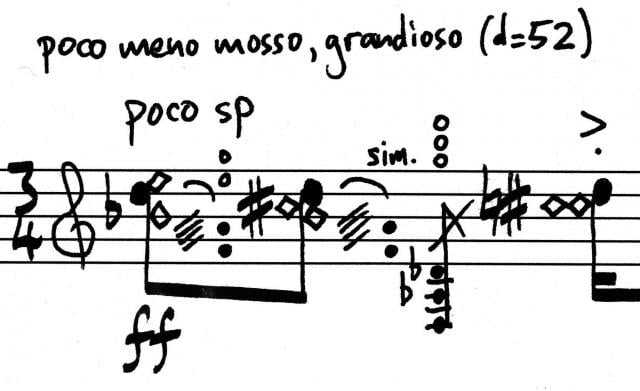
Notation, how music travels & public space
This lesson begins by focusing on the relationship between experimental practices and scores or notation systems. It also examines how sound has been used and understood by artists in specific urban contexts, such as ports, train stations, and airports, as well as rural settings, including forests, gardens, and the wider landscape. We conclude with an examination of how sound and music travel, be it through the populations who produce it, or the objects and digital files that are used to record and share it.

WEEK 5
Project: Erase the Sound of a Space
The practical component is optional, inviting learners to ‘erase a sound in space’ through a range of possible strategies.

WEEK 6
Listening as practice, global forms & the sound of the net
This lesson provides an overview of the methods and ideas from different schools of listening. It also presents a critical examination of the term ‘world music’ and how it has evolved in relation to economic and cultural globalization. With this global perspective in mind, the concluding portions of our lectures are dedicated to acoustic experience and musical experimentation on the net, the radio, cellular networks, and various social media, including all of the glitches, accidents, and failures we associate with these platforms.

WEEK 7
Project: Experiment with Failure
The practical component of this module is optional, asking learners to produce their own experiment with media and technical failure.

WEEK 8
Open Project
This module is optional and only for those who wish to put what they learned from the course into one final project that is more open and ambitious in scale. Two options are given for this, one being your most ambitious project, and the other based on the creation and use of your own musical instruments.
Go to Class
MOOC List is learner-supported. When you buy through links on our site, we may earn an affiliate commission.

Related Courses

Applied Public History: Places, People, Stories (Coursera) Coursera
University of London

Applied Public History: Places, People, Stories (Coursera)

This course introduces learners to applied public history: understanding and interpreting the past today, and engaging diverse communities in the practice of making and sharing histories. The course draws on project case studies, expert insights and diverse perspectives to model exciting approaches to researching and sharing the history of places and people. Learners will develop a toolkit to apply in their own practice, by participating in discussion, quizzes, creative activities and mini masterclasses. What kinds of stories can we discover through research into the history of places and people?

Oct 5th 2026
5-12 Weeks
Fundamentals of Music Theory (Coursera) Coursera
University of Edinburgh

Fundamentals of Music Theory (Coursera)

This course will introduce students to the theory of music, providing them with the skills needed to read and write Western music notation, as well as to understand, analyse, and listen informedly. It will cover material such as pitEli Appleby-Donaldches and scales, intervals, clefs, rhythm, form, meter, phrases and cadences, and basic harmony.

Sep 28th 2026
5-12 Weeks
Improvisación de jazz (Coursera) Coursera
Berklee College of Music

Improvisación de jazz (Coursera)

Aprenda los conceptos básicos de la improvisación con Gary Burton, uno de los improvisadores más reconocidos en el mundo del jazz, incluidos los procesos mentales, melódicos y armónicos que contribuyen a las habilidades instintivas que aplica un improvisador cuando realiza un solo.

Oct 5th 2026
5-12 Weeks
The Blues: Understanding and Performing an American Art Form (Coursera) Coursera
University of Rochester

The Blues: Understanding and Performing an American Art Form (Coursera)

The blues is an American art form and the most important musical form in jazz. Although there are other formal paradigms of the blues, such as 8-bar or 16-bar, this course focuses on different incarnations of the 12-bar blues. There are considerable differences between Early Jazz blues, Swing blues, Bebop blues, Modal blues, and Post Bop blues.

Oct 5th 2026
5-12 Weeks
The Cycle: Management of Successful Arts and Cultural Organizations (Coursera) Coursera
University of Maryland, College Park

The Cycle: Management of Successful Arts and Cultural Organizations (Coursera)

What makes a successful arts and cultural organization? Led by DeVos Institute Chairman Michael M. Kaiser and President Brett Egan, this course will introduce you to a management theory called the Cycle which supports thriving arts and cultural organizations. Learning from our work with managers from over 80 countries around the world, the DeVos Institute developed the Cycle as a simple, but powerful tool to assist managers in their effort to respond to an increasingly complex environment and propel their institutions to excellence.

Oct 5th 2026
5-12 Weeks
Words Spun Out of Images: Visual and Literary Culture in Nineteenth Century Japan (Coursera) Coursera
The University of Tokyo

Words Spun Out of Images: Visual and Literary Culture in Nineteenth Century Japan (Coursera)

In their ambition to capture “real life,” Japanese painters, poets, novelists and photographers of the nineteenth century collaborated in ways seldom explored by their European contemporaries. This course offers learners the chance to encounter and appreciate behavior, moral standards and some of the material conditions surrounding Japanese artists in the nineteenth century, in order to renew our assumptions about what artistic “realism” is and what it meant.

Oct 5th 2026
4 Weeks
Art & Activity: Interactive Strategies for Engaging with Art (Coursera) Coursera
The Museum of Modern Art

Art & Activity: Interactive Strategies for Engaging with Art (Coursera)

Art can be a powerful catalyst for building skills and understanding a range of subjects. Intended for primary and secondary teachers of all disciplines, Art & Activity builds upon the inquiry-based approaches of Art and Inquiry: Museum Teaching Strategies for Your Classroom, while delving into activity-based strategies that will make your students empowered participants.

Sep 28th 2026
4 Weeks
Creating Sounds for Electronic Music (Coursera) Coursera
Berklee College of Music

Creating Sounds for Electronic Music (Coursera)

What you’ll achieve: In this project-centered course*, you will create sounds and use them in your own musical compositions. Whether you're an aspiring producer, composer, or hobbyist, this course will help you gain skills in music production and confidence using software synthesizers. Along with your classmates, you will create a massive database of designed sounds, or patches, to use in your compositions. As part of the course, you will work with a free version of FXpansion Strobe 2.

Sep 28th 2026
4 Weeks
Princípios Gerais da Técnica do Violino e da Viola de Arco (Coursera) Coursera
Universidade Estadual de Campinas - UNICAMP

Princípios Gerais da Técnica do Violino e da Viola de Arco (Coursera)

Esse curso visa fornecer informações sobre aspectos básicos da técnica do violino e da viola de arco. Ao longo de 18 aulas, com duração média de 7 minutos cada, serão abordados temas como posicionamento do instrumento, maneiras de posicionar a mão esquerda, como segurar o arco, como executar os principais golpes de arco, como estudar mudanças de posição, etapas para desenvolvimento do vibrato e sugestões para a organização do estudo diário do instrumento.

Oct 5th 2026
4 Weeks
Desarrollando tu musicalidad (Coursera) Coursera
Berklee College of Music,Inter-American Development Bank - IDB

Desarrollando tu musicalidad (Coursera)

Aprende los conceptos básicos y enfoques necesarios para entender, crear e interpretar música contemporánea. Esta obra fue financiada con una donación del Banco Inter-Americano de Desarrollo con recursos del Fondo Coreano para la Reducción de la Pobreza. Las opiniones expresadas en esta obra son exclusivamente de los autores y no necesariamente reflejan el punto de vista del Banco Interamericano de Desarrollo, de su Directorio Ejecutivo ni de los países que representa.

Sep 28th 2026
5-12 Weeks