EdX

Waste Management and Critical Raw Materials (edX)

Waste Management and Critical Raw Materials (edX)

Learn about waste management and its key role in saving critical raw materials. Gain practical knowledge of the circular economy, recycling, refurbishment, and remanufacturing as a means of identifying new business opportunities. How can we ensure the continuous supply of the increasingly scarce raw materials that are needed to make the products we use every day? In this course, we will look at the potential benefits of circular procurement and how recycling technologies and more efficient ways of collecting and recycling critical raw materials (CRMs) can make your business and production more resource resilient.

Class Deals by MOOC List - Click here and see EdX's Active Discounts, Deals, and Promo Codes.

A good number of the materials found in everydayproducts are now referred to as "critical". This means that there is a risk of failure in their supplyand that they are also critical in terms of economic importance.
Many metals, for instance, are already critical or could become critical in the near future due to their limited availability and the growing demand for products worldwide. Think of the newest electronic products that contain critical metals such as gallium, which is used in integrated circuits; beryllium, used in electronic and telecommunications equipment and permanent magnets and germanium found in infra-red optics.
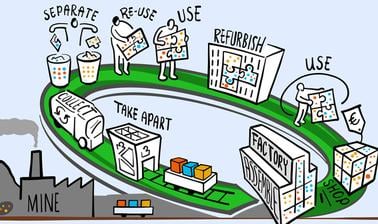
Innovative product design and reusing, recycling and remanufacturing products can help to deal with a raw materials shortage. But this can only provide an integrated solution if we keep CRMs in the loop through smarter CRM management. The starting point is to identify CRMs in products. It is not always clear what materials are in which products. It is, therefore, necessary to keep all metals in the loop for as long as possible.
Scarcity in the supply chain can not only damage businesses but alsonegatively impact economic development and the environment. For this reason, the course will also discuss environmental issues and electric and electronic waste regulations.
This course will be of value to a wide range of professionals working in or interested in this field. These include professionals involved in producing products containing CRMs (such as electronics) as well as local or national government officials tasked with organizingwaste management and recycling for these products. Students interested in the field of waste management will also find this course helpful for their studies in electronics, industrial design, and industrial ecology.
This course is part of the Sustainable Resource Management Professional Certificate.

What you'll learn

  • Current challenges and opportunities in resource resilience
  • Environmental problems caused by waste mismanagement of products that contain CRMs
  • Waste collection methods and efficient collection of waste in households and at companies
  • Remanufacturing, refurbishment, re-use and recycling processes of products which contain CRMs
  • Waste prevention through chain optimization
  • Benefits of circular procurement to keep critical raw materials in the loop through smart waste management
  • How product design can support efficient recycling and remanufacturing
  • How to uncover new business models to reduce waste and to make your business more resource resilient

Syllabus

Week 1: Urgency and challenges with critical raw materials (CRMs) and waste. How can we find out what CRMs are in products, and how can we get them back? The effects of materials shortage, future development and geo-politics on raw materials. Current waste management of products containing CRMs in general, waste management of commercial and household waste, regulation of electric and electronic waste (WEEE). Environmental problems such as leaching heavy metals from incinerator ashes and landfills. Partial metals retrieval from incinerator ashes.

Week 2: Different collection systems for recycling and remanufacturing/refurbishment, recycling psychology and the separate waste collection of commercial and household waste.

Week 3: Recycling technology: pre-processing, metallurgy and its challenges. Recycling economics and the problem of <1% (most) CRMs recycling.

Week 4: Remanufacturing and refurbishment systems: return of product (reverse logistics), disassembly and repair of the product, market demand and economics.

Week 5: Product design using better recycling or remanufacturing and refurbishment. Substitution of materials.

Week 6:New business models to generate profits from products that last longer. Circular procurement for government and companies.

Go to Class
MOOC List is learner-supported. When you buy through links on our site, we may earn an affiliate commission.

Related Courses

Business Model Metrics and Advanced Tools (edX) EdX
Delft University of Technology

Business Model Metrics and Advanced Tools (edX)

Learn advanced business model tools and metrics to help you achieve an agile business model. Do you want to enhance your business model by creating a clear focus or implement your new business model innovation into your IT? In this business and management course, we will discuss business model agility and how specific business model metrics will help you focus on the overall goals of our business.

No sessions available
5-12 Weeks
Estrategia y Transformación Digital (edX) EdX
Tecnológico de Monterrey,TecdeMonterreyX

Estrategia y Transformación Digital (edX)

Identificar los principios guía para la creación de estrategias dirigidas a la transformación digital en las empresas. En la actualidad el rápido cambio de modelos de negocio “análogos” a modelos “digitales” nos genera la necesidad de crear estrategias que ayuden a las empresas a delinear rutas de transformación digital.

Self Paced
Self-Paced
Big Data Strategies to Transform Your Business (edX) EdX
Delft University of Technology,DelftX

Big Data Strategies to Transform Your Business (edX)

Make your organization’s business strategy and model, as well as your own career path, future-proof by using big data’s disruptive power. While big data infiltrates all walks of life, most firms have not changed sufficiently to meet the challenges that come with it. In this course, you will learn how to develop a big data strategy, transform your business model and your organization. This course will enable professionals to take their organization and their own career to the next level, regardless of their background and position.

Self Paced
Self-Paced
Value Co-Creation in Sport Management – A New Logic in a Changing Society (edX) EdX
University of Bayreuth,BayreuthX

Value Co-Creation in Sport Management – A New Logic in a Changing Society (edX)

Do you want to become a successful sport management expert? Learn the importance of value co-creation and gather new insights that will make you more competitive in the field of sport management. Are you a passionate sports lover interested in exploring a new innovative logic in sport management? Enroll in this online course.

Self Paced
Self-Paced
Design for Recycling of Electronics in a Circular Economy (edX) EdX
Delft University of Technology,DelftX

Design for Recycling of Electronics in a Circular Economy (edX)

Discover the latest developments in Design for Recycling (DfR) of electrical and electronic equipment (EEE) and the application of recycled plastics into new products. Electronic products bring countless benefits to society, but their production and waste treatment also lead to numerous negative environmental and economic impacts. Since E-waste is the world’s fastest growing waste stream, governments are setting ambitious targets to help this industry transition towards a circular economy.

Nov 10th 2021
4 Weeks
Built environment sustainability assessment (edX) EdX
Universitat Politècnica de València,UPValenciaX

Built environment sustainability assessment (edX)

The course introduces the basic elements and trends for performing a through built environment assessment and develops the tools for urban sustainability policy impact analysis. The course introduces the basic elements and trends for performing a through built environment assessment and develops the tools for urban sustainability policy impact analysis.

Self Paced
Self-Paced
IoT Systems and Industrial Applications with Design Thinking (edX) EdX
École Polytechnique Fédérale de Lausanne,EPFLx

IoT Systems and Industrial Applications with Design Thinking (edX)

The first MOOC to provide a comprehensive introduction to Internet of Things (IoT) including the fundamental business aspects needed to define IoT related products. Internet of Things (IoT) and smart connected devices have radically changed the way our world works and how companies operate and create new businesses.

Self Paced
Self-Paced
Introduction to Connected Strategy (edX) EdX
Wharton School of the University of Pennsylvania

Introduction to Connected Strategy (edX)

Technology has caused firms to fundamentally change their strategy to connect with their customers in new and different ways. In this course, we explore the impact of connected strategies as well as business opportunities associated with those strategies. In this course, you’ll learn how technology has enabled firms to fundamentally change how they connectwith their customers.

Self Paced
Self-Paced
Economía Circular en los procesos logísticos (edX) EdX
LOGYCAX,LOGYCA

Economía Circular en los procesos logísticos (edX)

La economía circular es una alternativa que busca redefinir el crecimiento organizacional, con énfasis en los beneficios para toda la sociedad. Esto implica separar la actividad económica del consumo de recursos finitos y eliminar los residuos del sistema desde el diseño. Existen diferentes modelos que nos enseñan a utilizar este concepto, pero en este curso podrá encontrar como aplicar estos modelos en procesos logísticos de la mano de las empresas y expertos que lo han investigado.

Self Paced
Self-Paced
Global Environment and Trends in Technological Innovation (edX) EdX
Tecnológico de Monterrey,TecdeMonterreyX

Global Environment and Trends in Technological Innovation (edX)

Identification of the relevant factors in the competitive environment of companies, and the contemporary technological innovation trends. Nowadays, competitiveness of companies suffer an impact not only by economical, political, social, environmental, and health trends; technological innovation trends are relevant factors in the design of business models that are necessary for the prevalence of institutions.

Self Paced
Self-Paced