EdX

History of Roman Law (edX)

History of Roman Law (edX)

Explore Roman Law, its History, its Juridical Scienceand Codes, and see how relevant it could be for international legal culture today! “ Globalisation is paving the way for the increasingly international legal transactions and disputes. As a result, solicitors [and lawyers] are required to work across numerous jurisdictions. Knowledge not only of languages but also of some of the relevant legal concepts of these jurisdictions is beneficial. Due to the fact that the French, German, Italian and a vast number of other legal systems have kept alive many of the Roman legal rules and principles , studying Roman law gives students a solid grounding in the fundamental principles of these jurisdictions.…

Class Deals by MOOC List - Click here and see EdX's Active Discounts, Deals, and Promo Codes.

So don’t dismiss Roman law as an unimportant module..: the knowledge it offers can be valuable to your future studies and career ”. So speaks a Law Student at the University of Cambridge on The Guardian (“Studying Roman law: Juno it’s more useful than you’d think”, 11.4.2016): I often use his words to show my students that there are several ways to appreciate Roman Law, and sometimes they can be unexpected. Come and see what they are!

What you'll learn

  • the main phases of the evolution of the great Roman juridical Science
  • the changing role of principal actors within its various transformations
  • a deep analysis of Roman Codes and how to interpret their importance in current frameworks and solid grounding in the fundamental principles of Roman Law, valuable for an enriched juridical Culture.

Syllabus

The course will be scheduled as follows:
The History of Roman Law, from Monarchy to Justinian, with particular regard to:

  • the Institutions of the Republic and the Empire of Rome ( lessons 1-4 );
  • the Foundation and Evolution of Juridical Science ( lessons 5-8 );
  • the Age of Codes ( lessons 9-12 ).
Go to Class
MOOC List is learner-supported. When you buy through links on our site, we may earn an affiliate commission.

Related Courses

First Nights - Stravinsky’s Rite of Spring: Modernism, Ballet, and Riots (edX) EdX
HarvardX,Harvard University

First Nights - Stravinsky’s Rite of Spring: Modernism, Ballet, and Riots (edX)

Learn the fascinating history of Igor Stravinsky’s The Rite of Spring, one of the most challenging and rewarding ballets ever written. Igor Stravinsky’s The Rite of Spring premiered in Paris in 1913, sparking a riot and screaming so loud that the dancers could not hear the orchestra, and the choreographer had to shout numbers from backstage to keep the dancers on beat.

Self Paced
Self-Paced
Contract Law: From Trust to Promise to Contract (edX) EdX
HarvardX,Harvard University

Contract Law: From Trust to Promise to Contract (edX)

Contracts are a part of our everyday life, arising in collaboration, trust, promise and credit. How are contracts formed? What makes a contract enforceable? What happens when one party breaks a promise? Learn about contracts from Harvard Law Professor Charles Fried, one of the world’s leading authorities on contract law. Contracts are promises that the law will enforce. But when will the law refuse to honor a promise? What happens when one party does not hold to their part of the deal? This version of the course adds new units on Interpretation, Agency, Partnerships, Corporations, and Government Regulation.

Self Paced
Self-Paced
Greek and Roman Mythology (Coursera) Coursera
University of Pennsylvania

Greek and Roman Mythology (Coursera)

Myths are traditional stories that have endured over a long time. Some of them have to do with events of great importance, such as the founding of a nation. Others tell the stories of great heroes and heroines and their exploits and courage in the face of adversity. Still others are simple tales about otherwise unremarkable people who get into trouble or do some great deed. What are we to make of all these tales, and why do people seem to like to hear them? This course will focus on the myths of ancient Greece and Rome, as a way of exploring the nature of myth and the function it plays for individuals, societies, and nations. We will also pay some attention to the way the Greeks and Romans themselves understood their own myths.

Aug 24th 2026
5-12 Weeks
Art of Ancient Greece and Rome (saylor.org) Saylor Academy
Saylor.org

Art of Ancient Greece and Rome (saylor.org)

In this course, we will study the art of Classical Antiquity. The different units of the course reflect the main chronological stages in art development in Ancient Greece and Rome, from the coming together of the Greek city-state and the emergence of “geometric art” (around 900 B.C.) to the fourth century A.D. shift that took place within Roman culture and art due to the growing influence of Christianity.

Legacy Course
Self-Paced
Arch of Titus: Rome and the Menorah (Coursera) Coursera
Yeshiva University

Arch of Titus: Rome and the Menorah (Coursera)

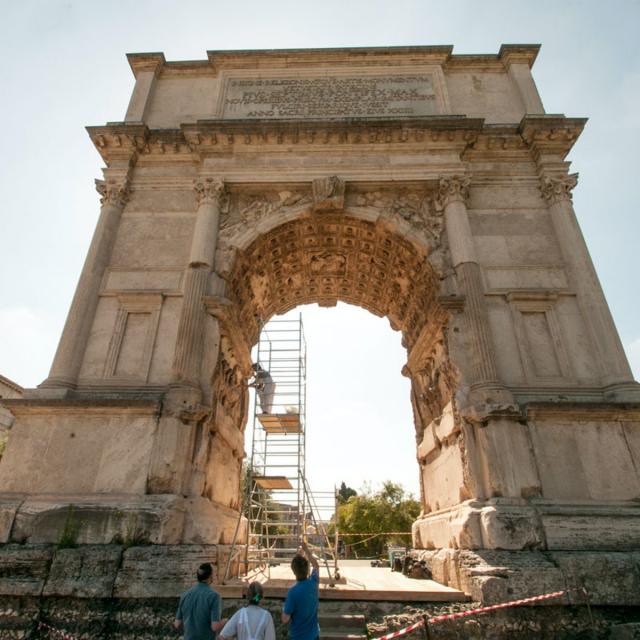
The Arch of Titus: Rome and the Menorah explores one of the most significant Roman monuments to survive from antiquity, from the perspectives of Roman, Jewish and later Christian history and art. The Arch of Titus commemorates the destruction of Jerusalem by the emperor Titus in 70 CE, an event of pivotal importance for the history of the Roman Empire, of Judaism, of Christianity and of modern nationalism. Together with your guide, Professor Steven Fine, you will examine ancient texts and artifacts, gaining skills as a historian as you explore the continuing significance of the Arch of Titus from antiquity to the very present.

Aug 3rd 2026
5-12 Weeks
Storia del Diritto Romano (Federica Web Learning) Federica Web Learning
University of Naples Federico II

Storia del Diritto Romano (Federica Web Learning)

Il corso di storia del diritto romano, strutturato cronologicamente, si propone di offrire un efficace strumento per la comprensione delle nozioni fondamentali della storia giuridica, sociale, politica, costituzionale di Roma antica, dalle origini della civitas alla Codificazione giustinianea. L’analisi è tesa ad una corretta impostazione dell’approccio allo studio dei fenomeni antichi e del loro impatto anche sull’attualità, costituendo un viaggio lungo circa 1400 anni attraverso lo svolgersi dell’esperienza istituzionale e giuridica romana.

Sep 9th 2019
No Information
The Fall of the Roman Republic (FutureLearn) FutureLearn
Colorado State University

The Fall of the Roman Republic (FutureLearn)

Explore the last century of the Roman Republic, its collapse and the creation of the Roman Empire. Covering the last century of the Roman Republic, this course will help you to understand the Republic’s collapse and how the emergence of the Roman Empire came about. You will gain an overview of the development of the Republic, as well as exploring significant aspects of Roman society, religion, and governance.

No sessions available
4 Weeks
Rome: a Virtual Tour of the Ancient City (FutureLearn) FutureLearn
University of Reading

Rome: a Virtual Tour of the Ancient City (FutureLearn)

Explore the architecture and history of Rome, walking around a 3D digital model of the ancient city, with this free online course. Explore ancient Rome through a unique, historically accurate 3D model. Take a guided tour around ancient Rome with expert Professor Matthew Nicholls, using his detailed and award-winning 3D digital model of the city.

Self Paced
5-12 Weeks
International Investment Law (edX) EdX
LouvainX,Université Catholique de Louvain - UCL

International Investment Law (edX)

Law

Learn the features and dynamics of an important field of international law that grants rights to foreign investors to foster States’ development. Are you aware of the controversial situations facing States and foreign investors nowadays in relation to, for instance, the protection of public health and the environment? Do you recall recent cases such as Philip Morris v Uruguay and Vattenfall v Germany?

Self Paced
Self-Paced
The Architectural Imagination (edX) EdX
HarvardX,Harvard University

The Architectural Imagination (edX)

Learn fundamental principles of architecture — as an academic subject or a professional career — by studying some of history’s most important buildings. Architecture engages a culture’s deepest social values and expresses them in material, aesthetic form. This course will teach you how to understand architecture as both cultural expression and technical achievement. Vivid analyses of exemplary buildings, and hands-on exercises in drawing and modeling, will bring you closer to the work of architects and historians.

Self Paced
Self-Paced