The Fall of the Roman Republic (FutureLearn)

The Fall of the Roman Republic (FutureLearn)

Explore the last century of the Roman Republic, its collapse and the creation of the Roman Empire. Covering the last century of the Roman Republic, this course will help you to understand the Republic’s collapse and how the emergence of the Roman Empire came about. You will gain an overview of the development of the Republic, as well as exploring significant aspects of Roman society, religion, and governance.

Class Deals by MOOC List - Click here and see FutureLearn's Active Discounts, Deals, and Promo Codes.

Major key figures such as The Gracchi, Marius, Sulla, Pompey, and Caesar are covered, showing how each contributed to the eventual fall of the Republic.

What topics will you cover?

  • Roman Society and the Emergence of Rome
  • Government of the Republic
  • The Gracchi
  • Sulla and Marius
  • Pompey and Caesar
  • Octavian the Empire

What will you achieve?
By the end of the course, you'll be able to...

  • Interpret ancient texts in translation about the fall of the Roman Republic
  • Identify the chronological events leading to the development of the Roman Empire
  • Discuss events surrounding the collapse of the Republic
Go to Class
MOOC List is learner-supported. When you buy through links on our site, we may earn an affiliate commission.
Related Courses

Rome: a Virtual Tour of the Ancient City (FutureLearn) FutureLearn
University of Reading

Rome: a Virtual Tour of the Ancient City (FutureLearn)

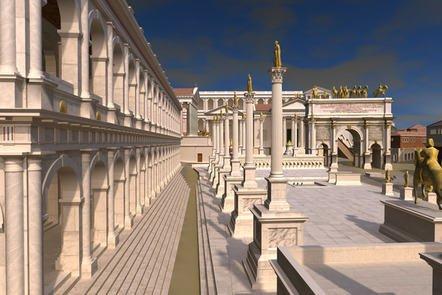
Explore the architecture and history of Rome, walking around a 3D digital model of the ancient city, with this free online course. Explore ancient Rome through a unique, historically accurate 3D model. Take a guided tour around ancient Rome with expert Professor Matthew Nicholls, using his detailed and award-winning 3D digital model of the city.

Self Paced
5-12 Weeks
World War 1: Trauma, Memory, Controversy (FutureLearn) FutureLearn
The Open University

World War 1: Trauma, Memory, Controversy (FutureLearn)

Explore the traumatic effects of WW1 on soldiers and civilians. Discover how we remember and debate the history of this war. In this free online course, you will study the social, cultural, medical and diplomatic history of the First World War. Topics range from physical and mental trauma suffered by combatants to the traumatic experiences of civilians in wartime.

Self Paced
4 Weeks
Roman Art and Archaeology (Coursera) Coursera
University of Arizona

Roman Art and Archaeology (Coursera)

The objective of this course is to provide an overview of the culture of ancient Rome beginning about 1000 BCE and ending with the so-called "Fall of Rome". We will look at some of the key people who played a role in Rome, from the time of the kings through the Roman Republic and the Roman Empire. We will also focus on the city of Rome itself, as well as Rome's expansion through Italy, the Mediterranean, and beyond.

Sep 21st 2026
5-12 Weeks
The Meaning of Rome: The Renaissance and Baroque City (edX) EdX
University of Notre Dame,NotreDameX

The Meaning of Rome: The Renaissance and Baroque City (edX)

Learn how the art, architecture, and urban form of Renaissance and Baroque Rome projected the city’s image of itself to its citizens and the world. We can read a city in a number of ways: in its plan, in the buildings that make its streets and public spaces, in the skyline. We can ask, what are the buildings or spaces saying? How do they say it? How does it all stitch together?

No sessions available
5-12 Weeks
A Global History of Architecture (edX) EdX
MIT,MITx

A Global History of Architecture (edX)

Learn about humanity’s rich architectural history on this journey around the globe – from 100,000 BCE to ca. 1,600 CE. How do we understand architecture? One way of answering this question is by looking through the lens of history, beginning with First Societies and extending to the 16th century. This course in architectural history is not intended as a linear narrative, but rather aims to provide a more global view, by focusing on different architectural "moments."

Oct 18th 2023
5-12 Weeks
Arch of Titus: Rome and the Menorah (Coursera) Coursera
Yeshiva University

Arch of Titus: Rome and the Menorah (Coursera)

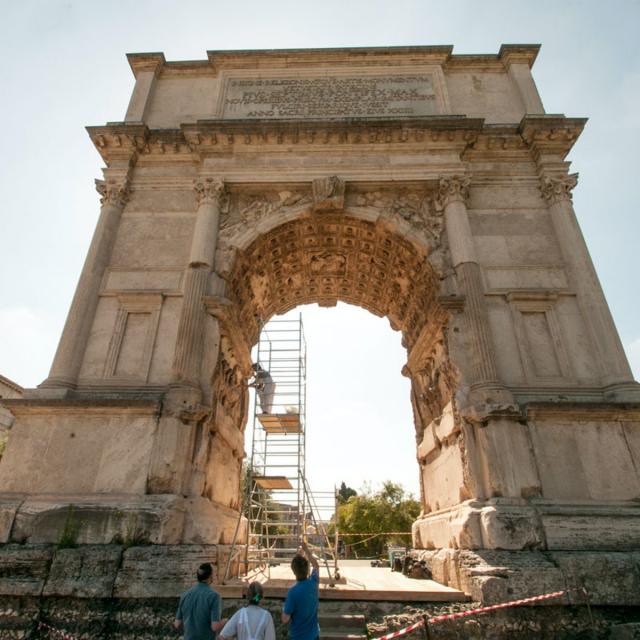
The Arch of Titus: Rome and the Menorah explores one of the most significant Roman monuments to survive from antiquity, from the perspectives of Roman, Jewish and later Christian history and art. The Arch of Titus commemorates the destruction of Jerusalem by the emperor Titus in 70 CE, an event of pivotal importance for the history of the Roman Empire, of Judaism, of Christianity and of modern nationalism. Together with your guide, Professor Steven Fine, you will examine ancient texts and artifacts, gaining skills as a historian as you explore the continuing significance of the Arch of Titus from antiquity to the very present.

Sep 28th 2026
5-12 Weeks
Art of Ancient Greece and Rome (saylor.org) Saylor Academy
Saylor.org

Art of Ancient Greece and Rome (saylor.org)

In this course, we will study the art of Classical Antiquity. The different units of the course reflect the main chronological stages in art development in Ancient Greece and Rome, from the coming together of the Greek city-state and the emergence of “geometric art” (around 900 B.C.) to the fourth century A.D. shift that took place within Roman culture and art due to the growing influence of Christianity.

Legacy Course
Self-Paced
Multilingual Practices: Tackling Challenges and Creating Opportunities (FutureLearn) FutureLearn
University of Groningen

Multilingual Practices: Tackling Challenges and Creating Opportunities (FutureLearn)

Learn about central aspects of multilingualism in today's globalised societies, such as cognition, policies and education. In a world of globalisation, people who do not share the same language meet more often every day. Being able to deal with these multilingual practices in an effective way can give you an advantage in your daily life and work.

Self Paced
4 Weeks
The Scientific Revolution: Understanding the Roots of Modern Science (FutureLearn) FutureLearn
University of Groningen

The Scientific Revolution: Understanding the Roots of Modern Science (FutureLearn)

Learn about the seventeenth-century Scientific Revolution and its role in shaping the modern Western world. How did the science of today come about? What constitutes ‘modern’ science? How does science relate to religion? Answer these questions and more with this course that travels back in time to the seventeenth-century Scientific Revolution to explore the roots of modern science.

Self Paced
3 Weeks
Health and Wellbeing in the Ancient World (FutureLearn) FutureLearn
The Open University

Health and Wellbeing in the Ancient World (FutureLearn)

Use literary and archaeological evidence to see how ancient Greeks and Romans approached health, well-being and societal issues. What did being healthy in ancient Rome or Greece look like? How can we tell what well-being meant in ancient times? This online course will help you investigate these questions, using both literary and archaeological evidence, to uncover details of real life in ancient societies.

Self Paced
5-12 Weeks
From World War to White Heat: the RAF in the Cold War (FutureLearn) FutureLearn
Royal Holloway, University of London

From World War to White Heat: the RAF in the Cold War (FutureLearn)

Explore the role that the Royal Air Force played in the Cold War through the collections of the RAF Museums at Hendon and Cosford. This free online course is a collaboration between the Royal Air Force (RAF) Museums and the Department of History at Royal Holloway, University of London. It will introduce you to some of the major turning points in the history of Britain in the post-1945 era.

Self Paced
5-12 Weeks