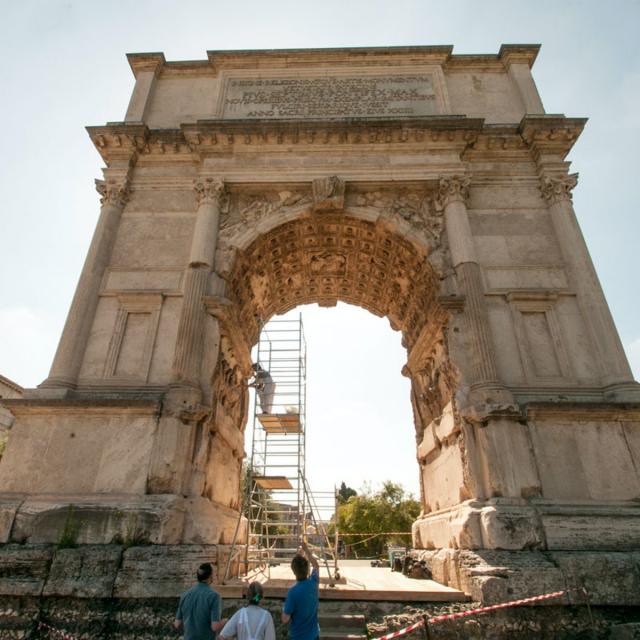
Arch of Titus: Rome and the Menorah (Coursera)

Offered by Yeshiva University,
Arch of Titus: Rome and the Menorah (Coursera)

The Arch of Titus: Rome and the Menorah explores one of the most significant Roman monuments to survive from antiquity, from the perspectives of Roman, Jewish and later Christian history and art. The Arch of Titus commemorates the destruction of Jerusalem by the emperor Titus in 70 CE, an event of pivotal importance for the history of the Roman Empire, of Judaism, of Christianity and of modern nationalism. Together with your guide, Professor Steven Fine, you will examine ancient texts and artifacts, gaining skills as a historian as you explore the continuing significance of the Arch of Titus from antiquity to the very present.

Class Deals by MOOC List - Click here and see Coursera's Active Discounts, Deals, and Promo Codes.

Course members will accompany Professor Fine on virtual "fieldtrips" to museums and historical sites in Los Angeles and New York where you will "meet" curators, scholars and artists. You will attend an academic colloquium and even "participate" in office hours. Students will participate in the latest advancement in the study of the Arch - the restoration of its original colors. You will learn how color was used in Roman antiquity and apply that knowledge to complete your own 'color restoration' of the Arch of Titus menorah relief.

Syllabus

WEEK 1
Why the Arch of Titus Matters
This module introduces the Arch of Titus and the larger themes of the course. Students will begin to view the Arch from the perspectives of Roman and Jewish history, of the victors and the vanquished, and the continuing history of this artifact. They will be sensitized to the presence of imagery related to the Arch in the larger culture, and be able to identity some of that imagery.

WEEK 2
The Arch of Titus as a Work of Art
This module explores the Arch of Titus as an artifact. Students will learn to look closely at this and other historical monuments in order to draw out the meanings of its iconography. They will see the Arch and especially its carved relief panels through selected refracting lenses.

WEEK 3
The Arch of Titus in History
Roman and Talmudic sources on Titus's triumphal parade in 71 CE will be the focus of this module. Students will read these ancient texts critically and assess the historical value for understanding the Arch and its later reception.

WEEK 4
The Arch of Titus from Antiquity to the Modern Era
Students will explore Jewish and Christian perspectives of the Arch and be able to explain how these perceptions affected their experience and interpretation of this artifact. Conversations with scholars and museum "visits" demonstrate a broad range of contemporary perspectives on the Arch and the continued significance of its iconography.

WEEK 5
The Arch of Titus in the Modern World
We will explore the ways that moderns have viewed and used the Arch, through the close reading of primary visual and literary sources. "Fieldtrips" and conversations contextualize the search for Arch imagery in our world, and demonstrate ways to recognize this iconography. Students will write a narrative of the Arch in modern times based upon primary literary sources.

WEEK 6
The Arch of Titus: Restoring its Color
Recent advances in the study of the original color, polychromy, of ancient Roman art will be presented. Students will learn the reasons for this rethinking of ancient art, and apply this learning to their own restorations of the polychrome of the Arch of Titus menorah panel.
Go to Class
MOOC List is learner-supported. When you buy through links on our site, we may earn an affiliate commission.

Related Courses

Applied Public History: Places, People, Stories (Coursera) Coursera
University of London

Applied Public History: Places, People, Stories (Coursera)

This course introduces learners to applied public history: understanding and interpreting the past today, and engaging diverse communities in the practice of making and sharing histories. The course draws on project case studies, expert insights and diverse perspectives to model exciting approaches to researching and sharing the history of places and people. Learners will develop a toolkit to apply in their own practice, by participating in discussion, quizzes, creative activities and mini masterclasses. What kinds of stories can we discover through research into the history of places and people?

Aug 10th 2026
5-12 Weeks
Christianity & Ecology (Coursera) Coursera
Yale University

Christianity & Ecology (Coursera)

There is a need for broader literacy and deeper knowledge of the world’s religions and their ecological contributions. This course is designed as a gateway to the rich ecological dimensions of the Christian religious tradition. We delve into unique contributions from Orthodox, Catholic, and Protestant Christianity, exploring views on and relationship with the natural world.

Aug 17th 2026
5-12 Weeks
Terrorism and Counterterrorism: Comparing Theory and Practice (Coursera) Coursera
Leiden University

Terrorism and Counterterrorism: Comparing Theory and Practice (Coursera)

Terrorism has arguably been one of the defining factors of our age. It frequently makes headlines, threatening or attacking governments, private business and ordinary citizens. And in many parts of the world, it has been one of the most important threats to peace, security and stability. But what does this exactly mean? What is the nature of this threat? Who or what is threatened, how, by whom and why? What can be done about it or how can we at least limit the impact of terrorism and make sure that terrorists do not make headlines and manage to scare us? These are just a handful of questions that will be addressed in this course that consists of three parts.

Aug 10th 2026
5-12 Weeks
Words Spun Out of Images: Visual and Literary Culture in Nineteenth Century Japan (Coursera) Coursera
The University of Tokyo

Words Spun Out of Images: Visual and Literary Culture in Nineteenth Century Japan (Coursera)

In their ambition to capture “real life,” Japanese painters, poets, novelists and photographers of the nineteenth century collaborated in ways seldom explored by their European contemporaries. This course offers learners the chance to encounter and appreciate behavior, moral standards and some of the material conditions surrounding Japanese artists in the nineteenth century, in order to renew our assumptions about what artistic “realism” is and what it meant.

Aug 10th 2026
4 Weeks
Structuring Values in Modern China (Coursera) Coursera
The Chinese University of Hong Kong

Structuring Values in Modern China (Coursera)

This sequence of four courses will propose a multi-disciplinary approach to the study of Chinese cultural history conceived of as a succession of modes of rationality (philosophical, bureaucratic, and economic). The focus will be on the moments of paradigm shift from one mode of rationality to another. For each of these moments, cultural facts and artifacts—thought, literature, ritual—will be examined in relationship to changing social, political, and economic systems.

Aug 17th 2026
5-12 Weeks
The Holocaust - An Introduction (II): The Final Solution (Coursera) Coursera
Tel Aviv University,Yad Vashem

The Holocaust - An Introduction (II): The Final Solution (Coursera)

The Holocaust was an inconceivable historical event, which forever robbed Western culture of its innocence. As civilized human beings, we fail to understand how events of such horror could have taken place, and how an idea so inhumanly warped could have spread like wildfire through an entire continent, instigating the systematic annihilation of millions of Jews.

Aug 10th 2026
3 Weeks
Film, Images & Historical Interpretation in the 20th Century: The Camera Never Lies (Coursera) Coursera
University of London,Royal Holloway, University of London

Film, Images & Historical Interpretation in the 20th Century: The Camera Never Lies (Coursera)

This course is a short taster on the topic of the use of Images, Film, and their use in historical interpretation in the 20th century. It is primarily provided for those who have a general interest in history that draws on photojournalism as primary evidence, and films based on historical events.

Aug 10th 2026
5-12 Weeks
A Journey through Western Christianity: from Persecuted Faith to Global Religion (200 - 1650) (Coursera) Coursera
Yale University

A Journey through Western Christianity: from Persecuted Faith to Global Religion (200 - 1650) (Coursera)

This course follows the extraordinary development of Western Christianity from its early persecution under the Roman Empire in the third century to its global expansion with the Jesuits of the early modern world. We explore the dynamic and diverse character of a religion with an enormous cast characters. We will meet men and women who tell stories of faith as well as of violence, suppression, and division.

Aug 10th 2026
5-12 Weeks
William Shakespeare's Twelfth Night: Comedy, Conflict, and Community (Coursera) Coursera
University of Colorado Boulder

William Shakespeare's Twelfth Night: Comedy, Conflict, and Community (Coursera)

This course introduces and explores William Shakespeare’s classic comedy, Twelfth Night. Interviews with actors who appeared in the Colorado Shakespeare Festival’s 2019 production of Twelfth Night, as well as lectures by scholars and theater professionals who work and teach at the University of Colorado Boulder, offer students insight into Shakespeare’s artistic vision and its applications.

Aug 17th 2026
5-12 Weeks
Arctic Economy (Coursera) Coursera
University of Alberta,UiT The Arctic University of Norway

Arctic Economy (Coursera)

Arctic communities have diverse histories and roles in local, regional and global economies. However, the scope and scale of globalization has increased so quickly that vulnerable Arctic communities are facing new kinds of challenges to their survival. In this 3-week MOOC, a unique collaboration between the University of Alberta and UiT The Arctic University of Norway, you will investigate the challenges faced by Indigenous, North American, Russian and Nordic Arctic communities in a modern world. So join us as we venture above the 60th parallel North, and explore how these fascinating communities adjust to change while maintaining their ways of life, socio-economic histories, and cultural traditions.

Aug 17th 2026
4 Weeks
Christian Virtues for Spiritual Growth (Coursera) Coursera
Duke University

Christian Virtues for Spiritual Growth (Coursera)

This Duke Divinity+ course is for all those who seek to cultivate their interior lives and to develop a way of thinking about ethics inspired by Christian tradition. In this course, renowned theologian Stanley Hauerwas reflects on the significance of specific virtues for understanding what it means to be a Christian. He examines the meaning and significance of four key virtues—kindness, hope, humility, and generosity—and their importance to living a good life.

Aug 17th 2026
4 Weeks
The Worldview of Thomas Berry: The Flourishing of the Earth Community (Coursera) Coursera
Yale University

The Worldview of Thomas Berry: The Flourishing of the Earth Community (Coursera)

Thomas Berry (1914-2009) was a historian of world religions and an early voice awakening moral sensibilities to the environmental crisis. He is known for articulating a “new story” of the universe that explores the implications of the evolutionary sciences and cultural traditions for creating a flourishing future. This course investigates Berry’s life and thought in relation to the Journey of the Universe project.

Aug 17th 2026
5-12 Weeks