EdX

Hinduism Through Its Scriptures (edX)

Hinduism Through Its Scriptures (edX)

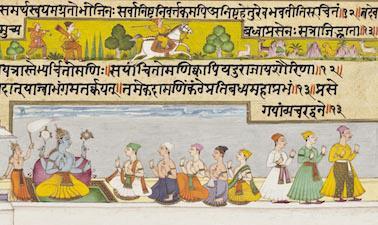
Learn about the rich diversity of Hindu sacred texts – hymns, narratives, philosophical thought – and their interpretations. Ever wondered about the sacred scriptures that have sustained for millennia one of the oldest and most diverse religions of the world - Hinduism? Want to discover the lessons this history may offer mankind in the 21st century?

Class Deals by MOOC List - Click here and see EdX's Active Discounts, Deals, and Promo Codes.

This religion course introduces the rich and diverse textual sources from which millions of Hindus have drawn religious inspiration for millennia. The Bhagavad Gita has offered philosophical insights to a number of modern thinkers. This course will introduce important passages from important Hindu sacred texts, their interpretations by moderns and will give you an opportunity to engage with them.

This course is part of the World Religions Through Their Scriptures XSeries Program.

What you'll learn:

  • Religious and philosophical insights conveyed in Hindu texts
  • How scriptures are interpreted to diverse ends in different historical contexts
  • Sensitive appreciation of world religions

Go to Class
MOOC List is learner-supported. When you buy through links on our site, we may earn an affiliate commission.

Related Courses

Philosophy, Science and Religion: Philosophy and Religion (Coursera) Coursera
University of Edinburgh

Philosophy, Science and Religion: Philosophy and Religion (Coursera)

Philosophy, Science and Religion mark three of the most fundamental modes of thinking about the world and our place in it. Are these modes incompatible? Put another way: is the intellectually responsible thing to do to ‘pick sides’ and identify with one of these approaches at the exclusion of others? Or, are they complementary or mutually supportive? As is typical of questions of such magnitude, the devil is in the details. For example, it is important to work out what is really distinctive about each of these ways of inquiring about the world. In order to gain some clarity here, we’ll be investigating what some of the current leading thinkers in philosophy, science and religion are actually doing.

Aug 17th 2026
5-12 Weeks
Violences et religions (Coursera) Coursera
University of Geneva

Violences et religions (Coursera)

La question « violences et religions » est d’actualité, et pas seulement depuis les attentats d’Al-Qaïda ou de Daech. Pour bien la comprendre, ce cours propose de prendre du recul et de l’envisager sous un angle historique et comparatiste. Le domaine concerné étant l’espace euro-méditerranéen, ce sont essentiellement le christianisme et l’islam qui seront traités (quelques séquences sont également consacrées au judaïsme).

Aug 10th 2026
5-12 Weeks
Religious Symbols of the World (edX) EdX
Seoul National University,SNUx

Religious Symbols of the World (edX)

This course is the third and final course in the series following “Understanding Religious Symbolism” and “Myths, Rituals, and Cosmos.” Through the theories and patterns that you learned in these three courses, I hope that you will be able to interpret the various religious phenomena in different cultures, and through this gain a better understanding of culture and human beings.

Self Paced
Self-Paced
Sikhism Through Its Scriptures (edX) EdX
HarvardX,Harvard University

Sikhism Through Its Scriptures (edX)

This course examines the Sikh scripture from a doctrinal and historical perspective by providing an overview of Sikh teachings as well as the historical context within which the scripture evolved and became canonized. Sikhi, commonly known as Sikhism, is a monotheistic religious tradition that was founded byGuru Nanak in late fifteenth-century Panjab in South Asia. Today, Sikhi’s approximately twenty-five to thirty million adherents can be found all over the globe, making it one of the six major religions of the world.

Self Paced
Self-Paced
The Politics of Skepticism (Coursera) Coursera
Erasmus University Rotterdam

The Politics of Skepticism (Coursera)

This is a course about the history of Skepticism from the ancient Greeks to today, with special attention to the political ramifications of questioning man's ability to know the world and himself with any certainty. We will discuss the debates raging between Plato and the Sophists, the rise of Christianity in the Roman world, and the so-called 'Skeptical Crisis' of the Renaissance as well as Pierre Bayle's Skepticism and David Hume's.

Aug 3rd 2026
5-12 Weeks
Religion and Thought in Modern China: the Song, Jin, and Yuan (Coursera) Coursera
The Chinese University of Hong Kong

Religion and Thought in Modern China: the Song, Jin, and Yuan (Coursera)

This sequence of four courses will propose a multi-disciplinary approach to the study of Chinese cultural history conceived of as a succession of modes of rationality (philosophical, bureaucratic, and economic). The focus will be on the moments of paradigm shift from one mode of rationality to another. For each of these moments, cultural facts and artifacts—thought, literature, ritual—will be examined in relationship to changing social, political, and economic systems.

Aug 17th 2026
5-12 Weeks
Philosophy, Science and Religion: Science and Philosophy (Coursera) Coursera
University of Edinburgh

Philosophy, Science and Religion: Science and Philosophy (Coursera)

Philosophy, Science and Religion mark three of the most fundamental modes of thinking about the world and our place in it. Are these modes incompatible? Put another way: is the intellectually responsible thing to do to ‘pick sides’ and identify with one of these approaches at the exclusion of others? Or, are they complementary or mutually supportive? As is typical of questions of such magnitude, the devil is in the details. For example, it is important to work out what is really distinctive about each of these ways of inquiring about the world. In order to gain some clarity here, we’ll be investigating what some of the current leading thinkers in philosophy, science and religion are actually doing.

Aug 3rd 2026
5-12 Weeks
The Emergence of the Modern Middle East - Part II (Coursera) Coursera
Tel Aviv University

The Emergence of the Modern Middle East - Part II (Coursera)

This course will discuss the developments in the Middle East from the early 20th century to the present. It will discuss the rise and retreat of Arab nationalism, the problems of internal cohesion of the Arab states, issues of religion and state, and the evolution of Islamist politics. It will also focus on the evolution of the Arab-Israeli conflict and its impact on the region and will conclude with an in depth analysis of the “Arab Spring” by placing these contemporary revolutionary events in their historical context.

Aug 10th 2026
5-12 Weeks
Western Religions & Ecology (Coursera) Coursera
Yale University

Western Religions & Ecology (Coursera)

At first glance the fields of religion and ecology may seem and unlikely pairing, but a deeper consideration reveals the two have a great deal to contribute to one another and are indeed inextricably linked. Religions recognize the unity and interdependence of humans with nature. Ecological sciences affirm this deep interconnection with the natural world. This partnership can inspire work for the wellbeing of the Earth community

Aug 3rd 2026
5-12 Weeks
A Journey through Western Christianity: from Persecuted Faith to Global Religion (200 - 1650) (Coursera) Coursera
Yale University

A Journey through Western Christianity: from Persecuted Faith to Global Religion (200 - 1650) (Coursera)

This course follows the extraordinary development of Western Christianity from its early persecution under the Roman Empire in the third century to its global expansion with the Jesuits of the early modern world. We explore the dynamic and diverse character of a religion with an enormous cast characters. We will meet men and women who tell stories of faith as well as of violence, suppression, and division.

Aug 10th 2026
5-12 Weeks