The Cosmopolitan Medieval Arabic World (Coursera)

Offered by Leiden University,
The Cosmopolitan Medieval Arabic World (Coursera)

Did you know that Arabic was for centuries the lingua franca in an area stretching from the south of Spain to the Chinese border? Did you know that the Middle East under Muslim rule in those days was the world’s beating heart of trade, but also of science and scholarship?

Class Deals by MOOC List - Click here and see Coursera's Active Discounts, Deals, and Promo Codes.

Did you know that Islam in its formative period was heavily influenced by existing cultures in the region, like Indian, Greek, Persian and Byzantine culture? Did you know that for many centuries after the establishment of the Muslim Empire the majority of the population remained largely Christian and Jewish?
Did you know that they held a protected status in Islamic law? Did you know that this generally open-minded, curious and open society stimulated many great innovations and inventions?
Did you know that European scholarship in the Renaissance leaned heavily on the texts and inventions from the Middle East which were the outcome of this sophisticated advanced society?
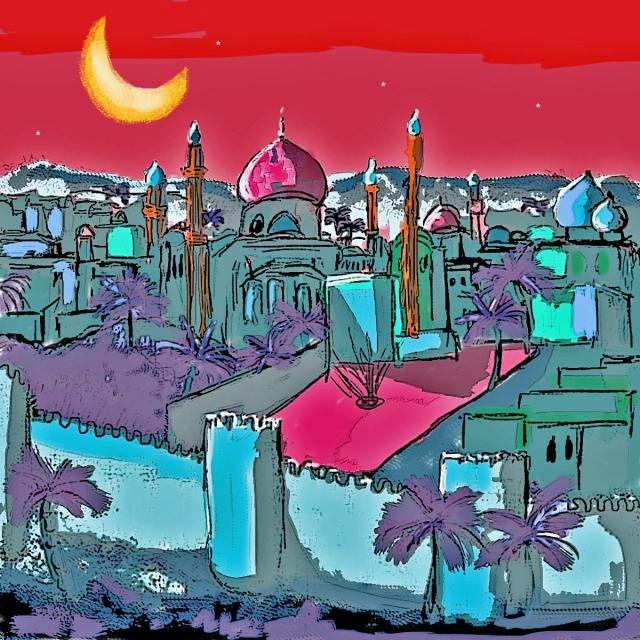
In this course we will focus on the fascinating history of the Arabic Medieval World. We will take you on a journey through the Middle Ages starting off in eighth-century Baghdad. Along the old pilgrim trails we will go to places like Mecca, Jerusalem and Najaf. We will show you the impressive markets of places like Cairo and Samarkand. However we will not hide the dark sides of society either, by introducing you to the flourishing widespread slave trade. We will visit the Abbasid court, the Harem of the caliph, and the palace of the Mamluk Sultan. We will show you some beautiful medieval manuscripts, that live on as the silent witnesses of the impressive achievements of scientists and medical doctors of this forgotten era. All along we will present you with historiographical debates and dilemma’s. Reflecting on the way we look at and interpret history. And while taking you on this journey, we will travel back and forth in time explaining to you how events of the past affected and shaped the world as we know it today.

What You Will Learn

  • In this course you will find out that the Arabic Medieval World was diverse, advanced and connected.
  • In this course you will learn that knowledge travels between cultures and that the Arabic Medieval World influenced the world as we know it today.

Syllabus

WEEK 1
Welcome to this Course
Great that you are joining us! In this course you will learn about the Cosmopolitan Medieval Arabic World. Before you start with the course we invite you to first go through this module and introduce yourself in the forum to meet your fellow learners. If you encounter any difficulties while studying, please let us know in the forum. For technical difficulties or questions regarding the course certificate, you can always contact the Coursera Learner Helpdesk. Good luck & we hope you will enjoy this course!
The Medieval Islamic City
In this Module we will examine the Islamic City. We will discuss if such a thing as "the Islamic city" exists. If so, what are the features that we are looking for ? We will also focus on specific examples of cities in the Medieval Middle East, most notably Baghdad. How was it possible that Baghdad grew to the size that it did? And what role did hygiene and medical care for instance play in that growth?

WEEK 2
Travel & Religion
In this Module we will focus on diversity and connection by looking at religion. We will explore Medieval society and zoom in on the fact that many different religions and religious views coexisted. We will see that different religions shared practices. Sometimes they would even worship in the same place. But we will also show examples of tension and the interaction between politics and religion. Furthermore we will try to find out how religious travelling shaped society.

WEEK 3
Trade
In this module we will take a look at trade. For the Medieval Middle East, trade was immensely important and it owed much of its wealth and prosperity to trade. There are the romantic images of caravans carrying lush fabrics, porcelain and gold along the desert roads of the silk route. And there is the dark side of a flourishing slave trade. But how correct are our images of what the Islamic or Arab world was and is like? Why is it that many people know about harems and very few people know about the legal innovations that enabled trade that we will also discuss in this module? To explore that question further we will introduce you to the concept of Orientalism.

WEEK 4
Power Play
In the last Module we introduced the slave trade in the Medieval Middle East. In this module we will further explore slavery. How was it possible that some of the most powerful people in society, both men and women, were or had been slaves? We will discuss the outrage that followed professor Jonathan Brown's views on slavery and Islam. And with the concept of Orientalism in mind, we will try to sketch a more realistic picture of Harems.

WEEK 5
Science
In this module we will focus on science in the Medieval Muslim world. How did scientific inventions of the Medieval Arabic world make their way to Europe and how did they eventually contribute to shaping today's world? How was knowledge preserved and how did books travel through the ages? We will research if survival of ideas and sources was a matter of sheer luck, or if we can recognize some patterns.

WEEK 6
In conclusion: the Cosmopolitain Medieval Arabic World
In this Course we tried to show you that the Medieval Islamic world was diverse advanced and connected. We have also focused on the danger of over- or under-representation of historical facts. Lastly we have tried to connect the past to the present by explaining and showing how events that took place a long time ago still affect today's world.
Go to Class
MOOC List is learner-supported. When you buy through links on our site, we may earn an affiliate commission.

Related Courses

Introduction to Archaeology: Knowing The Past (Coursera) Coursera
Rice University

Introduction to Archaeology: Knowing The Past (Coursera)

This course is an introduction to a series on the discipline of Archaeology. It is intended for learners at all stages, including advanced high school, college students, or life-long learners. Basic information about Archaeology and its history are presented in this course, while the following three courses cover scientific methods, forms of interpretation, and contemporary social issues that archaeologists engage with.

Jun 8th 2026
4 Weeks
History of Rock, Part Two (Coursera) Coursera
University of Rochester

History of Rock, Part Two (Coursera)

This course, part 2 of a 2-course sequence, examines the history of rock, primarily as it unfolded in the United States, from the early 1970s to the early 1990s. This course covers the music of Led Zeppelin, the Allman Brothers, Carole King, Bob Marley, the Sex Pistols, Donna Summer, Michael Jackson, Madonna, Prince, Metallica, Run-DMC, and Nirvana, and many more artists, with an emphasis both on cultural context and on the music itself. We will also explore how developments in the music business and in technology helped shape the ways in which styles developed.

Jun 8th 2026
5-12 Weeks
Soul Beliefs: Causes and Consequences - Unit 2: Belief Systems (Coursera) Coursera
Rutgers University

Soul Beliefs: Causes and Consequences - Unit 2: Belief Systems (Coursera)

Throughout history, the vast majority of people around the globe have believed they have, however defined, a “soul.” While the question of whether the soul exists cannot be answered by science, what we can study are the causes and consequences of various beliefs about the soul and its prospects of surviving the death of the body. Why are soul and afterlife beliefs so common in human history? Are there adaptive advantages to assuming souls exist?

Jun 8th 2026
5-12 Weeks
Understanding China, 1700-2000: A Data Analytic Approach, Part 1 (Coursera) Coursera
The Hong Kong University of Science and Technology - HKUST

Understanding China, 1700-2000: A Data Analytic Approach, Part 1 (Coursera)

The purpose of this course is to summarize new directions in Chinese history and social science produced by the creation and analysis of big historical datasets based on newly opened Chinese archival holdings, and to organize this knowledge in a framework that encourages learning about China in comparative perspective. Our course demonstrates how a new scholarship of discovery is redefining what is singular about modern China and modern Chinese history.

Jun 8th 2026
5-12 Weeks
Plagues, Witches, and War: The Worlds of Historical Fiction (Coursera) Coursera
University of Virginia

Plagues, Witches, and War: The Worlds of Historical Fiction (Coursera)

A unique and exciting introduction to the genre and craft of historical fiction, for curious students, aspiring authors--anyone with a passion for the past. Read classics of the genre, encounter bestselling writers of historical fiction, and discover your own historical archive while interacting with a global community of interested readers.

Jun 8th 2026
5-12 Weeks
Trade, Immigration and Exchange Rates in a Globalized World (Coursera) Coursera
IE Business School

Trade, Immigration and Exchange Rates in a Globalized World (Coursera)

This is the second of the three courses part of the Globalization, Economic Growth and Stability Specialization. This course will focus on facets of globalization that affect a country´s economic perspectives and decisions. Globalization has recently been the predominant subject in many political debates, and this course will go into the determinants of globalization.

Jun 8th 2026
5-12 Weeks
Paradoxes of War (Coursera) Coursera
Princeton University

Paradoxes of War (Coursera)

The Paradoxes of War teaches us to understand that war is not only a normal part of human existence, but is arguably one of the most important factors in making us who we are. Through this course, I hope that you will come to appreciate that war is both a natural expression of common human emotions and interactions and a constitutive part of how we cohere as groups. That is, war is paradoxically an expression of our basest animal nature and the exemplar of our most vaunted and valued civilized virtues.

Jun 1st 2026
13-24 Weeks
Introduction to Religions & Ecology (Coursera) Coursera
Yale University

Introduction to Religions & Ecology (Coursera)

At first glance the fields of religion and ecology may seem and unlikely pairing, but a deeper consideration reveals the two have a great deal to contribute to one another and are indeed inextricably linked. Religions recognize the unity and interdependence of humans with nature. Ecological sciences affirm this deep interconnection with the natural world. This partnership can inspire work for the wellbeing of the Earth community
.

Jun 8th 2026
5-12 Weeks
The Arctic as a System (Coursera) Coursera
University of Colorado Boulder

The Arctic as a System (Coursera)

In this course you will first learn about the Arctic as a geographic region, the peoples the Arctic, and the long history of Arctic settlement and exploration. Attention then turns to key features of the Arctic environment – its climate and weather, features of the ocean, sea ice, lands and the Greenland Ice Sheet, and some of the rapid changes being observed.

Jun 8th 2026
5-12 Weeks
The Emergence of the Modern Middle East - Part I (Coursera) Coursera
Tel Aviv University

The Emergence of the Modern Middle East - Part I (Coursera)

This course will review the emergence of the modern Middle East from the fall of the Ottoman Empire, at the end of the First World War to the present. We will discuss the Ottoman legacy in the region and the Western imperial impact on the creation of the Arab state system. The course will review the rise and retreat of Arab nationalism, the problems of internal cohesion of the Arab states, issues of religion and state, and the evolution of Islamist politics. We will also focus on the evolution of the Arab-Israeli conflict and its impact on the region and will conclude with an in depth analysis of the “Arab Spring” by placing these contemporary revolutionary events in their historical context.

Jun 1st 2026
4 Weeks
The Holocaust: The Destruction of European Jewry (Coursera) Coursera
University of California, Santa Cruz

The Holocaust: The Destruction of European Jewry (Coursera)

The Holocaust: The Destruction of European Jewry is an adaptation of an on-campus course that has been co-taught by Murray Baumgarten, Distinguished Professor of English and Comparative Literature (Literature Department), and Peter Kenez, Professor Emeritus (History Department), for over 20 years at UC Santa Cruz. In this course, you will explore the Holocaust from the overlapping perspectives of literature and history—through memoirs, historical documents, poetry, documentary footage, filmic representations, and novels.

Jun 1st 2026
5-12 Weeks