EdX

The Jewish Bible: Its History As A Physical Artifact (edX)

The Jewish Bible: Its History As A Physical Artifact (edX)

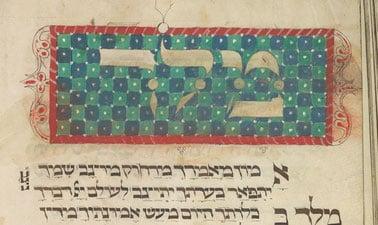
Can a book teach us more than just what is written inside of it? Beyond the words on a page, physical texts provide insights into the history, culture, and people of a time. One such text is the Jewish Bible, which has a physical history as storied and diasporic as that of the Jewish people.

Class Deals by MOOC List - Click here and see EdX's Active Discounts, Deals, and Promo Codes.

When studying the Jewish Bible and other historical works, the physical attributes—the form of the writing, whether it be scroll, codex, or simply a printed page layout, in addition to the size and shape—determine how we read the book and understand its meaning. Whether you are interested in literature or history, ancient or religious art and texts, or looking to deepen your understanding of religion and its impact on the world, this course will delve deeper into the Jewish Book as a physical object and spark desire to learn more about the materials as both artifact and religious content—enriching your understanding of the Jewish Bible, how it came to be, and its place today in a digital age.
In The Jewish Bible: Its History as a Physical Artifact, you will focus largely on the Torah Scroll—elaborate, handwritten scrolls that share the first five books of Moses, the first books of the Jewish Bible. The physical Torah has been a revered part of the Jewish community for centuries; there is even a tradition of touching the Torah as it is brought around the congregation as a sign of respect and paying homage to its history. In this course you will learn about the birth of the scrolls; their evolution from scrolls to codex; and the Jewish Bible through culture, history, and religion.
By exploring the ancient Hebrew Bibles that Jews have held in their hands, chanted in the synagogue, and studied in school and at home, you will be immersed in the history of the book as an artifact of other religions, and how Jews transformed the Bible over centuries using cultural and religious context. As you study the Bible as a physical book, you will learn how the materiality of the Jewish Book serves as an interface between the Hebrew text, history, and the modern world.

What you'll learn

  • The importance of the Jewish Bible as a physical object
  • What the Jewish Book meant and still means for the Jewish people, from the earliest rendering to the most complex layouts of Jewish Study Bible pages
  • How the shape, script, and layout represent the cultural, political, intellectual, and religious changes of the Jewish community in the context of the non-Jewish cultures
  • How to read and interpret the context and meaning of the pages, from the earliest forms of Codex through the digital age
  • The differences in the books that make up the Jewish Bible, and the page formats of the codex throughout history, encouraging your own reading and comparison between instances
  • How to appreciate ancient texts, using the Bible as a physical object, through touch, smell, and written word—enhancing your appreciation for ancient wisdom, rituals, and Rabbinic law

Go to Class
MOOC List is learner-supported. When you buy through links on our site, we may earn an affiliate commission.

Related Courses

Violences et religions (Coursera) Coursera
University of Geneva

Violences et religions (Coursera)

La question « violences et religions » est d’actualité, et pas seulement depuis les attentats d’Al-Qaïda ou de Daech. Pour bien la comprendre, ce cours propose de prendre du recul et de l’envisager sous un angle historique et comparatiste. Le domaine concerné étant l’espace euro-méditerranéen, ce sont essentiellement le christianisme et l’islam qui seront traités (quelques séquences sont également consacrées au judaïsme).

Oct 5th 2026
5-12 Weeks
Luther and the West (Coursera) Coursera
Northwestern University

Luther and the West (Coursera)

In this course we will discuss the history of some ideas that have been hugely influential in the modern west and that were taken out to the rest of the world. The discussion centers on an extraordinary and historically important figure, a sixteenth century German man named Martin Luther. Luther is recognized today as the originator of many of the most significant ideas that continue to affect and shape who we as modern people are and how we see the world and ourselves for better and for worse.

Sep 21st 2026
5-12 Weeks
Changing Minds: Geographic Discoveries and New Worlds through the Eyes of a Renaissance Jewish Scholar (edX) EdX
University of Pennsylvania,PennX

Changing Minds: Geographic Discoveries and New Worlds through the Eyes of a Renaissance Jewish Scholar (edX)

This course will situate a manuscript in the context of the world from which it was produced so that we better understand both. The Italian Renaissance was a time of scientific discovery and artistic revolution, it was also a time of world exploration, religious ferment, and technological changes such as the broad dissemination of print. By understanding a single thinker, Jewish polymath Abraham ben Mordecai Farissol, and one of his most important manuscripts, Iggeret Orhot ‘Olam , in context, this course will offer a fresh.

Self Paced
Self-Paced
Religious Literacy: Traditions and Scriptures (edX) EdX
HarvardX,Harvard University

Religious Literacy: Traditions and Scriptures (edX)

Learn how to better understand the rich and complex ways that religions function in historic and contemporary contexts. The study of religion is the study of a rich and fascinating dimension of human experience that includes but goes well beyond beliefs and ritual practices. In this religion course, learners explore case studies about how religions are internally diverse, how they evolve and change through time, and how religions are embedded in all dimensions of human experience.

Self Paced
Self-Paced
Science & Religion 101 (Coursera) Coursera
University of Alberta

Science & Religion 101 (Coursera)

This course examines the nature of both science and religion and attempts to explore the possible relationships between them. The primary purpose is to dispel the popular myth that science and religion are entrenched in a never-ending conflict. As a result, this course argues that if the limits of both science and religion are respected, then their relationship can be complementary.

Sep 28th 2026
5-12 Weeks
A Journey through Western Christianity: from Persecuted Faith to Global Religion (200 - 1650) (Coursera) Coursera
Yale University

A Journey through Western Christianity: from Persecuted Faith to Global Religion (200 - 1650) (Coursera)

This course follows the extraordinary development of Western Christianity from its early persecution under the Roman Empire in the third century to its global expansion with the Jesuits of the early modern world. We explore the dynamic and diverse character of a religion with an enormous cast characters. We will meet men and women who tell stories of faith as well as of violence, suppression, and division.

Oct 5th 2026
5-12 Weeks
The Science of Religion (edX) EdX
The University of British Columbia,UBCx

The Science of Religion (edX)

What is religion? Are we wired to believe? Does science have the answers? Join us on a journey to the origins of religion and spirituality. Drawing on new scientific advances, this religion course examines foundational questions about the nature of religious belief and practice.

This course is archived
5-12 Weeks
Chemerinsky on Constitutional Law - Individual Rights and Liberties (Coursera) Coursera
University of California, Irvine

Chemerinsky on Constitutional Law - Individual Rights and Liberties (Coursera)

Chemerinsky on Constitutional Law: Individual Rights and Liberties will highlight the construction and interpretation of the U.S. Constitution through the centuries with an emphasis on protections of individual liberties and the evolution of equal protection. You'll learn the history behind the Constitution, cases that formed important precedent, and how changes in interpretation have been dependent on shifts in cultural and political climate as well as the composition of the Supreme Court.

Oct 5th 2026
5-12 Weeks
In the Margins of a Medieval Jewish Prayer Book: What Can Physical Manuscripts Tell Us about History? (edX) EdX
University of Pennsylvania,PennX

In the Margins of a Medieval Jewish Prayer Book: What Can Physical Manuscripts Tell Us about History? (edX)

This course is a case study of how a particular manuscript, a Jewish prayer book for high holidays, can provide historians with vital insights about Jewish communal life, the way a manuscript can help us map cultural change and continuity in the Middle Ages, and the history of the physical object itself. Elisabeth Hollender (Goethe University, Frankfurt) guides students through the examination of a late 13th century manuscript from Western Ashkenaz, focusing on how the manifold signs of change left in the manuscript illustrate and illuminate the history of a Jewish community in the Rhineland.

Self Paced
Self-Paced
The Politics of Skepticism (Coursera) Coursera
Erasmus University Rotterdam

The Politics of Skepticism (Coursera)

This is a course about the history of Skepticism from the ancient Greeks to today, with special attention to the political ramifications of questioning man's ability to know the world and himself with any certainty. We will discuss the debates raging between Plato and the Sophists, the rise of Christianity in the Roman world, and the so-called 'Skeptical Crisis' of the Renaissance as well as Pierre Bayle's Skepticism and David Hume's.

Sep 28th 2026
5-12 Weeks
Découvrir l'anthropologie (edX) EdX
LouvainX,Université Catholique de Louvain - UCL

Découvrir l'anthropologie (edX)

Expérimentez un autre regard sur les sociétés humaines avec des chercheurs en anthropologie prospective. Comment les humains s’organisent-ils en sociétés ? Qu’appelle-t-on « familles » et comment se constituent-elles ? Quel regard et quels types d’analyse l’anthropologie propose-t-elle sur les systèmes de parenté, symboliques, politiques, religieux ?

Self Paced
Self-Paced
Soul Beliefs: Causes and Consequences - Unit 1: Historical Foundations (Coursera) Coursera
Rutgers University

Soul Beliefs: Causes and Consequences - Unit 1: Historical Foundations (Coursera)

Throughout history, the vast majority of people around the globe have believed they have, however defined, a “soul.” While the question of whether the soul exists cannot be answered by science, what we can study are the causes and consequences of various beliefs about the soul and its prospects of surviving the death of the body. Why are soul and afterlife beliefs so common in human history? Are there adaptive advantages to assuming souls exist?

Sep 28th 2026
5-12 Weeks