EdX

In the Margins of a Medieval Jewish Prayer Book: What Can Physical Manuscripts Tell Us about History? (edX)

In the Margins of a Medieval Jewish Prayer Book: What Can Physical Manuscripts Tell Us about History? (edX)

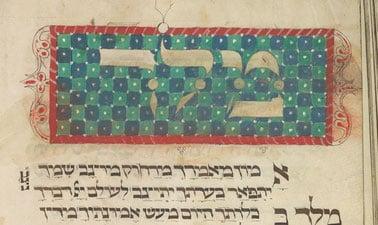
This course is a case study of how a particular manuscript, a Jewish prayer book for high holidays, can provide historians with vital insights about Jewish communal life, the way a manuscript can help us map cultural change and continuity in the Middle Ages, and the history of the physical object itself. Elisabeth Hollender (Goethe University, Frankfurt) guides students through the examination of a late 13th century manuscript from Western Ashkenaz, focusing on how the manifold signs of change left in the manuscript illustrate and illuminate the history of a Jewish community in the Rhineland.

Class Deals by MOOC List - Click here and see EdX's Active Discounts, Deals, and Promo Codes.

The course asks the following questions (and more):

  • How can we locate a particular manuscript within a larger liturgical tradition?
  • What sorts of information can be gained about a community by looking at a manuscript as a physical object?
  • What do manuscripts tell us about the experience of medieval Jewish liturgical practice?
  • What physical changes to manuscripts present problems and opportunities for interpretation?

What you'll learn

  • Acquire knowledge of medieval Asheknazi (originating in the German-speaking lands) and surrounding liturgical traditions
  • Understand the process of using a manuscript as a material object to understand the history of religious culture
  • Gain familiarity with a particular manuscript (CAJS Rare MS 382) and its unique features and problems

Syllabus

  1. An Introduction to Jewish Prayer Books
  2. What Page Layout Can Teach Us about How the Book Was Used
  3. Jewish Geography and the Different Prayer Rites
  4. Times Were Changing—How about the Manuscript? Reading the Notes Jotted in the Margins
  5. Fire and Theft! Interpreting the Scars on the Physical Manuscript

Prerequisites:
There are no prerequisites for taking this course. However, we encourage learners to explore edX DemoX if they are unfamiliar with the edX platform.
Though this course can stand alone, it is the fifth part of a series exploring what can be learned from studying Jewish manuscripts. Part 1 is by Professor Y. Tzvi Langermann (PennX–Katz1.1x), part 2 is by Professor Alessandro Guetta (PennX–Katz1.2x), part 3 is by Professor Fabrizio Lelli (PennX–Katz1.3x), and part 4 is by Professor Judith Schlanger (PennX-Katz1.4x).
Go to Class
MOOC List is learner-supported. When you buy through links on our site, we may earn an affiliate commission.

Related Courses

Scholarly Communication (Coursera) Coursera
Moscow Institute of Physics and Technology

Scholarly Communication (Coursera)

Scholarly Communication is a concise but comprehensive course on how to write research papers in English. The course will help the candidates gain a better understanding of the rhetorical conventions of English and the common challenges the candidates may face as an academic writer. The course provides instruction, exercises, structure, and deadlines needed to create a publishable paper.

May 16th 2022
4 Weeks
Teaching the Holocaust: Innovative Approaches to the Challenges We Face (FutureLearn) FutureLearn
University College London,Yad Vashem

Teaching the Holocaust: Innovative Approaches to the Challenges We Face (FutureLearn)

Explore history, delve into pedagogical challenges revealed by research, and find practical solutions for teaching the Holocaust. The Holocaust was the murder of approximately 6 million Jews perpetrated by Nazi Germany and its collaborators. That this atrocity proved possible raises many complex questions which remain relevant for young people today.

Self Paced
3 Weeks
Creating Modern China: The Republican Period to the Present (edX) EdX
HarvardX,Harvard University

Creating Modern China: The Republican Period to the Present (edX)

Explore the birth of modern China with a focus on the time between the fall of the Qing and the end of World War II. What does it mean to be modern? What constitutes modern politics, modern institutions, a modern military, and modern infrastructure? In this period of great excitement and experimentation, the country is asking itself: How do you become modern and remain true to the Chinese national identity?

Self Paced
Self-Paced
The Qur'an Between Judaism and Christianity (FutureLearn) FutureLearn
The University of Nottingham

The Qur'an Between Judaism and Christianity (FutureLearn)

Get an introduction to the history of the Qur'an, and its relationship with Judaism and Christianity. Explore the relationship between the Qur'an, Judaism and Christianity. This online course will illustrate how the Qur’an situates itself as part of, and as a correction to, the religious discourse of the Jewish and Christian communities of Late Antique Arabia.

Jan 10th 2022
4 Weeks
First Nights: Monteverdi’s L’Orfeo and the Birth of Opera (edX) EdX
HarvardX,Harvard University

First Nights: Monteverdi’s L’Orfeo and the Birth of Opera (edX)

Learn about Claudio Monteverdi’s L’Orfeo, one of the first operas ever written. Claudio Monteverdi’s L’Orfeo premiered in Mantua in 1607, and continues to be regarded as one of the most important examples of early opera. With L’Orfeo, Monteverdi helped to establish the techniques and traditions that continue to inform the genre of opera to this day.

Self Paced
Self-Paced
Coexistence in Medieval Spain: Jews, Christians, and Muslims (Coursera) Coursera
University of Colorado System

Coexistence in Medieval Spain: Jews, Christians, and Muslims (Coursera)

This course explores Jewish, Christian, and Muslim intercultural relations in Iberia from the Visigothic era (6th century CE) until the creation of Queen Isabel I and King Ferdinand II Catholic Spain (late 15th century). We evaluate the many identities of the peninsula known as Christian Hispania, Jewish Sefarad, and Islamic al-Andalus. We trace the origins and trajectory of conflict between these communities (the Muslim conquest of Spain, Christian Reconquista, prohibitions blocking intermixing of peoples, and expulsions).

Sep 14th 2026
5-12 Weeks
Writing and Editing: Polishing a Manuscript | Learn with Wattpad (Skillshare) Skillshare
Skillshare

Writing and Editing: Polishing a Manuscript | Learn with Wattpad (Skillshare)

Join one of Wattpad's most successful writers Ali Novak for a fun, straightforward class on editing and revising your writing. While writing a draft is a feat in itself, revising and editing your work is when your story takes shape and the real writing begins! In this 25-minute class, Ali walks through the process of polishing a manuscript for publication.

Self Paced
Self-Paced
Deciphering Secrets: Unlocking the Manuscripts of Medieval Toledo (Spain) (edX) EdX
Universidad Carlos III de Madrid - UC3M

Deciphering Secrets: Unlocking the Manuscripts of Medieval Toledo (Spain) (edX)

Explore the medieval city of Toledo (Spain) and assess its history of Jewish, Christian, and Muslim religious and cultural coexistence. This course evaluates the medieval history of Toledo from the reign of King Alfonso “The Wise” (1252-1284) until the creation of the blood purity statutes in the 1450s.

No sessions available
5-12 Weeks
The Holocaust - An Introduction (II): The Final Solution (Coursera) Coursera
Tel Aviv University,Yad Vashem

The Holocaust - An Introduction (II): The Final Solution (Coursera)

The Holocaust was an inconceivable historical event, which forever robbed Western culture of its innocence. As civilized human beings, we fail to understand how events of such horror could have taken place, and how an idea so inhumanly warped could have spread like wildfire through an entire continent, instigating the systematic annihilation of millions of Jews.

Oct 5th 2026
3 Weeks
Invasions, Rebellions, and the Fall of Imperial China (edX) EdX
HarvardX,Harvard University

Invasions, Rebellions, and the Fall of Imperial China (edX)

An overview of modern Chinese history, including the fall of the Qing and the end of imperial China. In the 18th century, the Qing Dynasty is at its height; it is the wealthiest, most powerful, most civilized state on earth. And yet the 19th century brought enormous challenges for the Qing and for the place we call China. By the 20th century, a 2,000-year imperial tradition is gone. What happened?

Self Paced
Self-Paced