Age of Jefferson (Coursera)

Age of Jefferson (Coursera)

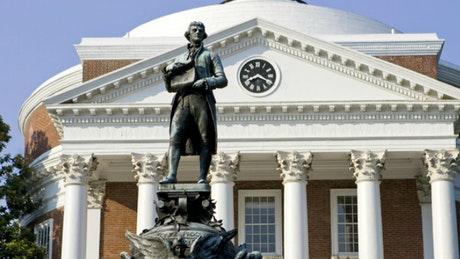
This course provides an overview of Thomas Jefferson's work and perspectives presented by the University of Virginia in partnership with Thomas Jefferson’s Monticello. Together, UVA and Monticello are recognized internationally as a UNESCO World Heritage Site.

Class Deals by MOOC List - Click here and see Coursera's Active Discounts, Deals, and Promo Codes.

Syllabus

WEEK 1
Thomas Jefferson, American Icon
Thomas Jefferson is an American icon. He has also been one of the most polarizing and controversial figures in American history. In this introductory module, we’ll explore how Jefferson’s reputation has changed and evolved over the last two centuries. We’ll discover what Jefferson considered to be his most important contribution to the “Age of Enlightenment” in which he was living. We’ll discuss why some people in both the nineteenth and twentieth centuries have viewed Jefferson and his ideas with skepticism or worse while others have embraced Jefferson. Overall, learning about how people from many different backgrounds and perspectives have interpreted Jefferson throughout history will help us understand why it’s so important to think critically and honestly about Jefferson’s life and legacy today.

WEEK 2
Jefferson’s Declaration of Independence
No document is more closely associated with Jefferson than the Declaration of Independence. Listing it as the first of three achievements on his tombstone, Jefferson clearly believed the Declaration to be of profound importance. Generations of Americans have agreed, constantly quoting its phrases and invoking its ideas. But do we really understand what Jefferson was trying to do when he wrote the Declaration? In this module, we’ll explore the Revolutionary context in which Jefferson lived and worked. We’ll ask why the Declaration takes the form that it does, and also what Jefferson hoped it would accomplish. Surprisingly, the parts of the Declaration that we celebrate most frequently today may not be the ones Jefferson would have understood to be the most important.

WEEK 3
Jefferson and Slavery
The man who wrote in the Declaration of Independence that “all men are created equal” was a lifelong slaveowner whose affluence rested on the exploitation of hundreds of African Americans. In this module, we travel to Montalto, the mountain overlooking Jefferson’s home and plantation on Monticello, to try to gain some perspective on this great tension in Jefferson’s life and thought. Our goal will be neither simply to exonerate nor to castigate Jefferson, but rather to understand how he viewed slavery and his relationship to it. Only by confronting and considering this complicated, frustrating, and tragic chapter in American history can we come to a more complete and nuanced understanding of Thomas Jefferson and his legacy. As students attending the University Jefferson founded, it is especially important to engage this topic.

WEEK 4
Jefferson and Religion
The role of religion in public life continues to be a topic of debate today in both the United States and around the world. Thomas Jefferson was never happier than when his Bill for Religious Freedom was finally enacted in Virginia in 1786. In this module, we’ll try to understand why Jefferson believed freedom of religion to be so essential to the future of the United States. To do this, we’ll explore the historical context in which Jefferson developed his ideas about the proper relationship between religious denominations and the state. We’ll also investigate Jefferson’s own faith—a subject of much controversy from his own day through the present. Considering Jefferson’s serious engagement with questions of religion will help us understand the kinds of communities and society he hoped would take hold and flourish in the new nation.

WEEK 5
Jefferson and Education
Founding the University of Virginia in 1819 was the most obvious example of Jefferson’s interest in education, but it was by no means the first time he considered the subject. Indeed, education was one of Jefferson’s constant preoccupations. In this session, we’ll discuss Jefferson’s ideas about education as they developed over the course of his life, from the ambitious plan for a state-supported system of schools outlined in his “Bill for the More General Diffusion of Knowledge,” to his conclusion in the early nineteenth century that the other institutions of higher learning that existed in the United States just weren’t suited to forming the leaders of a free republic. Throughout the discussion, we’ll try to understand why Jefferson was so focused on education by asking what he believed was at stake if Americans failed in their duty to provide proper instruction for future generations.

WEEK 6
'The earth belongs to the living'
In 1789, Jefferson wrote a letter to James Madison from Paris in which he asserted that “the earth belongs to the living.” Calculating that a single generation could be said to last nineteen years, he proposed that no debts should be incurred that could not be paid off in nineteen years; that all laws should be re-written every nineteen years; and that Americans should re-write even their constitutions every nineteen years. Madison thought the ideas Jefferson outlined in this letter to be wildly impractical, and most commentators since then have come to the same conclusion. In this module, however, we’ll explore what Jefferson was getting at in claiming that “the earth belongs to the living.” In so doing, we’ll discover how this phrase expresses an idea that lies at the very core of Jefferson’s conception of equality, democracy, and the American nation.

WEEK 7
Final Exam

Go to Class
MOOC List is learner-supported. When you buy through links on our site, we may earn an affiliate commission.

Related Courses

Søren Kierkegaard - Subjectivity, Irony and the Crisis of Modernity (Coursera) Coursera
University of Copenhagen

Søren Kierkegaard - Subjectivity, Irony and the Crisis of Modernity (Coursera)

In this course created by former associate professor at the Søren Kierkegaard Research Centre, Jon Stewart, we will explore how Kierkegaard deals with the problems associated with relativism, the lack of meaning and the undermining of religious faith that are typical of modern life. His penetrating analyses are still highly relevant today and have been seen as insightful for the leading figures of Existentialism, Post-Structuralism and Post-Modernism.

Aug 17th 2026
5-12 Weeks
Miracles of Human Language: An Introduction to Linguistics (Coursera) Coursera
Leiden University,Meertens Instituut - KNAW

Miracles of Human Language: An Introduction to Linguistics (Coursera)

Everywhere, every day, everybody uses language. There is no human society, no matter how small or how isolated, which does not employ a language that is rich and diverse. This course introduces you to linguistics, featuring interviews with well-known linguists and with speakers of many different languages. Join us to explore the miracles of human language!

Aug 17th 2026
5-12 Weeks
Intellectual Humility: Science (Coursera) Coursera
University of Edinburgh

Intellectual Humility: Science (Coursera)

It’s clear that the world needs more intellectual humility. But how do we develop this virtue? And why do so many people still end up so arrogant? Do our own biases hold us back from becoming as intellectually humble as we could be—and are there some biases that actually make us more likely to be humble? Which cognitive dispositions and personality traits give people an edge at being more intellectually humble - and are they stable from birth, learned habits, or something in between? And what can contemporary research on the emotions tell us about encouraging intellectual humility in ourselves and others?

Aug 17th 2026
4 Weeks
Resilient Teaching Through Times of Crisis and Change (Coursera) Coursera
University of Michigan

Resilient Teaching Through Times of Crisis and Change (Coursera)

Resilient teaching is the ability to facilitate learning experiences that are designed to be adaptable to fluctuating conditions and disruptions. This teaching ability can be seen as an outcome of a design approach that attends to the relationship between learning goals and activities, and the environments they are situated in. Resilient teaching approaches take into account how a dynamic learning context may require new forms of interactions between teachers, students, content, and tools. Additionally, they necessitate the capacity to rethink the design of learning experiences based on a nuanced understanding of context.

Aug 17th 2026
4 Weeks
Structuring Values in Modern China (Coursera) Coursera
The Chinese University of Hong Kong

Structuring Values in Modern China (Coursera)

This sequence of four courses will propose a multi-disciplinary approach to the study of Chinese cultural history conceived of as a succession of modes of rationality (philosophical, bureaucratic, and economic). The focus will be on the moments of paradigm shift from one mode of rationality to another. For each of these moments, cultural facts and artifacts—thought, literature, ritual—will be examined in relationship to changing social, political, and economic systems.

Aug 17th 2026
5-12 Weeks
Innovative Teaching with ChatGPT (Coursera) Coursera
Vanderbilt University

Innovative Teaching with ChatGPT (Coursera)

Despite what you may have heard, ChatGPT offers exciting possibilities for supporting innovative teaching and personalized education. This course provides practical techniques that any educator, from K-12 to higher education, can use to help support their teaching. No experience with ChatGPT, prompt engineering, or Generative AI is required.

Aug 17th 2026
1 Week
Assessment in Higher Education: Professional Development for Teachers (Coursera) Coursera
Erasmus University Rotterdam

Assessment in Higher Education: Professional Development for Teachers (Coursera)

Are you a teacher in higher education wanting to get the best out of your students and assessments? Then on behalf of Risbo, Erasmus University Rotterdam, we would like to welcome you to this MOOC on Assessment in Higher Education. In this MOOC we will guide you through the different phases of preparing, creating and evaluating the assessments in your course.

Aug 17th 2026
5-12 Weeks
Journey of the Universe: The Unfolding of Life (Coursera) Coursera
Yale University

Journey of the Universe: The Unfolding of Life (Coursera)

Journey of the Universe weaves together the discoveries of the evolutionary sciences together with humanities such as history, philosophy, art, and religion. The course draws on the Emmy-award winning film, Journey of the Universe, and the book from Yale University Press. Journey explores cosmic evolution as a creative process based on connection, interdependence, and emergence. It examines a range of dynamic interactions in the unfolding of galaxies, Earth, life, and human communities. It investigates ways in which we understand evolutionary processes and the implications for humans and our ecological future.

Aug 17th 2026
5-12 Weeks
Try RRI! A guide for Responsible Research and Innovation (Coursera) Coursera
University of Amsterdam

Try RRI! A guide for Responsible Research and Innovation (Coursera)

In this online course you will learn how to apply Responsible Research and Innovation (RRI) in your own work. First by understanding why it is important to act responsibly in your research and innovation processes at all. In a second step, you will get introduced to several tools that will help make your own work in research and/or innovation more aware by introducing concepts of RRI.

Aug 17th 2026
3 Weeks
Critical Issues in Urban Education (Coursera) Coursera
University of Chicago

Critical Issues in Urban Education (Coursera)

Urban school reform in the United States is characterized by contentious, politicized debate. This course explores a set of critical issues in the education and educational reform space, with a focus on aspects of the field that have sparked controversy and polarized views. We will dig into these debates, situating them within the larger history of public education and school reform, and considering the viewpoints, the evidence, and translation of issues into educational policy.

Aug 17th 2026
5-12 Weeks