Exploring Light: Hands-on Activities and Strategies for Teachers (Coursera)

Offered by Exploratorium,
Exploring Light: Hands-on Activities and Strategies for Teachers (Coursera)

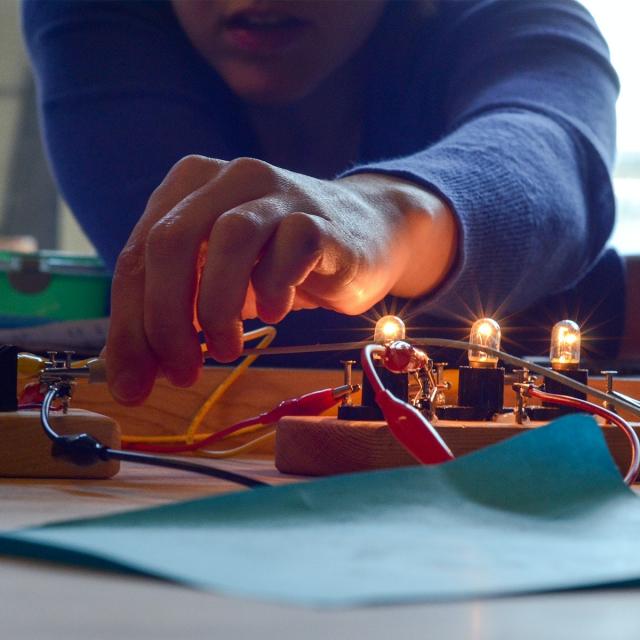
This is an Exploratorium teacher professional development course taught by Teacher Institute staff, open to any science teacher (particularly middle or high school level) and science enthusiast. This is a hands-on workshop that explores topics and strategies teachers can use to help their students become active investigators of light.

Class Deals by MOOC List - Click here and see Coursera's Active Discounts, Deals, and Promo Codes.

There are four weeks of course content, which require 2-4 hours per week. Each module builds upon the previous one, so we strongly suggest you follow the sequence we've outlined rather than skip ahead or do the course in less time. The course is designed to give you an opportunity to learn and share with others, not test what you know. There are weekly activity and reflection assignments, but these will not be graded. To receive credit for this course, you will need to complete the peer-reviewed final assignment.

As a participant, you will:

  • Watch videos that demonstrate natural phenomena and the Exploratorium's approach to teaching and learning
  • Conduct personal investigations by engaging in hands-on activities based in those phenomena
  • Reflect and share your experience doing activities
  • Discuss and identify challenges and opportunities for teaching
  • Devise a lesson of your own based on one or more of the activities.

Each week, we'll look at a different light-related topic: We will start by examining human visual perception, then take a brief historical tour of our evolving scientific understanding. We’ll also look at optics and optical instruments and finish by looking at the wave nature of light.
To get the most out of this experience, you'll have to try out some activities! In return, you'll get lots of valuable teaching resources, an in-depth understanding of the subject matter, and useful tips and techniques for the classroom.
NOTE: This is a hands-on workshop, so you will need to buy or find materials. All of the materials required are inexpensive and should be easy to obtain, and we welcome substitutions! A separate list of materials is available for each activity.

Syllabus

WEEK 1
Introduction to Exploring Light
Welcome to our course! This is a hands-on workshop designed for middle-school and high-school teachers and other people interested in teaching and learning about light. In this first week, we'll introduce you to our pedagogy at the Exploratorium Teacher Institute, which is about supporting educators to incorporate the hands-on, inquiry-based experiences of our museum into classrooms. We'll demonstrate exhibits and teach you how to do activities (which we call Science Snacks) that explore and investigate natural phenomena, and you will need to gather your own materials to do experiments on your own. We hope you will share teaching tips and facilitation strategies with each other as well. We recommend you look through the materials below and follow the suggested course deadlines to get the most out of this experience. We also suggest you browse the discussion forums we've set up. To help you get started and find out who's in this course, please take a moment to introduce yourself in the forum. Please also fill out our pre-course survey, thanks!

Perception
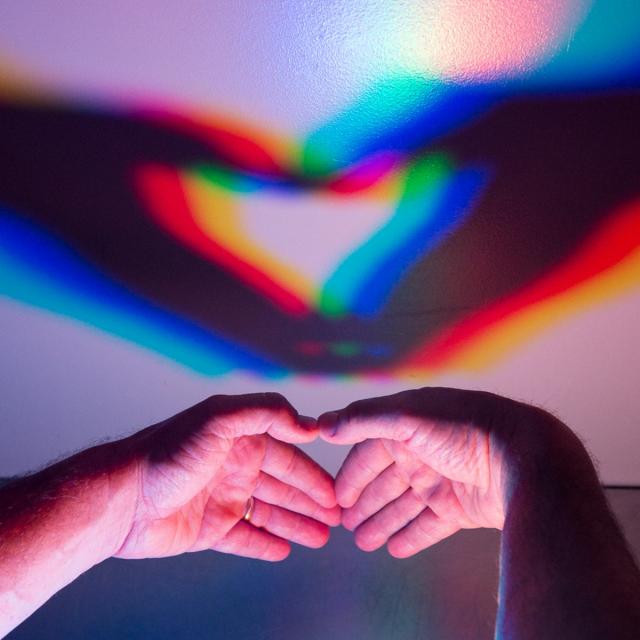
We don't just see with our eyes; our brain plays a big role in determining what we see. A huge percentage of the human brain is devoted to processing visual information, but we still can't make sense of everything going on around us, so we rely on certain "shortcuts" or tricks. In other words, your brain makes things up! This week, we're going to explore a few interesting visual shortcuts and some of the technologies that have been invented to take advantage of them. Your assignment is to watch the videos below, try some activities at home, and share your experience in the discussion forums. Collect data about your peripheral vision and compare with your classmates Show off your afterimage designs for Bird in a Cage Take pictures of your experiments with Colored Shadows We can't wait to see what you come up with!

WEEK 2
History of Our Ideas About Light
A historical timeline approach to studying light illustrates the importance of models to the advancement of science. Scientific models of light have changed over the years as more and better experiments were done. At the same time, an important skill as a teacher is choosing the simplest model to help a student towards understanding.This week, we'll revisit some famous experiments and different models of light to advance our own understanding. We'd like you to start off by reading the introductory essay below. Then, watch the video demonstrations and try some activities on your own. This week, we'd also like you to pick an activity or two to share with someone else. Don't forget to post photos, videos and comments in the discussion forum to share with your fellow students.

WEEK 3
Optics and Image Making
This week, we're exploring optics and how to make images with light. In addition to our exhibit and activity demonstrations, you'll learn how to put activities together into a lesson that helps students develop and test a mental model of how the world works. We want you to do this lesson as a learner and then reflect and discuss with your peers in the forum. The lesson is designed as a series of experiments, each one giving you a piece of information that lets you make a mental model. You'll be presented with several scenarios, asked to make a prediction, and then we'll reveal what happens. You'll have an opportunity to revise and adjust your model at each stage. For those of you taking this course for credit, we recommend you begin working on your peer-reviewed assignment. If you want some feedback before you submit your assignment, we suggest you post questions and drafts of your lesson plan in the forum.

WEEK 4
The Wave Nature of Light
What is light? Sometimes we model it as a wave, sometimes as a particle. Light is light. Nevertheless, the wave properties of light lend themselves towards a rich array of experiments that help further our understanding. This is the final week of content for our course. Please continue to do activities this week, but also take a few moments to share what you learned, and any suggestions you have for us. If you are taking the course for a grade, please submit your final assignment and complete the required peer reviews before the deadline. We hope you have enjoyed this experience and that you'll come check out our museum in San Francisco!
Go to Class
MOOC List is learner-supported. When you buy through links on our site, we may earn an affiliate commission.

Related Courses

Thermodynamique : fondements (Coursera) Coursera
École Polytechnique Fédérale de Lausanne

Thermodynamique : fondements (Coursera)

Ce cours vous apportera une compréhension des concepts fondamentaux de la thermodynamique du point de vue de la physique, de la chimie et de l’ingénierie. Il est scindé un deux MOOCs. Dans la première partie, le Professeur J.-Ph. Ansermet de l’EPFL et son collaborateur le Dr. Sylvain Bréchet ont rassemblé en quatre leçons tous les principes fondamentaux de la thermodynamique. La deuxième partie du MOOC illustre l’approche thermodynamique par une série d’applications présentées par des spécialistes provenant de diverses institutions partenaires du réseau RESCIF.

Sep 14th 2026
4 Weeks
Copyright for Educators & Librarians (Coursera) Coursera
Duke University,Emory University,University of North Carolina at Chapel Hill

Copyright for Educators & Librarians (Coursera)

Fear and uncertainty about copyright law often plagues educators and sometimes prevents creative teaching. This course is a professional development opportunity designed to provide a basic introduction to US copyright law and to empower teachers and librarians at all grade levels. Course participants will discover that the law is designed to help educators and librarians.

Sep 14th 2026
5-12 Weeks
Engaging ELLs and Their Families in the School and Community (Coursera) Coursera
Arizona State University

Engaging ELLs and Their Families in the School and Community (Coursera)

In this course, you will learn how to better and more successfully engage your ELL(s) and their families in the school and community. You will learn how to engage your ELL student in the classroom setting as well as in various aspects of the school including extracurricular activities and the inner workings of the school and education system. You will also be introduced to strategies for engaging the families of your ELL students in the school community and the wider community of your city and state.

Sep 7th 2026
5-12 Weeks
Resilient Teaching Through Times of Crisis and Change (Coursera) Coursera
University of Michigan

Resilient Teaching Through Times of Crisis and Change (Coursera)

Resilient teaching is the ability to facilitate learning experiences that are designed to be adaptable to fluctuating conditions and disruptions. This teaching ability can be seen as an outcome of a design approach that attends to the relationship between learning goals and activities, and the environments they are situated in. Resilient teaching approaches take into account how a dynamic learning context may require new forms of interactions between teachers, students, content, and tools. Additionally, they necessitate the capacity to rethink the design of learning experiences based on a nuanced understanding of context.

Sep 14th 2026
4 Weeks
Image and video processing: From Mars to Hollywood with a stop at the hospital (Coursera) Coursera
Duke University

Image and video processing: From Mars to Hollywood with a stop at the hospital (Coursera)

In this course, you will learn the science behind how digital images and video are made, altered, stored, and used. We will look at the vast world of digital imaging, from how computers and digital cameras form images to how digital special effects are used in Hollywood movies to how the Mars Rover was able to send photographs across millions of miles of space.

Sep 7th 2026
5-12 Weeks
Mechanics: Motion, Forces, Energy and Gravity, from Particles to Planets (Coursera) Coursera
UNSW Sydney - University of New South Wales

Mechanics: Motion, Forces, Energy and Gravity, from Particles to Planets (Coursera)

Most of the phenomena in the world around you are, at the fundamental level, based on physics, and much of physics is based on mechanics. Mechanics begins by quantifying motion, and then explaining it in terms of forces, energy and momentum. This allows us to analyse the operation of many familiar phenomena around us, but also the mechanics of planets, stars and galaxies.

Sep 14th 2026
5-12 Weeks
Innovative Teaching with ChatGPT (Coursera) Coursera
Vanderbilt University

Innovative Teaching with ChatGPT (Coursera)

Despite what you may have heard, ChatGPT offers exciting possibilities for supporting innovative teaching and personalized education. This course provides practical techniques that any educator, from K-12 to higher education, can use to help support their teaching. No experience with ChatGPT, prompt engineering, or Generative AI is required.

Sep 14th 2026
1 Week
Studying at Japanese Universities (Coursera) Coursera
The University of Tokyo

Studying at Japanese Universities (Coursera)

Are you interested in studying at Japanese universities? Do you want to learn about Japan’s university application and enrollment processes, as well as the types of programs on offer? This course will help you to both discover great programs offered by different Japanese universities and prepare a study plan through project-based learning. We introduce a number of options to match a variety of goals, from full degree to non-degree programs, programs taught in English, as well as short-term programs in Japan. During the course, international students at UTokyo will provide you with useful information and advice to start you on the path to studying in Japan.

Sep 7th 2026
4 Weeks
Writing Skills for Engineering Leaders (Coursera) Coursera
Rice University

Writing Skills for Engineering Leaders (Coursera)

Engineering leaders must write extensively for their jobs, and their writing needs to be professional, reader-focused, and error-free. What leaders write in particular can affect productivity and the bottom line, so the written communication that leaders create must be clear and concise. In this course, you’ll learn essential writing skills that you can apply in your daily activities on the job as an engineering leader.

Sep 14th 2026
4 Weeks
e-Learning Ecologies: Innovative Approaches to Teaching and Learning for the Digital Age (Coursera) Coursera
University of Illinois at Urbana-Champaign

e-Learning Ecologies: Innovative Approaches to Teaching and Learning for the Digital Age (Coursera)

For three decades and longer we have heard educators and technologists making a case for the transformative power of technology in learning. However, despite the rhetoric, in many ways and at most institutional sites, education is still relatively untouched by technology. Even when technologies are introduced, the changes sometimes seem insignificant and the results seem disappointing. If the print textbook is replaced by an e-book, do the social relations of knowledge and learning necessarily change at all or for the better?

Sep 7th 2026
4 Weeks
Materials Data Sciences and Informatics (Coursera) Coursera
Georgia Institute of Technology

Materials Data Sciences and Informatics (Coursera)

This course aims to provide a succinct overview of the emerging discipline of Materials Informatics at the intersection of materials science, computational science, and information science. Attention is drawn to specific opportunities afforded by this new field in accelerating materials development and deployment efforts.

Sep 7th 2026
5-12 Weeks
Mindshift: Break Through Obstacles to Learning and Discover Your Hidden Potential (Coursera) Coursera
McMaster University

Mindshift: Break Through Obstacles to Learning and Discover Your Hidden Potential (Coursera)

Mindshift is designed to help boost your career and life in today’s fast-paced learning environment. Whatever your age or stage, Mindshift teaches you essentials such as how to get the most out of online learning and MOOCs, how to seek out and work with mentors, the secrets to avoiding career ruts (and catastrophes) and general ruts in life, and insights such as the value of selective ignorance over general competence.

Sep 14th 2026
4 Weeks