Designing Business Models for the Digital Economy (openSAP)

Offered by SAP,
Designing Business Models for the Digital Economy (openSAP)

Business models look very different in the digital economy than they did in the past. If your business hasn’t changed its approach to how it does business, sign up to this free online course and learn how to build the most appropriate business model.

The digital economy, encompassing topics like Industry Cloud, Internet of Things, Business Networks, Platform-as-a-Service offerings, etc. has led to the rise of new business models. In turn, former, well-established business models are often no longer suitable, because the way products are created, the approach to customers, the revenue model / cost structure, and much more has changed.

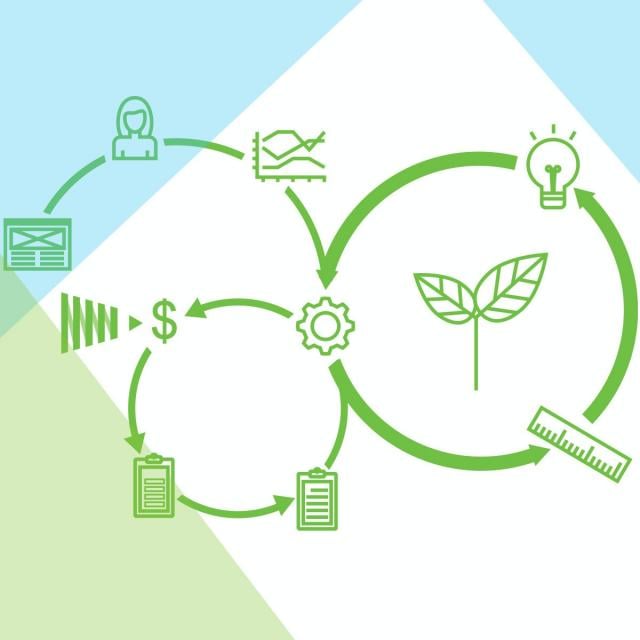
Using the Business Model Innovation (BMI) approach, you can design business models and improve them iteratively towards the most appropriate business model. In this course, you will learn about the motivation behind and relevance of BMI. You will experience a full iteration cycle, starting with the design of an initial business model baseline. Over six weeks, you will learn how to analyze specific elements of your business model, challenge the entire business model, test the key assumptions underlying your business model with customers, and finally pick the most appropriate business model from a number of alternatives – for example, to create a business case and justify an investment decision.
The course is accompanied by an end-to-end, applied example from SAP – the SAP Sports One solution – which used the BMI approach as an essential part in commercialization.
External guest speakers will stress the importance of BMI in the digital economy. In addition, key players from various key areas in SAP, like Finance & Administration, Portfolio and Pricing, and Global Innovation Center Network, will explain how they apply and elaborate BMI at SAP.
A collaborative group exercise with other course participants will help you to practice and apply what you’ve learned each week and come up with your own end-to-end BMI case.
Welcome to the course and we have fun!

Course Content

Getting Started: Course Preparation Week
Week 1: Introduction to Business Model Innovation
Week 2: Business Model Baseline
Week 3: "Analyze & Improve" your business model
Week 4: "Challenge & Change" your business model
Week 5: "Test & Verify" your business model with Minimum Viable Products (MVP)
Week 6: "Evaluate & Decide" on your business model


Go to Class
MOOC List is learner-supported. When you buy through links on our site, we may earn an affiliate commission.

Related Courses

The Impact of Digitization on Leadership and Work (openSAP) OpenSAP
SAP

The Impact of Digitization on Leadership and Work (openSAP)

The dramatic increase in network density and complexity has an immense impact on society and organizations. The changing face of consumer and employee relationships, volatile markets, and changing values and expectations make old management models redundant. Executives need to find a way out of the complexity trap. In this course, you’ll learn how digitization and increasing network density affect society, leadership, and work, and you’ll discover why individual intelligence has to be extended to collective intelligence. We’ll introduce you to a method that quantitatively and qualitatively analyzes the culture of systems, and show how this method has been implemented in large-scale studies.

Self Paced
Self-Paced
The Business Opportunities of a Digitally Transformed Economy (openSAP) OpenSAP
SAP

The Business Opportunities of a Digitally Transformed Economy (openSAP)

Join this free online course to learn how to lead your company towards a digitally transformed economy and make it more resilient, profitable, and sustainable. Since our first openSAP course on digital transformation and its impact in 2015, the world has changed even more than we could have imagined. Many businesses have already started their journey towards a digitally transformed economy, while others are just starting out. There are many catalysts of change which challenge companies to reconsider their traditional business models, and in 2020 there are even more than expected.

Self Paced
Self-Paced
Developing An Entrepreneurial Mindset: First Step Towards Success (Coursera) Coursera
Michigan State University

Developing An Entrepreneurial Mindset: First Step Towards Success (Coursera)

This course is the first in a series on starting a business. Though new venture creation is the focus of the specialization, this course is important for everyone.To create a successful business it is not only about what you do (technical execution), it is also about how you think. This course provides learners with insights to re-frame their thinking in order to maximize their chances for success. So what can a learner expect to gain from this course? At the end of this course a learner: 1.) will be able to argue effectively against all of the reasons for not starting their business (or reaching some goal); 2.) will be able to operate effectively within the new framework or model for starting a business (or any new endeavor), thus increasing their chances for success; and 3.) will be able to make the initial business startup decisions of what type of business to start, and what type of businessmowner to be.

Jun 8th 2026
3 Weeks
Building the Business Model for Corporate Entrepreneurs (Coursera) Coursera
University of Maryland, College Park

Building the Business Model for Corporate Entrepreneurs (Coursera)

Led by Dan Gordon, a University of Maryland faculty member who teaches business modeling in the National Science Foundation's I-Corps Program, this course enables you to develop and apply the Business Model Canvas tool to scope a corporate challenge or opportunity. You will learn how to identify and communicate the nine elements of a business model: Customer Segments, Value Propositions, Channels, Customer Relationships, Revenue Streams, Key Resources, Key Activities, Key Partners, and Cost Structure.

Jun 8th 2026
4 Weeks
SAP Integration Solution Advisory Methodology (openSAP) OpenSAP
SAP

SAP Integration Solution Advisory Methodology (openSAP)

Join this free online course to learn about the SAP Integration Solution Advisory Methodology (ISA-M) and how you can raise the integration maturity level of your organization. Today's organizations operate in a world that is increasingly digitalized and networked. As a result, the scope of integration is increasing as they add technologies such as software as a service (SaaS), Big Data, the Internet of Things (IoT), and artificial intelligence (AI) to their existing landscapes. However, to succeed with this transformation and become intelligent enterprises, organizations require a foundation of integrated business processes and data.

Self Paced
Self-Paced
Digital Transformation Track (openSAP) OpenSAP
SAP

Digital Transformation Track (openSAP)

Earn a Digital Transformation certificate by joining this free online curriculum. To help you focus on the digital transformation and gain the skills you need to succeed, we've put together this Digital Transformation track. You will learn about leadership in Digital Transformation, Internet of Things, Intelligent Enterprise, Blockchain, Machine Learning, and Information Security Management.

Self Paced
Self-Paced
Liquid Legal: Transforming an Industry (openSAP) OpenSAP
SAP

Liquid Legal: Transforming an Industry (openSAP)

With the technological changes driven by the digitalization, the globalization of the legal market, and the arrival of new players, the legal function needs to change. This course describes a vision of the legal industry and the key principles that support a paradigm shift from one of security towards one of opportunity. In particular, it shows opportunities for in-house legal departments of large enterprises, and discusses how they can become a strategic partner for corporate executives, clients, and stakeholders.

Self Paced
Self-Paced
Entrepreneurship (Coursera) Coursera
The Chinese University of Hong Kong

Entrepreneurship (Coursera)

An entrepreneur is someone who is always on the lookout for problems that can be turned into opportunities and finds creative ways to leverage limited resources to reach their goals. In this course, learners will be introduced to the fundamental concepts, theories, and frameworks of entrepreneurship and learn how to apply them within the context of the world's largest market: China.

Jun 8th 2026
4 Weeks
New Technologies for Business Leaders (Coursera) Coursera
Rutgers University

New Technologies for Business Leaders (Coursera)

This introductory course is developed for high-level business people (and those on their way) who want a broad understanding of new Information Technologies and understand their potential for business functions (e.g. marketing, supply change management, finance). This is not a course for people looking for guidance on how to become a deep technical expert or implement these technologies.

Jun 8th 2026
5-12 Weeks