Arctic Change & the Nexus of Governance, Economics & Culture (Coursera)

Arctic Change & the Nexus of Governance, Economics & Culture (Coursera)

In this course, you will learn how the changing Arctic environment is tied to the growing economic and strategic importance of the North. After setting the stage through a review of the peoples of the Arctic and how they are dealing with change, Arctic governance, economies national defense, attention turns to marine use of the Arctic, oil and gas exploration, mining, fisheries and tourism.

Class Deals by MOOC List - Click here and see Coursera's Active Discounts, Deals, and Promo Codes.

The course ends with a survey of recent Arctic events.
Learning Objectives: Articulate the drivers of the growing economic and strategic importance of the Arctic in the context of the environmental changes unfolding in the region, governance, and geopolitics. Identify the impacts of the changing Arctic, both positive and negative, on the peoples of the North.
Course 3 of 3 in the Arctic Climate, Environ. & Geographies of a Changing North Specialization

Syllabus

WEEK 1
Arctic Peoples, Governance, Economics and Geopolitics
In this module, we'll take a closer look at the peoples of the Arctic - the Arctic as a homeland - and then turn attention to the role of the Arctic Council of the eight Arctic nations. After a foray into Arctic demographics, we'll briefly look at some of the big economic drivers in the Arctic (setting a stage for later more focused discussion in subsequent modules) and how the changing Arctic is playing into national defense.

WEEK 2
Marine Use of the Arctic
Here we will learn how the loss of sea ice is opening up the Arctic Ocean to increased marine use and the many issues that have arisen. To set a framework, we will first become familiar with marine use limits in the Arctic Ocean as set by the United Nations Convention Law of the Sea. Then we will explore use of the Northern Sea Route along the Russian Side of the Arctic Ocean, the Northwest Passage through the channels of the Canadian Arctic Archipelago, and the the issues that may play into how heavily these shortcuts between the Atlantic and the Pacific may be used. Finally, we will look at the International Polar Code, which sets requirements for ships operating in polar waters.

WEEK 3
Arctic Riches: Oil and Gas
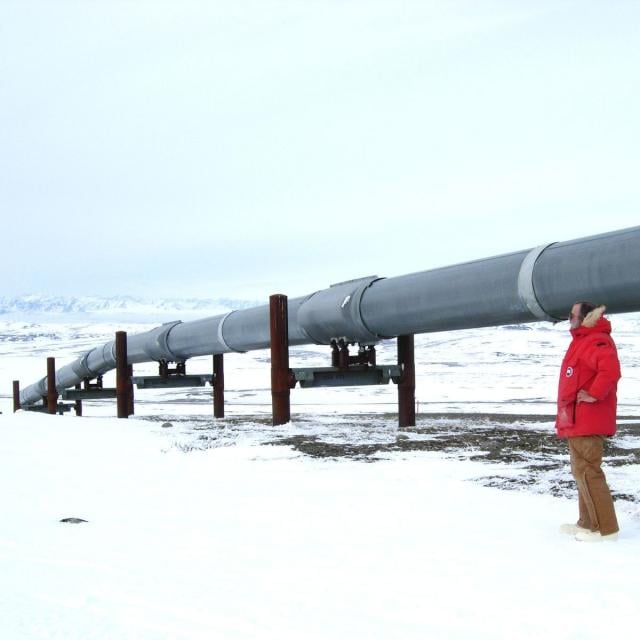
Large areas of the Arctic are underlain by significant deposits of oil and natural gas. In this module, we will look at exploration and production activities by Russia, which are occurring all along its shelf seas and over many land areas, the United States along the North Slope of Alaska, the Beaufort and Chukchi Seas, Norway, where all production is offshore, as well as prospects for Arctic development by Canada and Norway.

WEEK 4
Beyond Oil and Gas
In this module, we'll first look at another big sector of the Arctic's economy - mining - using examples such as Nornickel in Russia, the Red Dog Mine and gold mining in Alaska, diamond mining in Canada, and coal mining in Svalbard. Attention then turns to commercial and sport fishing, and the growing tourist industry. Finally, we'll take a look at some recently emerging events in the Arctic.
Go to Class
MOOC List is learner-supported. When you buy through links on our site, we may earn an affiliate commission.

Related Courses

Global sustainability and corporate social responsibility: Be sustainable (Coursera) Coursera
Macquarie University

Global sustainability and corporate social responsibility: Be sustainable (Coursera)

It is no longer acceptable for organisations to focus entirely on financial success if they are to be competitive on the global stage. As corporate scandals continue to make headlines, you will expand your strategic thinking beyond your organisation’s competitive financial environment to consider its broader impact on society. You will grapple with the conflicting outcomes of maximising financial return and societal impact as you develop the skills to create a balance that is sustainable.

Jun 8th 2026
5-12 Weeks
Firm Level Economics: Markets and Allocations (Coursera) Coursera
University of Illinois at Urbana-Champaign

Firm Level Economics: Markets and Allocations (Coursera)

In this class, we will derive equilibrium outcomes across a variety of market structures. We will begin by understanding equilibrium under a market structure called Perfect Competition, a benchmark construction. Economists have tools to measure the efficiency of market outcomes. We next consider the polar extreme of a competitive market: a monopoly market. We will determine the monopoly equilibrium price and quantity and efficiency properties. Much economic activity takes place in markets with just a handful of very large producers.

Jun 8th 2026
4 Weeks
Game Theory (Coursera) Coursera
Stanford University,The University of British Columbia

Game Theory (Coursera)

Popularized by movies such as "A Beautiful Mind," game theory is the mathematical modeling of strategic interaction among rational (and irrational) agents. Beyond what we call `games' in common language, such as chess, poker, soccer, etc., it includes the modeling of conflict among nations, political campaigns, competition among firms, and trading behavior in markets such as the NYSE.

Jun 8th 2026
5-12 Weeks
Water Resources Management and Policy (Coursera) Coursera
University of Geneva

Water Resources Management and Policy (Coursera)

Water management today is faced with new challenges such as climate change or the effects of human activity. Public and private stakeholders who are active in this field must develop new ways to better manage the water cycle "as a whole". The objective of this MOOC is to develop an understanding of the problems related to water management. Firstly, this course will define a resource and, more specifically, the resource of water.

Jun 8th 2026
5-12 Weeks
The Sustainable Development Goals – A global, transdisciplinary vision for the future (Coursera) Coursera
University of Copenhagen

The Sustainable Development Goals – A global, transdisciplinary vision for the future (Coursera)

In 2015, the UN launched the 17 Sustainable Development Goals (SDGs). Adopted by 193 member states, the goals represent an important international step in setting humanity on a trajectory towards sustainable development. Within this course, you will get a historical overview of how sustainability has been understood, as well as a thorough introduction to the SDGs – what they are, how progress can be measured, and how the SDGs are relevant for the management of the global systems supporting humanity. The course will examine how various societal actors are responding to and implementing the SDGs.

Jun 8th 2026
3 Weeks
Global Environmental Management (Coursera) Coursera
Technical University of Denmark - DTU

Global Environmental Management (Coursera)

Learn about the best environmental technologies for a sustainable development and how they are managed in various settings around the world. This course gives you an opportunity to learn about global trends that influence our environment and the living conditions and how different management systems and approaches that are used around the world to manage the environment. This includes current environmental technologies built for the environment and technologies for sustainable soil management, groundwater protection methods and integrated Water resources management.

Jun 8th 2026
5-12 Weeks
實驗經濟學 (Experimental Economics: Behavioral Game Theory) (Coursera) Coursera
National Taiwan University

實驗經濟學 (Experimental Economics: Behavioral Game Theory) (Coursera)

人是否會如同理論經濟學的預測進行決策?這門課將透過每週的課程影片以及課後作業帶你了解實驗經濟學的基本概念。每週將會有習題練習以及指定閱讀的期刊論文。你將會參與一些線上的實驗、報告論文並且互評其他同學的報告。

Jun 10th 2026
5-12 Weeks
Inequality and Democracy (Coursera) Coursera
Universiteit Utrecht

Inequality and Democracy (Coursera)

Most countries are getting more and more unequal. But the core of democracy is political equality: that everyone should have an equal say in how their country is run. Can we really expect these things to go together? Can people have equal political power while economic inequality grows and grows? Take this course and decide for yourself.

Jun 8th 2026
5-12 Weeks
Agriculture, Economics and Nature (Coursera) Coursera
University of Western Australia

Agriculture, Economics and Nature (Coursera)

Sound economic thinking is crucial for farmers because they depend on good economic decision making to survive. Governments depend on economic information to make good policy decisions on behalf of the community. This course will help you to contribute to better decision making by farmers, or by agencies servicing agriculture, and it will help you to understand why farmers respond to policies and economic opportunities in the ways they do.

Jun 8th 2026
5-12 Weeks
Sharing Cities: Governance and Urban Sustainability (Coursera) Coursera
Lund University

Sharing Cities: Governance and Urban Sustainability (Coursera)

How can we govern the sharing economy in our cities? This course connects the sharing economy, cities, governance and urban sustainability to provide unique knowledge and insights into sharing cities. We utilize a diversity of leading examples of the emerging sharing economy in cities to bring this course to life. The sharing economy can contribute to social, environmental and economic sustainability, and sharing cities can unlock new opportunities and solve urban challenges by facilitating and applying the sharing economy in urban contexts. But it is imperative that the sharing economy is shaped and designed to advance urban sustainability.

Jun 8th 2026
5-12 Weeks
The Economics of Agro-Food Value Chains (Coursera) Coursera
Technische Universität München - TUM

The Economics of Agro-Food Value Chains (Coursera)

In this course, you learn how the agro-food value chain approaches the challenge of constantly improving its competitiveness by producing high quality food and products and also aiming to attain greater sustainability. Some of the topics of this course are: the notion of quality for food and agricultural products and consumer value; how to conduct market research in this field; labelling, branding and pricing strategies, as-well as innovation in the agro-food sector; how sustainability can be used as a competitive advantage through corporate social responsibility: the role and different types of industrial standards; the different forms of coordination in the chain, in particular with regard to the retailing and distribution sector.

Jun 10th 2026
5-12 Weeks