Applied Computational Fluid Dynamics (Coursera)

Offered by Siemens,
Applied Computational Fluid Dynamics (Coursera)

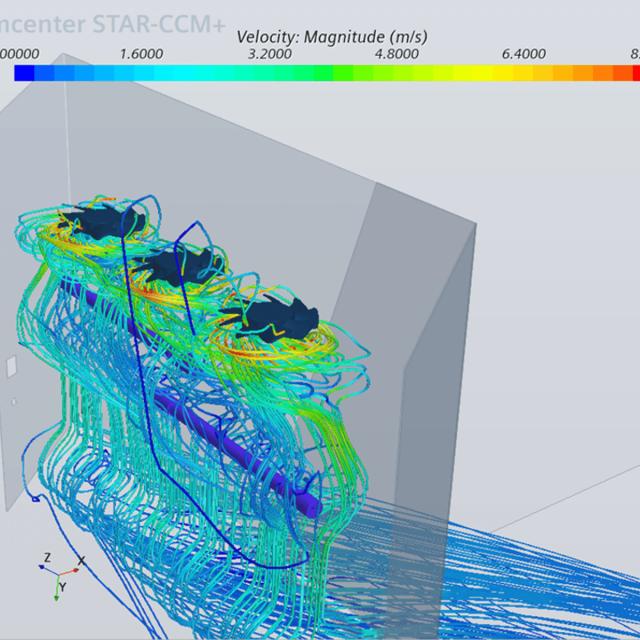
If you’re reading this, you’re likely interested in exploring applied computational fluid dynamics (CFD) using the Simcenter STAR-CCM+ software or another CFD tool. This course can be a first step in improving your job performance and furthering your career or educational trajectory.

Class Deals by MOOC List - Click here and see Coursera's Active Discounts, Deals, and Promo Codes.

We’ve created this course to help you use the knowledge of flow physics and computational fluid dynamics to obtain quality solutions of flow and heat transfer problems most efficiently. This course is not about instructions on how to use a particular software. Simcenter STAR-CCM+ was used exclusively for all simulations presented in this course. Still, the learning outcomes would be the same if another public or commercial software were used, as long as it has the same capabilities.

Syllabus

WEEK 1
Introduction to Applied Computational Fluid Dynamics
In Week 1, we'll explore flow in a channel with a semi-circular obstacle on the bottom wall is used to introduce the basic flow models (Euler, Navier-Stokes, and Reynolds-averaged Navier-Stokes equations), the basic features of most flows in engineering applications (boundary layer, shear layer, flow separation, recirculation zone), and the approaches to simulate flows including these phenomena. The distinction between inviscid, laminar, and turbulent flows is explained, as well as how the flow features can be visualized and analyzed and how the knowledge of the flow regime affects the design of the computational grid and the choice of physics models and simulation parameters. Finally, the ways of increasing the efficiency of simulation and the estimation of discretization errors are presented.

WEEK 2
Flows in Diffusors and Nozzles
In Week 2, we'll explore flows in diffusors and nozzles are studied. They are generic representations of diverging or converging cross-sections of flow paths found in many engineering applications. In both diffusors and nozzles flow separation and recirculations occurs if diverging/converging angles are high enough. In symmetric diffusor geometries the flow is often asymmetric, and in nozzles vena contracta may occur. These phenomena and the evaluation of efficiency of energy conversion as well as the energy losses are explained. The effects of geometrical details (variation of expansion/contraction angle, rounding of corners by different radii) and suction through diffusor walls are also analyzed. Detailed studies of grid-dependence of solutions are performed and the effect of the order of discretization for convection fluxes is analyzed.

WEEK 3
Secondary and Vortex Flows
In Week 3, we'll explore pressure or turbulence induced flow in directions other than the primary flow path are studied. First three-dimensional pressure-driven secondary flows in duct or pipe bends are analyzed in detail, followed by the analysis of turbulence-driven secondary flow in ducts with non-circular cross-sections. The physics behind these phenomena is described and the ways of simulating them are explained. Next, horseshoe vortex and tip vortex flows are analyzed; they too are generic representations of flows resulting in many practical applications with body junctions and free tips. The flow physics, computational details (design of an optimal grid and its local refinement, the choice of physics models and the simulation approach) are explained.

WEEK 4
Flows Around a Circular Cylinder
In Week 4, we'll explore flows around a circular cylinder at Reynolds numbers between 5 and 5 million are studied. Circular cylinder is a generic representation of a slender body exposed to a cross-flow; such situations are found in many practical applications. Depending on the Reynolds number, the flow may be creeping, steady or unsteady laminar, or turbulent. The flow separation and recirculation can have many different forms, leading to vortex shedding (the von Karman vortex street), transition to turbulence in the wake, in shear layers, or in boundary layers on cylinder surface. Both the drag crises on a cylinder at the critical Reynolds number and the Magnus effect on a rotating cylinder are described. Different techniques of simulating turbulent flows - direct numerical simulation, large-eddy simulation or solution of the Reynolds-averaged Navier-Stokes equations using different turbulence models are presented and it is explained which technique is appropriate for which type of flow.

WEEK 5
Flows with Heat Transfer
In Week 5, we'll explore heat transfer, including conduction in solids, natural and forced convection in fluids, and conjugate heat transfer. I’ll explain how the heat is transferred between continua at the solid-fluid interface, what is different in laminar and turbulent flows, which properties of a computational grid are desirable at the fluid-solid interface, and why are prism layers at walls important. The difference between stable and unstable stratification in natural convection flows and the importance of accounting for the correct dependence of fluid properties on temperature are emphasized. Finally, it is explained how to optimally simulate simultaneous heat transfer across multiple flow streams separated by solid bodies.

Go to Class
MOOC List is learner-supported. When you buy through links on our site, we may earn an affiliate commission.

Related Courses

Mécanique Lagrangienne (Coursera) Coursera
École Polytechnique Fédérale de Lausanne

Mécanique Lagrangienne (Coursera)

Le formalisme de Lagrange permet une résolution efficace de problèmes complexes de mécanique. Il permet aussi d'apporter un éclairage plus fondamental sur les lois de conservation (théorème de Noether). A titre d'illustration de la méthode de Lagrange, on traitera le problème très important des oscillateurs harmoniques couplés, exprimé comme un problème de valeurs propres et de vecteurs propres. On termine avec un formalisme permettant d'analyser les résonances paramétriques, notion illustrée par l'expérience montrant la stabilité d'un pendule inversé forcé.

Oct 5th 2026
5-12 Weeks
Applications in Engineering Mechanics (Coursera) Coursera
Georgia Institute of Technology

Applications in Engineering Mechanics (Coursera)

This course applies principles learned in my course “Introduction to Engineering Mechanics” to analyze real world engineering structures. You will need to have mastered the engineering fundamentals from that class in order to be successful in this course offering. This course addresses the modeling and analysis of static equilibrium problems with an emphasis on real world engineering systems and problem solving.

Oct 5th 2026
5-12 Weeks
Advanced Fluid Mechanics 3: Potential Flows & Boundary Layers (edX) EdX
MIT,MITx

Advanced Fluid Mechanics 3: Potential Flows & Boundary Layers (edX)

Learn to analyze the structure of high Reynolds number inviscid flows using potential flow theory, the roles of vorticity generation in viscous boundary layers, circulation and lift, flow separation, and transition to turbulence. A separate final short module briefly introduces the role of surface tension in engineering fluid mechanics. This course features lecture and demo videos, lecture concept checks, practice problems, and extensive problem sets.

Self Paced
Self-Paced
Fundamentals of particle accelerator technology (NPAP MOOC) (Coursera) Coursera
Lund University

Fundamentals of particle accelerator technology (NPAP MOOC) (Coursera)

Did you know that particle accelerators play an important role in many functions of todays society and that there are over 30 000 accelerators in operation worldwide? A few examples are accelerators for radiotherapy which are the largest application of accelerators, altogether with more than 11000 accelerators worldwide. These accelerators range from very compact electron linear accelerators with a length of only about 1 m to large carbon ion synchrotrons with a circumference of more than 50 m and a huge rotating carbon ion gantry with a weight of 600 tons!

Oct 5th 2026
5-12 Weeks
Engineering Systems in Motion: Dynamics of Particles and Bodies in 2D Motion (Coursera) Coursera
Georgia Institute of Technology

Engineering Systems in Motion: Dynamics of Particles and Bodies in 2D Motion (Coursera)

This course is an introduction to the study of bodies in motion as applied to engineering systems and structures. We will study the dynamics of particle motion and bodies in rigid planar (2D) motion. This will consist of both the kinematics and kinetics of motion. Kinematics deals with the geometrical aspects of motion describing position, velocity, and acceleration, all as a function of time. Kinetics is the study of forces acting on these bodies and how it affects their motion.

Oct 5th 2026
5-12 Weeks
Mastering bitumen for better roads and innovative applications (Coursera) Coursera
École des Ponts ParisTech

Mastering bitumen for better roads and innovative applications (Coursera)

During the four coming weeks, best experts in bitumen will bring you their knowledge and experience to build a strong understanding of today’s realities and new perspectives on the future of bitumen. Total is the European leader on bitumen markets. Innovation has always been the key to sustainability and durability in the products they develop. Their main objective here is to share technical knowledge and experience to insure bitumen are being used in the most effective and efficient ways for their different applications in road works.

Oct 5th 2026
4 Weeks
Municipal Solid Waste Management in Developing Countries (Coursera) Coursera
École Polytechnique Fédérale de Lausanne

Municipal Solid Waste Management in Developing Countries (Coursera)

Have you come across large piles of garbage in neighborhoods and streets, or smelly waste disposal sites polluting the environment of low and middle income countries? Are you also convinced that improvements are necessary and do you want to know what kind of sustainable solutions are appropriate to better manage waste and enhance recycling and recovery? If yes, this course is for you!

Oct 5th 2026
5-12 Weeks
Mécanique du point matériel (Coursera) Coursera
École Polytechnique Fédérale de Lausanne

Mécanique du point matériel (Coursera)

Pour illustrer les concepts introduits dans la première partie, on traite ici des problèmes pour lesquels le système mécanique peut être considéré comme un point matériel. Cette partie couvre notamment les problèmes à traiter en coordonnées cylindriques ou sphériques, le problème des orbites des planètes et les référentiels accélérés.

Oct 5th 2026
5-12 Weeks
Fundamentals of Engineering Exam Review (Coursera) Coursera
Georgia Institute of Technology

Fundamentals of Engineering Exam Review (Coursera)

The purpose of this course is to review the material covered in the Fundamentals of Engineering (FE) exam to enable the student to pass it. It will be presented in modules corresponding to the FE topics, particularly those in Civil and Mechanical Engineering. Each module will review main concepts, illustrate them with examples, and provide extensive practice problems.

Oct 5th 2026
5-12 Weeks
Material Behavior (Coursera) Coursera
Georgia Institute of Technology

Material Behavior (Coursera)

Have you ever wondered why ceramics are hard and brittle while metals tend to be ductile? Why some materials conduct heat or electricity while others are insulators? Why adding just a small amount of carbon to iron results in an alloy that is so much stronger than the base metal? In this course, you will learn how a material’s properties are determined by the microstructure of the material, which is in turn determined by composition and the processing that the material has undergone.

Oct 5th 2026
5-12 Weeks
Introduction to Acoustics (Part 2) (Coursera) Coursera
Korea Advanced Institute of Science and Technology - KAIST

Introduction to Acoustics (Part 2) (Coursera)

Learners might have learned the basic concepts of the acoustics from the ‘Introduction to Acoustics (Part 1).’ Now it is time to apply to the real situation and develop their own acoustical application. Learners will analyze the radiation, scattering, and diffraction phenomenon with the Kirchhoff –Helmholtz Equation. Then learners will design their own reverberation room or ducts that fulfill the condition they have set up.

Oct 5th 2026
5-12 Weeks
Introduction to Basic Vibrations (Coursera) Coursera
Korea Advanced Institute of Science and Technology - KAIST

Introduction to Basic Vibrations (Coursera)

Introduction to Basic Vibrations starts with the fundamental principle of vibrations with a single and double degree of freedom systems. These fundamental vibration systems provide a solid platform not only to understand general vibrations but also to apply or use them into simple mechanical problems.

Oct 5th 2026
5-12 Weeks