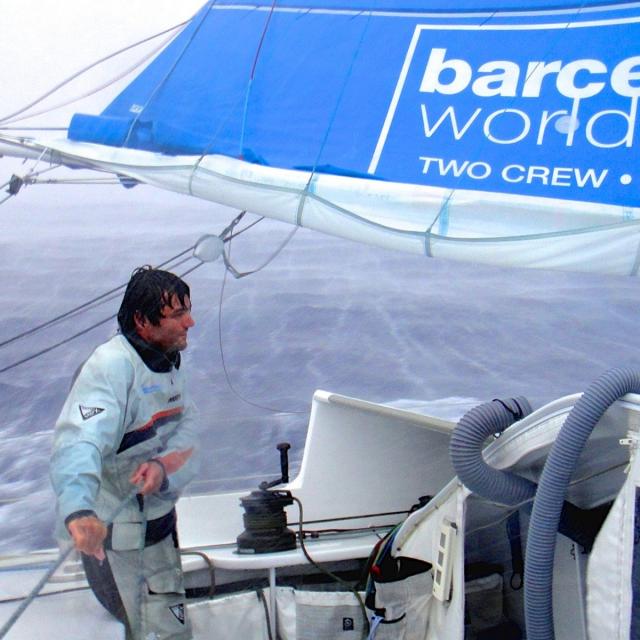
In this course you can learn about the mechanics of global weather, the foundations of ocean meteorology, predictive modeling and how sailors receive data via satellite and use high-performance navigation software.
Class Deals by MOOC List - Click here and see Coursera's Active Discounts, Deals, and Promo Codes.
This course looks at oceanic meteorology and climatology through the lens of the sport of sailing.
You will gain a basic knowledge of meteorology needed by sailors to take part in a regatta such as the Barcelona World Race, the only double-handed, round the world regatta with no stops.
You will learn about the strategies employed during a round the world regatta and how these are put to use on board the latest ocean racing yachts.
Syllabus
WEEK 1
Understanding maritime meteorology
In this module you will learn the foundations for an understanding of general and in particular maritime meteorology. What are the factors and engines powering the weather? What do we need to know to understand the weather phenomena we experience every day? What do ocean sailors need to know to predict the weather? Instructors: Tomàs Molina, Santi Serrat .
WEEK 2
Meteorological predictions
In this module you will learn: How meteorological predictions are made. What numerical weather models and equations look like. This will be explained by Tomàs Molina in Module 2.1 You will look at the forecasting structures that help us to interpret the information given by the models: Advection, troughs, ridges, barometric swamps and low pressure systems. These will be explained by Tomàs Molina in Module 2.2 What the basic prediction models used by sailors are. This will be explained by Marcel van Triest in Module 2.3 Remember you can access to the help forum
. If you are experiencing difficulty learning or accessing course content, or if you simply want more information.
WEEK 3
The sailor as meteorologist
In this module you will learn how sailors use meteorology to sail around the world and to win round the world regattas. All of their interest is focussed on the wind and they need theoretical, but above all practical, knowledge to help them to take the correct decisions at sea. Remember you can access to the help forum. If you are experiencing difficulty learning or accessing course content, or if you simply want more information.
WEEK 4
Ocean regattas and meteorology
The science of meteorology is a fundamental part of any type of ocean navigation. In the case of yacht racing, it's importance is even greater, given that the wind is the force propelling the boat and is the key factor in formulating the strategy and tactics needed to win. However, the lead role of meteorology in a regatta is for safety, and that is something that the race organisers always make a priority. In Module 4.1 the general climatology for a regatta such as the Barcelona World Race is described, as well as the preparations the skippers make with the sails, the boat and other personal kit. In Module 4.2 you will learn how the Race Management of a regatta work together with the meteorologist to ensure that the information reaches the boats and to guarantee the maximum safety levels for the crews. In Module 4.3 the type of information the crews receive whilst out on the oceans is described, as well as the telecommunications systems used to make this happen. In Module 4.4 you will learn how weather information impacts on safety and you will look at the specific case of ice detection in the Southern Ocean.
WEEK 5
Climatology and meteorology in the Barcelona World Race: From the Mediterranean Sea to the Indian Ocean
We begin now by going over the Barcelona World Race round the world route. In Module 5 you will learn about general and specific strategies for sailing from Barcelona to the Indian Ocean.
WEEK 6
Climatology and meteorology in the Barcelona World Race: From the Indian Ocean to Gibraltar
In this module we are going to study the meteorology and strategy for the seas of the south of the planet. Down in the Southern Ocean is where the sailors go up against the toughest sailing conditions in the regatta and where they must also abide by safety restrictions due to the danger of floating ice. On the following pages, Marcel van Triest will analyse general strategy and also look at case studies from the Barcelona World Race 2010/11. In that edition, ice gates were used to restrict the fleet's descent south and to avoid boats heading into danger zones. For the 2014/15 edition, however, ice gates have been substituted by a “restriction zone”, a polygon with some 72 sides surrounding the Antarctic. In this video Marcel explains the general context of the passage through the Southern Ocean and reviews the routes taken in the 2010/11 edition of the race. They key difference in this edition is that the regatta does not take the boats through Cook Strait (New Zealand).