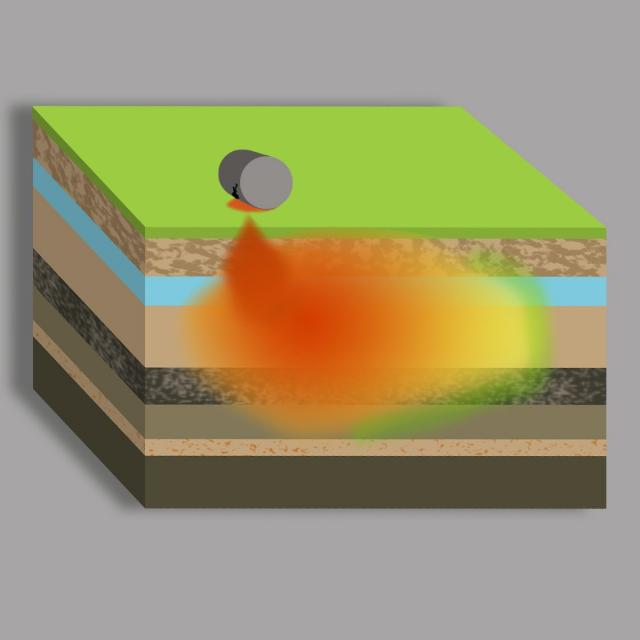
Cleaning up the large number of groundwater contamination sites is a significant and complex environmental challenge. The environmental industry is continuously looking for remediation methods that are both effective and cost-efficient. Over the past 10 years there have been amazing, important developments in our understanding of key attenuation processes and technologies for evaluating natural attenuation processes, and a changing institutional perspective on when and where Monitored Natural Attenuation (MNA) may be applied.
Class Deals by MOOC List - Click here and see Coursera's Active Discounts, Deals, and Promo Codes.
Despite these advances, restoring groundwater contaminated by anthropogenic sources to allow for unrestricted use continues to be a challenge. Because of a complex mix of physical, chemical, and biological constraints associated with active in-situ cleanup technologies, there has been a long standing focus on understanding natural processes that attenuate groundwater contaminant plumes.
We will build upon basic environmental science and environmental engineering principles to discover how to best implement MNA as a viable treatment for groundwater contamination plumes. Additionally we will delve into the history behind and make predictions about the new directions for this technology.
Any professional working in the environmental remediation industry will benefit from this in-depth study of MNA. We will use lectures, readings, and computational exercises to enhance our understanding and implementation of MNA. At the completion of this course, students will have updated understanding and practical tools that can be applied to all possible MNA sites.
Syllabus
WEEK 1
Course Overview and MNA as an Evolving Technology
Welcome to the course! In the Course Overview section, you will find general information about the course as well as instructions on how to navigate the course. In the lectures for this week, we will start with history. We look at a general brief history of groundwater remediation, and then a specific history of MNA featuring a list of the key protocols from 1994 to 2015. Special topics include active remediation vs. MNA, and Neat New MNA Technologies, and how degradation, storage, and dilution are all part of the MNA story.
WEEK 2
Biodegradation Principles
In this series of lectures, we will learn when biodegradation can or cannot occur and what conditions are conducive to faster degradation.
WEEK 3
Abiotic Degradation Principles
In this series of lectures, we will focus on the principles of abiotic degradation and discuss how these processes support monitored natural attenuation. You will be learning about the key reactions and minerals that are involved in abiotic degradation. We will also be covering what methods are used to determine if abiotic degradation is relevant at a particular site, and the rates at which these reactions may be occurring
WEEK 4
Attenuation and Storage in Low K Zones
In these lectures, we will focus on the idea that storage of contaminants in geologic media as a potential natural attenuation mechanism. Under this scenario, certain contaminants diffuse in low permeability media such as silt, clay, and limestone and then eventually reenter the aquifer by a process called back diffusion. Like sorption, this process is not destructive, but attenuates a contaminant plume by sequestering some of the initial loading and then slowly releases it over long time scales. You will learn about diffusion vs. dispersion, see case studies in the lab and field, learn how to sample and model this process, and hear the latest research about degradation processes associated with matrix diffusion.
WEEK 5
Dilution as an Attenuation Process - Sometimes
In this series of lectures, we will discuss how dilution is an attenuation process – sometimes. We start with the basics, and review groundwater flow and one of the “top ten things” that every hydrogeologist should know: the distinction between Darcy Velocity and Seepage Velocity. Next we give some examples of regulatory programs where dilution is considered an acceptable attenuation process. Then we present how dispersion and mixing in wells are dilution-related processes. Finally we show how the emerging field of mass flux/ mass discharge can be used to see if a contaminant plume is strong enough to impact water supply wells and/or streams, and to see where your plume ranks in the “Plume Magnitude Classification System.”
WEEK 6
Better Technologies: Compound Specific Isotopes & Molecular Biological Tools
In this series of lectures, we will focus on several established and emerging methods for demonstrating that biological and other attenuation processes are occurring. We will start with an overview on lines of evidence for biological degradation processes, and then transition to newer molecular methods for identifying and quantifying biodegradation potential for a variety of compounds. Several of this week’s lectures also examine compound-specific isotope analysis, which has been emerging as a key resource for MNA studies. You will learn how stable isotope analyses can provide critical information on whether attenuation is occurring, the rate at which it is occurring, and even the pathway that is responsible.
WEEK 7
Monitoring for MNA
In this series of lectures, we will discuss how you should perform the monitoring that is such an important part of monitored natural attenuation (after all, it’s right there in the title!). We start off with a discussion of how data are collected, including using newer high-resolution techniques, to help build a proper conceptual site model and support the selection of MNA as a remedy. Then we touch on how to design a long-term monitoring program to assess the performance of MNA. Methods for analyzing concentration trends and graphically presenting MNA data are also presented, along with a discussion of the potential sources of variability in monitoring data.
WEEK 8
Modeling Tools to Support MNA
In this series of lectures, we talk about models and how they can be used to understand MNA. We first start with two key MNA questions: How Long? (will the plume get) and How Far? (how long until the site is clean). Then a review of analytical computer models, remediation timeframe models, the more complex but more powerful numerical models, and even a discussion of the “Fourth Paradigm: Big Data”.
WEEK 9
New Directions for MNA
This final series of lectures will cover a mélange of interesting MNA topicsl We start with the brand new ESTCP BIOPIC tool, then talk about the broad universe of MNA that extends to a lot of different contaminant classes. Then some new developments in the LNAPL world: Natural Source Zone Depletion, both with conventional methods and a new method based on thermal monitoring. Then we talk a little bit about low threat closures and transition assessments, and end up with a brief conversation with the three instructors. And then you are done!