EdX

Plasma Physics: Applications (edX)

Plasma Physics: Applications (edX)

Learn about plasma applications from nuclear fusion powering the sun, to making integrated circuits, to generating electricity. This physics course, taught by world-renowned experts in the field, will provide you with an overview of applications in plasma physics. From the study of far distant astrophysical objects over diverse applications in industry, to the ultimate goal of sustainable electricity generation from nuclear fusion.

Class Deals by MOOC List - Click here and see EdX's Active Discounts, Deals, and Promo Codes.

In the first part of this course, you will learn how nuclear fusion powers our Sun and the stars in the Universe. You will explore the cyclic variation of the Sun’s activity, how plasma flows can generate large-scale magnetic fields, and how these fields can reconnect to release large amounts of energy, manifested for instance by violent eruptions on the Sun.
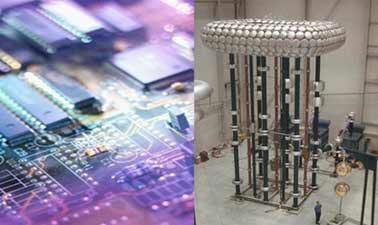
The second part of this course discusses the key role plasma applications play today in industry and medicine. After a brief survey of the field, you will study in detail how plasmas are generated and sustained in strong electric fields and how this knowledge can be used to avoid undesired occurrence of plasmas in the form of electrical arcs. You will then, in detail, study the transition region between plasma and material surface, called the sheath, and you will learn why its properties are indispensable for the manufacturing of today’s integrated circuits.
Finally, in the third and most extensive part of this course, you will familiarize yourself with the different approaches to fusion energy, the current status, and the necessary steps from present-day experimental devices towards a fusion reactor providing electricity to the grid.
After deriving the general conditions for net energy gain from fusion, we will focus on magnetic confinement fusion. You will learn about the key ingredients of a magnetic fusion reactor, how to confine, heat, and control fusion plasmas at temperatures of 100 million degrees Kelvin, explore the relevant transport mechanisms, and explore the challenges of plasma wall interactions and structural materials.
To enjoy this course on plasma applications, it is recommended to first familiarize yourself with the plasma physics basics taught in Plasma Physics: Introduction.
What you'll learn:

  • Different applications of plasmas
  • Understanding of the fusion energy challenge, and acquisition of the basis for developing an overall vision of the different R&D elements
  • Understanding of the main plasma societal applications and relevant tools
  • Vision and appreciation of the importance of plasmas in space and astrophysics
  • By solving problems in course content, you will acquire some basic knowledge of MATLAB programming
Go to Class
MOOC List is learner-supported. When you buy through links on our site, we may earn an affiliate commission.

Related Courses

Circular Economy: An Introduction (edX) EdX
Delft University of Technology,DelftX

Circular Economy: An Introduction (edX)

Ready to make a difference? Learn how to contribute to a sustainable economic system by implementing novel business and design approaches! Our global society is not sustainable. We all know about the challenges we’re facing: waste, climate change, resource scarcity, loss of biodiversity. At the same time, we want to sustain our economies and offer opportunities for a growing world population. This course is about providing solutions we really believe in: a Circular Economy.

Self Paced
Self-Paced
Quantum Mechanics of Molecular Structures (edX) EdX
The University of Tokyo,UTokyoX

Quantum Mechanics of Molecular Structures (edX)

Learn two methods used to determine molecular structures and their properties in this introduction to Quantum Mechanics. Knowing the geometrical structure of the molecules around us is one of the most important and fundamental issues in the field of chemistry. This course introduces the two primary methods used to determine the geometrical structure of molecules: molecular spectroscopy and gas electron diffraction.

Self Paced
Self-Paced
Electronique I (edX) EdX
École Polytechnique Fédérale de Lausanne,EPFLx

Electronique I (edX)

Introduction à l’électronique analogique- première partie. Fonctions de base réalisées à l’aide des amplificateurs opérationnels. Ce cours est un cours d’introduction à la réalisation des fonctions linéaires et non-linéaires de base à l’aide de l’amplificateur opérationnel.


Self Paced
Self-Paced
Manufacturing Process Control I (edX) EdX
MIT,MITx

Manufacturing Process Control I (edX)

Learn how to model variations in manufacturing processes and develop methods to reduce and control deterministic variations to achieve consistent process quality. Randomness is inherent in all processes including manufacturing. The fundamental concepts taught in this course will help learners develop powerful statistical process control methods that are the foundation of world-class manufacturing quality.

Aug 18th 2026
5-12 Weeks
Product Design: The Delft Design Approach (edX) EdX
Delft University of Technology,DelftX

Product Design: The Delft Design Approach (edX)

Learn to design meaningful products and services in this challenging design course. Do you want to learn how to design? Using the Delft Design Approach, you will learn how to use a number of key design methods to create meaningful products and services. This course is an introduction to the Delft Design Approach offering a set of signature methods from Delft to teach you how to get from understanding the user in context to defining a meaningful design challenge and – in the end – deliver a great design!

Self Paced
Self-Paced
Water and Wastewater Treatment Engineering: Physicochemical Technology (edX) EdX
Tsinghua University,TsinghuaX

Water and Wastewater Treatment Engineering: Physicochemical Technology (edX)

Learn the basic principles and characteristics of physicochemical technology in water and wastewater treatment engineering. This course mainly talks about the basic principles, process composition, operation characteristics, process calculation methods and some engineering examples of the main physicochemical treatment methods in water and wastewater treatment.

Self Paced
Self-Paced
The Engineering of Structures Around Us (edX) EdX
DartmouthX,Dartmouth College

The Engineering of Structures Around Us (edX)

Explore how engineers design bridges and buildings in our communities and iconic structures around the world. In this introductory course, you’ll learn some engineering principles that can be applied to structural systems everywhere: in nature, in furniture, in mechanical and aerospace systems, and in any solid object that resists a load. Together we’ll explore how structures work, why they were designed the way they were designed, how they support loads, and where forces flow through them.

Self Paced
Self-Paced
Fundamentos de Comunicaciones Ópticas (edX) EdX
Universitat Politècnica de València,UPValenciaX

Fundamentos de Comunicaciones Ópticas (edX)

Se tratan conceptos básicos de las comunicaciones ópticas como el guiado, los modos, la atenuación o la dispersión y el diseño de sistemas. Este curso está destinado a estudiantes universitarios de la rama de las Tecnologías de la Información y las Comunicaciones que quieran conocer los mecanismos fundamentales de las comunicaciones por fibra óptica.

Self Paced
Self-Paced
Science & Cooking: From Haute Cuisine to Soft Matter Science (chemistry) (edX) EdX
HarvardX,Harvard University

Science & Cooking: From Haute Cuisine to Soft Matter Science (chemistry) (edX)

Top chefs and Harvard researchers explore how everyday cooking and haute cuisine can illuminate basic principles in chemistry, physics, and engineering. Learn about food molecules and how chemical reactions can affect food texture and flavor. During each module of this course, chefs reveal the secrets behind some of their most famous culinary creations — often right in their own restaurants. Inspired by such cooking mastery, the Harvard team will then explain the science behind the recipe.

Self Paced
Self-Paced
Electrotechnique II (edX) EdX
École Polytechnique Fédérale de Lausanne,EPFLx

Electrotechnique II (edX)

Découvrez les systèmes alternatifs triphasés et leurs charges associées ainsi que les régimes transitoires, base des alimentations à découpage. Ce cours traite des systèmes alternatifs triphasés, piliers de l'alimentation électrique industrielle et de certains types de machines électriques. Les charges triphasées associées, symétriques ou dissymétriques, seront étudiées ainsi que les puissances actives, réactives et apparentes qui en découlent. Des méthodes de compensation de la puissance réactive seront développées.

Self Paced
Self-Paced
On-Ramp to AP* Physics C: Mechanics (edX) EdX
Weston High School

On-Ramp to AP* Physics C: Mechanics (edX)

This course will help the students who have taken intro-level high-school physics to get ready for more advanced courses including AP Physics C: Mechanics. This short course is intended for the high-school students who have taken an introductory-level physics course, acquired some background in Mechanics and intend to take a more advanced course – for instance, AP Physics C.

Self Paced
Self-Paced
Quantum Mechanics for Scientists and Engineers 2 (edX) EdX
StanfordOnline

Quantum Mechanics for Scientists and Engineers 2 (edX)

This course covers key topics in the use of quantum mechanics in many modern applications in science and technology, introduces core advanced concepts such as spin, identical particles, the quantum mechanics of light, the basics of quantum information, and the interpretation of quantum mechanics, and covers the major ways in which quantum mechanics is written and used in modern practice.

Self Paced
Self-Paced