Learn how to build your own sustainable New Business Model, based on your own ideas. Step by step, you will build and test the model, leading to a mature result than can be put to practice instantly after the course.
Have you ever dreamed about starting your own business? Are you dedicated to sustainability but don't know how to put this passion into practice? Do you see challenges in your community which you want to change? If the answer to one or all of these questions is yes, then this is the course for you!
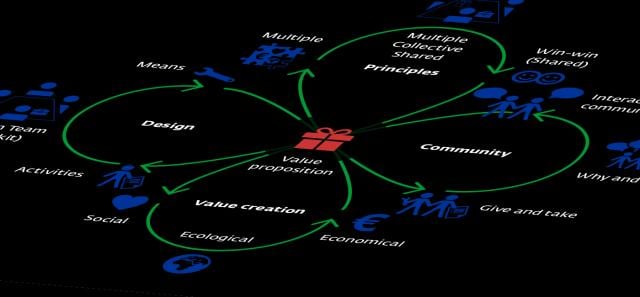
In this course, you will systematically explore and build your own New Business Model around your own idea. In a systematic manner, we will present you with five building blocks that will help you develop a viable and valuable model. By using the knowhow and experience of your peers in this course, you gain insight into what others are doing and get feedback on your own results. Step by step, you will build and test the model, leading to a mature result than can be put to practice instantly after the course. Enrol and invest in new adventures that will help you to create a lasting impact for yourself and the community around you.
By the end of the course, you will know:
- the role of business models in a changing economy, against the background of trends and developments.
- understand how the economy and society is changing and how to use this as input for your value proposition.
- how to make making an initial design for your NBM.
- who and what you will need for your NBM and how to design your own NBM.
- how to improve your value proposition, based on three principles of value creation.
- how to develop a community of people who actively participate in your NBM.
- how to distinguish and assess the values your NBM is creating.
Course Structure
Chapter 1: Introduction
1.0 Introduction: Part of the first video, welcome to the week, learning objectives and assignments.
1.1 What is sustainability: Understand the notion of sustainability from a organisational and business wise perspective.
1.2 The great transition: Identify the transition from a linear to a circular economy and what this implies.
1.3 Business Models & why do we need new business models?: What is a business model and why a changing economy needs a new generation of business models.
1.4 Living in a changing economy: Identify seven trends and developments of a changing economy
1.5 Let’s talk about your NBM: What are you going to do? At the end of this course you will have your own new business model. Note to self: Isn’t this the right time to start your own community for your NBM?
Chapter 2: WEconomy
2.1 WEconomy: Understand how the economy and society is changing and how to use this as input for your value proposition.
2.2 Bio-based, functional and circular economy: Describe how we can shift from a commodity-based economy to one based on natural materials.Understand how the economy is changing from a linear to a circular model and what this implies when it comes to design. Explain the notion of selling functions instead of products and how this impacts ownership / legal structures.
2.3 Sharing and Collaborative economy: Understand what “asset management” is and how it offers tremendous possibilities for the sustainable economy. Understand how a changing economy requires new concepts of collaboration. 2.4 Self-production (3D) economy: Envision the rise of self-production through 3D print technology.
2.5 Internet of Things + Let’s talk about your NBM: Understand how people and things and things are exponentially connected and what this implies for transition. Write down your value proposition for the first time, upload and ask for feedback.
Chapter 3: New Business Model Design
3.1 Pitching your NBM team: Identify and describe the people with whom you want to develop the initial value proposition.
3.2 Organising your NBM?: Describe what kind of organisational concept you have in mind.
3.3 Resources needed for your NBM? Make an inventory of the things you need to structure your value proposition.
3.4 Case-study: Study several real world examples and analyse how they have shaped their value proposition.
3.5 Let’s talk about your NBM: This week we concentrated on the who, how and what. Write this down for your NBM, upload it and ask for feedback.
Chapter 4: Principles & Value proposition
4.1 What is value creation? Understand the nature of value creation from a co-creation perspective.
4.2 Comparing conventional and new business models: Recognise the difference in value creation between conventional and new business models.
4.3 Principles: Understand how business models are based on principles and what the principles are at play in new business models.
4.4 Reassessing the value proposition: Analyse your initial value proposition in the light of principles of value creation.
4.5 Let’s talk about your NBM: Write down your new value proposition, upload it and ask for feedback.
Chapter 5: Community building
5.1 What is a community?: Identify the key elements that make up a community.
5.2 Communities come in different shapes and sizes: Describe the different character of communities.
5.3 Building a community means building a value network: Create a value network based on diversity, scope and the nature of membership.
5.4 How to build your own community? Structure a community based on role division, principles and membership.
5.5 Let’s talk about your NBM: Start looking for a limited number of people who will help you elaborate the model, either on the internet or in your psychical environment. Ask them for feedback on your value proposition and upload the feedback.
Chapter 6 Assessing value creation
6.1 What is the value created? Understand the nature of values and which role they play in business models.
6.2 How do we assess values: Understanding the difference monetisation and valuation.
6.3 Assessing the value created by your NBM: Understand how valuation and monetisation are embedded in your NBM
6.4 Missed chances: Assess your business model from a non-monetary perspective.
6.5 Let’s talk about your NBM: At the end of this week you will have a complete clover canvas and you will hand this in as a text (100 words).
6.6 Make a video of your NBM: Make a video of your NBM and upload it.