EdX

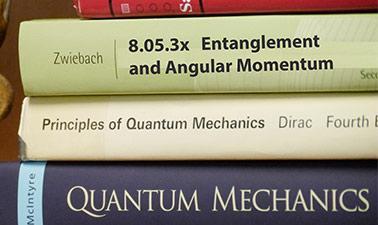
Mastering Quantum Mechanics Part 3: Entanglement and Angular Momentum (edX)

Offered by MIT, MITx,
Mastering Quantum Mechanics Part 3: Entanglement and Angular Momentum (edX)

Learn about entanglement and Bell inequalities, representations and addition of angular momentum, and central potentials. This physics course introduces the concept of tensor product states to discuss entanglement and Bell inequalities.

Class Deals by MOOC List - Click here and see EdX's Active Discounts, Deals, and Promo Codes.

You will learn about angular momentum and its representations. This is used to understand the spectrum of central potentials and to introduce hidden symmetries. Lastly, you will learn about the addition of angular momentum and an algebraic approach to the hydrogen atom spectrum.

This is the last of three courses offering a sophisticated view of quantum mechanics and its proper mathematical foundation.

To follow this course you should have taken Part 1: Wave Mechanics, and Part 2: Quantum Dynamics.
Completing the 3-part Quantum Mechanics series will give you the necessary foundation to pursue advanced study or research at the graduate level in areas related to quantum mechanics.

What you'll learn:

  • Entanglement and Bell inequality.
  • Representations of Angular momentum.
  • The Central Potential Problem.
  • Addition of Angular Momentum.
  • An algebraic approach to the hydrogen atom.

Syllabus

Week 1:
Multiparticle states and tensor products
Entanglement and quantum teleportation

Week 2:
The Einstein, Podolsky, Rosen paradox and Bell inequalities
Representations of angular momentum

Week 3:
Angular momentum and central potentials

Week 4:
Hidden symmetries and degeneracies
Addition of angular momentum

Week 5:
Algebraic solution of the hydrogen atom
Final Assessment
Go to Class
MOOC List is learner-supported. When you buy through links on our site, we may earn an affiliate commission.

Related Courses

Quantum Mechanics for Scientists and Engineers 1 (edX) EdX
StanfordOnline

Quantum Mechanics for Scientists and Engineers 1 (edX)

This 9 week course aims to teach quantum mechanics to anyone with a reasonable college-level understanding of physical science or engineering. Quantum mechanics was once mostly of interest to physicists, chemists and other basic scientists. Now the concepts and techniques of quantum mechanics are essential in many areas of engineering and science such as materials science, nanotechnology, electronic devices, and photonics.

Self Paced
Self-Paced
Is this Physics or Magic? Learning Physics through Minds-on Science Demonstration (edX) EdX
National University of Singapore,NUS

Is this Physics or Magic? Learning Physics through Minds-on Science Demonstration (edX)

Is this MOOC an introduction to Physics or Magic? Here's calling all curious minds from every corner of the globe to join us to learn physics via science demonstrations which are exciting, visually appealing and thought provoking. In this MOOC, you'll get to witness how demonstrations can add reality and vividness to the process of concept formation, and pick up one or two scientific nuggets along the way.

Sep 5th 2023
5-12 Weeks
Quantum Detectors (edX) EdX
Purdue University,PurdueX

Quantum Detectors (edX)

Learn about quantum sensors and devices that extract maximal information from the world around us. Classical detectors and sensors are ubiquitous around us from heat sensors in cars to light detectors in a camera cell phone. Leveraging advances in the theory of noise and measurement, an important paradigm of quantum metrology has emerged. Here, ultra-precision measurement devices collect maximal information from the world around us at the quantum limit.

Feb 12th 2024
5-12 Weeks
Fundamentals of Transistors (edX) EdX
Purdue University,PurdueX

Fundamentals of Transistors (edX)

This course develops a simple framework for understanding the essential physics of transistors, including modern nanoscale transistors. Important technology considerations and circuit applications are also discussed. The transistor has been called the greatest invention of the 20th century - it enabled the electronics systems that have shaped the world we live in. Today's nanotransistors are a high volume, high impact success of the nanotechnology revolution.

Feb 13th 2023
5-12 Weeks
Cosmic Rays, Dark Matter, and the Mysteries of the Universe (edX) EdX
Waseda University,WasedaX

Cosmic Rays, Dark Matter, and the Mysteries of the Universe (edX)

Join us on a unique exploration of one of the universe’s deepest mysteries: cosmic rays. In the Universe, high-energy cosmic rays are violently propagating in space. While we know these cosmic rays come from outside of the solar system, exactly how and where they originate is a mystery. Professor Shoji Torii from Waseda University and many researchers from around the world, believe that understanding about their origin will help resolve the mysteries of the Universe, such as, supernova remnants, dark matter, and even the Universe’s evolution.

Self Paced
Self-Paced
Solid State Devices 1 (edX) EdX
Purdue University,PurdueX

Solid State Devices 1 (edX)

Semiconductor are everywhere in human activities, from your credit card to space exploration. This graduate-level introduction brings aspects of physics, chemistry, and engineering together to understand, analyze, and design transistors and solar cells. This course provides the graduate-level introduction to understand, analyze, characterize and design the operation of semiconductor devices such as transistors, diodes, solar cells, light-emitting devices, and more.

Jan 9th 2023
13-24 Weeks
Quantum Mechanics of Molecular Structures (edX) EdX
The University of Tokyo,UTokyoX

Quantum Mechanics of Molecular Structures (edX)

Learn two methods used to determine molecular structures and their properties in this introduction to Quantum Mechanics. Knowing the geometrical structure of the molecules around us is one of the most important and fundamental issues in the field of chemistry. This course introduces the two primary methods used to determine the geometrical structure of molecules: molecular spectroscopy and gas electron diffraction.

Self Paced
Self-Paced
Cement Chemistry and Sustainable Cementitious Materials (edX) EdX
École Polytechnique Fédérale de Lausanne,EPFLx

Cement Chemistry and Sustainable Cementitious Materials (edX)

Learn the basics of cement chemistry and laboratory best practices for assessment of its key properties. Every day, we see concrete used all around us – to build our houses, offices, schools, bridges, and infrastructure. But few people actually understand what gives concrete its strength, resistance, and utility. The aim of this course is to offer basic cement chemistry to practitioners, as well as new students in the fields of chemistry and engineering.

Self Paced
Self-Paced
Quantum Mechanics for Scientists and Engineers 2 (edX) EdX
StanfordOnline

Quantum Mechanics for Scientists and Engineers 2 (edX)

This course covers key topics in the use of quantum mechanics in many modern applications in science and technology, introduces core advanced concepts such as spin, identical particles, the quantum mechanics of light, the basics of quantum information, and the interpretation of quantum mechanics, and covers the major ways in which quantum mechanics is written and used in modern practice.

Self Paced
Self-Paced
Science & Cooking: From Haute Cuisine to Soft Matter Science (chemistry) (edX) EdX
HarvardX,Harvard University

Science & Cooking: From Haute Cuisine to Soft Matter Science (chemistry) (edX)

Top chefs and Harvard researchers explore how everyday cooking and haute cuisine can illuminate basic principles in chemistry, physics, and engineering. Learn about food molecules and how chemical reactions can affect food texture and flavor. During each module of this course, chefs reveal the secrets behind some of their most famous culinary creations — often right in their own restaurants. Inspired by such cooking mastery, the Harvard team will then explain the science behind the recipe.

Self Paced
Self-Paced