EdX

Boltzmann Law: Physics to Computing (edX)

Offered by Purdue University, PurdueX,
Boltzmann Law: Physics to Computing (edX)

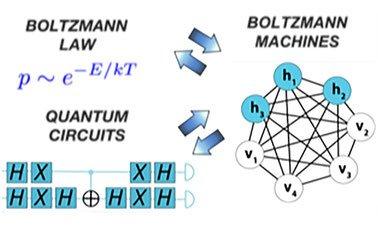
Provides a unified perspective connecting equilibrium statistical mechanics with stochastic neural networks and quantum computing. A unique course that connects three diverse fields using the unifying concept of a state-space with 2^N dimensions defined by N binary bits.

Class Deals by MOOC List - Click here and see EdX's Active Discounts, Deals, and Promo Codes.

We start from the seminal concepts of statistical mechanics like entropy, free energy and the law of equilibrium that have been developed with the purpose of describing interacting systems occurring in nature. We then move to the concept of Boltzmann machines (BM) which are interacting systems cleverly engineered to solve important problems in machine learning. Finally, we move to engineered quantum systems stressing the phenomenon of quantum interference which can lead to awesome computing power.

What you'll learn

  • Boltzmann Law
  • Boltzmann Machines
  • Transition Matrix
  • Quantum Boltzmann Law
  • Quantum Gates

Syllabus

Week 1: Boltzmann Law
1.1 State Space
1.2 Boltzmann Law
1.3 Shannon Entropy
1.4 Free Energy
1.5 Self-consistent Field
1.6 Summary for Exam 1

Week 2: Boltzmann Machines
2.1. Sampling
2.2. Orchestrating Interactions
2.3. Optimization
2.4. Inference
2.5. Learning

Week 3: Transition Matrix
3.1. Markov Chain Monte Carlo
3.2. Gibbs Sampling
3.3. Sequential versus Simultaneous
3.4. Bayesian Networks
3.5. Feynman Paths
3.6 Summary for Exam 2

Week 4: Quantum Boltzmann Law
4.1. Quantum Spins
4.2. One q-bit Systems
4.3. Spin-spin Interactions
4.4. Two q-bit Systems
4.5. Quantum Annealing

Week 5: Quantum Transition Matrix
5.1. Adiabatic to Gated Computing
5.2. Hadamard Gates
5.3. Grover Search
5.4. Shor's Algorithm
5.5. Feynman Paths
5.6 Summary for Exam 3

Epilogue

Go to Class
MOOC List is learner-supported. When you buy through links on our site, we may earn an affiliate commission.

Related Courses

Cellular Polymers: Structure, Properties, Processing, Applications (edX) EdX
University of Bayreuth,BayreuthX

Cellular Polymers: Structure, Properties, Processing, Applications (edX)

Take our MOOC and dive deep into Cellular Polymers. Understand what makes them superior to other materials, how they are processed and why they are used in countless applications in our everyday life. This MOOC is your first step in the pioneering field of Cellular Polymers that connects chemistry, physics, materials science, engineering, and technology. Get yourself ready and enroll now.

Self Paced
Self-Paced
Cement Chemistry and Sustainable Cementitious Materials (edX) EdX
École Polytechnique Fédérale de Lausanne,EPFLx

Cement Chemistry and Sustainable Cementitious Materials (edX)

Learn the basics of cement chemistry and laboratory best practices for assessment of its key properties. Every day, we see concrete used all around us – to build our houses, offices, schools, bridges, and infrastructure. But few people actually understand what gives concrete its strength, resistance, and utility. The aim of this course is to offer basic cement chemistry to practitioners, as well as new students in the fields of chemistry and engineering.

Self Paced
Self-Paced
Computing for Data Analysis (edX) EdX
Georgia Institute of Technology,GTx

Computing for Data Analysis (edX)

A hands-on introduction to basic programming principles and practice relevant to modern data analysis, data mining, and machine learning. The modern data analysis pipeline involves collection, preprocessing, storage, analysis, and interactive visualization of data. In the course, you’ll see how computing and mathematics come together.

Aug 19th 2024
13-24 Weeks
Cosmic Rays, Dark Matter, and the Mysteries of the Universe (edX) EdX
Waseda University,WasedaX

Cosmic Rays, Dark Matter, and the Mysteries of the Universe (edX)

Join us on a unique exploration of one of the universe’s deepest mysteries: cosmic rays. In the Universe, high-energy cosmic rays are violently propagating in space. While we know these cosmic rays come from outside of the solar system, exactly how and where they originate is a mystery. Professor Shoji Torii from Waseda University and many researchers from around the world, believe that understanding about their origin will help resolve the mysteries of the Universe, such as, supernova remnants, dark matter, and even the Universe’s evolution.

Self Paced
Self-Paced
Applied Quantum Computing II: Hardware (edX) EdX
Purdue University,PurdueX

Applied Quantum Computing II: Hardware (edX)

Learn how present-day material platforms are built to perform quantum information processing tasks. This course is part 2 of the series of Quantum computing courses, which covers aspects from fundamentals to present-day hardware platforms to quantum software and programming. The goal of part 2 is to provide the essential understanding of how the fundamental quantum phenomena discussed in part 1 can be realized in various material platforms and the underlying challenges faced by each platform.

Feb 12th 2024
5-12 Weeks
Understanding Nuclear Energy (edX) EdX
Delft University of Technology,DelftX

Understanding Nuclear Energy (edX)

Learn the science and technology behind nuclear energy and the special features of this energy source. In this nuclear energy course, we will tackle provocative questions such as: Is nuclear energy a good substitute for fossil fuels to reduce our CO2 emission or not?; Can nuclear reactors operate safely without any harm to the public and environment?; How much nuclear waste is produced and how long does it need to be stored safely?; How can we make nuclear energy clean and more sustainable?; How much are nuclear energy costs?

Self Paced
Self-Paced
Computing in Python I: Fundamentals and Procedural Programming (edX) EdX
Georgia Institute of Technology,GTx

Computing in Python I: Fundamentals and Procedural Programming (edX)

Learn the fundamentals of computing in Python, including variables, operators, and writing and debugging your own programs. This course starts from the beginning, covering the basics of how a computer interprets lines of code; how to write programs, evaluate their output, and revise the code itself; how to work with variables and their changing values; and how to use mathematical, boolean, and relational operators.

Self Paced
Self-Paced
Pre-University Physics (edX) EdX
Delft University of Technology,DelftX

Pre-University Physics (edX)

Prepare for your technical studies by reviewing the fundamentals of physics. Become familiar with the way physics and physics-related topics are taught at university level. Physics is the foundation of many important science and engineering disciplines. Understanding its basics is fundamental for advanced studies. In this course, you will have the chance to review the fundamentals either for your own interest, or to ensure you have a smooth start in the first year of your Bachelor’s degree.

Self Paced
Self-Paced
Advanced Linear Algebra: Foundations to Frontiers (edX) EdX
University of Texas at Austin,UTAustinX

Advanced Linear Algebra: Foundations to Frontiers (edX)

Learn advanced linear algebra for computing. Linear algebra is one of the fundamental tools for computational and data scientists. In Advanced Linear Algebra: Foundations to Frontiers (ALAFF), you will build your knowledge, understanding, and skills in linear algebra, practical algorithms for matrix computations, and the analysis of the effects of floating-point arithmetic as performed by computers.

Self Paced
Self-Paced