Machine Design Part I (Coursera)

Machine Design Part I (Coursera)

“Machine Design Part I” is the first course in an in-depth three course series of “Machine Design.” The “Machine Design” Coursera series covers fundamental mechanical design topics, such as static and fatigue failure theories, the analysis of shafts, fasteners, and gears, and the design of mechanical systems such as gearboxes. Throughout this series of courses we will examine a number of exciting design case studies, including the material selection of a total hip implant, the design and testing of the wing on the 777 aircraft, and the impact of dynamic loads on the design of an bolted pressure vessel. In this first course, you will learn robust analysis techniques to predict and validate design performance and life.

Class Deals by MOOC List - Click here and see Coursera's Active Discounts, Deals, and Promo Codes.

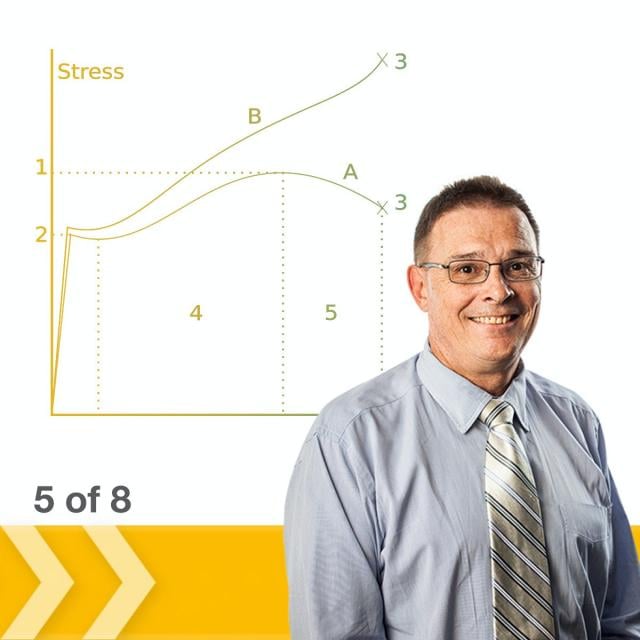
We will start by reviewing critical material properties in design, such as stress, strength, and the coefficient of thermal expansion. We then transition into static failure theories such as von Mises theory, which can be utilized to prevent failure in static loading applications such as the beams in bridges. Finally, we will learn fatigue failure criteria for designs with dynamic loads, such as the input shaft in the transmission of a car.

Syllabus

WEEK 1
Material Properties in Design
In this week, we will first provide an overview on the course's content, targeted audiences, the instructor's professional background, and tips to succeed in this course. Then we will cover critical material properties in design, such as strength, modulus of elasticity, and the coefficient of thermal expansion. A case study examining material selection in a Zimmer orthopedic hip implant will demonstrate the real life design applications of these material properties. At the end of the week you will have the opportunity to check your own knowledge of these fundamental material properties by taking Quiz 1 "Material Properties in Design."

WEEK 2
Static Failure Theories - Part I
In week 2, we will review stress, strength, and the factory of safety. Specifically, we will review axial, torsional, bending, and transverse shear stresses. Please note that these modules are intended for review- students should already be familiar with these topics from their previous solid mechanics, mechanics of materials, or deformable bodies course. For each topic this week, be sure to refresh your analysis skills by working through worksheets 2, 3, 4 and 5. There is no quiz for this week.

WEEK 3
Static Failure Theories - Part II
In this week we will first cover the ductile to brittle transition temperature and stress concentration factors. Then, we will learn two critical static failure theories; the Distortion Energy Theory and Brittle Coulomb-Mohr Theory. A case study featuring the ultimate load testing of the Boeing 777 will highlight the importance of analysis and validation. Be sure to work through worksheets 6, 7, 8 and 9 to self-check your understanding of the course materials. At the end of this week, you will take Quiz 2 “Static Failure.”

WEEK 4
Fatigue Failure - Part I
In week 4, we will introduce critical fatigue principles, starting with fully revisable stresses and the SN Curve. Then, we discuss how to estimate a fully adjusted endurance limit. Finally, a case study covering the root cause analysis of the fatigue failure of the Aloha Airlines flight 293 will emphasize the dangers of fatigue failure. In this week, you should complete worksheets 10, 11 and 12 as well as Quiz 3 “Fully Reversed Loading in Fatigue.”

WEEK 5
Fatigue Failure - Part II
In this last week of the course, we will cover the fatigue failure criteria for fluctuating and randomly varying stresses, including key concepts such as the Modified Goodman line and Miner’s Rule. This week be sure to complete worksheets 13 and 14 as well as Quiz 4 “Fluctuating Fatigue and Miner’s Rule.” Finally, take Quiz 5, “The Comprehensive Quiz”, which will measure your overall knowledge of this course.


Go to Class
MOOC List is learner-supported. When you buy through links on our site, we may earn an affiliate commission.

Related Courses

Managing Emotions in Times of Uncertainty & Stress (Coursera) Coursera
Yale University

Managing Emotions in Times of Uncertainty & Stress (Coursera)

Developed by the Yale Center for Emotional Intelligence, Managing Emotions in Times of Uncertainty & Stress will provide participants with the knowledge, skills, and strategies to understand and manage their emotions and those of their students. The 10-hour online course is designed for school staff, including teachers, paraprofessionals, counselors, principals, and non-teaching staff in preK-12 schools.

Aug 10th 2026
5-12 Weeks
Innovation for Impact (i4i) The Carlson-Polizzotto Method of Value Creation (Coursera) Coursera
Northeastern University

Innovation for Impact (i4i) The Carlson-Polizzotto Method of Value Creation (Coursera)

Welcome! Partnering with Tech industry giants Curtis Carlson and Len Polizzotto, Northeastern University brings you “Value Creation: The Carlson-Polizzotto Method” a short-form course experience like no other. Building careers by solving for the value proposition - Curt and Len are responsible for driving the integration of the software technology behind Apple’s voice command intelligent assistant and creating the standard for high definition television - now known to billions today as Siri and HDTV.

Aug 10th 2026
1 Week
Data and Health Indicators in Public Health Practice (Coursera) Coursera
Johns Hopkins University

Data and Health Indicators in Public Health Practice (Coursera)

Epidemiology is often described as the cornerstone science in public health. Epidemiology in public health practice uses study design and analyses to identify causes in an outbreak situation, guides interventions to improve population health, and evaluates programs and policies. In this course, we'll define the role of the professional epidemiologist as it relates to public health services, functions, and competencies. With that foundation in mind, we'll introduce you to the problem solving methodology and demonstrate how it can be used in a wide variety of settings to identify problems, propose solutions, and evaluate interventions.

Aug 10th 2026
4 Weeks
Fundamentals of Engineering Exam Review (Coursera) Coursera
Georgia Institute of Technology

Fundamentals of Engineering Exam Review (Coursera)

The purpose of this course is to review the material covered in the Fundamentals of Engineering (FE) exam to enable the student to pass it. It will be presented in modules corresponding to the FE topics, particularly those in Civil and Mechanical Engineering. Each module will review main concepts, illustrate them with examples, and provide extensive practice problems.

Aug 10th 2026
5-12 Weeks
Excel/VBA for Creative Problem Solving, Part 2 (Coursera) Coursera
University of Colorado Boulder

Excel/VBA for Creative Problem Solving, Part 2 (Coursera)

Excel/VBA for Creative Problem Solving, Part 2" builds off of knowledge and skills obtained in "Excel/VBA for Creative Problem Solving, Part 1" and is aimed at learners who are seeking to augment, expand, optimize, and increase the efficiency of their Excel spreadsheet skills by tapping into the powerful programming, automation, and customization capabilities available with Visual Basic for Applications (VBA).

Aug 10th 2026
4 Weeks
Mechanics of Materials I: Fundamentals of Stress & Strain and Axial Loading (Coursera) Coursera
Georgia Institute of Technology

Mechanics of Materials I: Fundamentals of Stress & Strain and Axial Loading (Coursera)

This course explores the topic of solid objects subjected to stress and strain. The methods taught in the course are used to predict the response of engineering structures to various types of loading, and to analyze the vulnerability of these structures to various failure modes. Axial loading with be the focus in this course.

Aug 17th 2026
5-12 Weeks
Fundamentals of Fluid-Solid Interactions (Coursera) Coursera
École Polytechnique

Fundamentals of Fluid-Solid Interactions (Coursera)

What is fluid-solid interactions ? It is what happens when the motions of a fluid and of a solid are somehow coupled. This happens all the time, around you when leaves flutter in the wind, inside you when your heart beats, above you when wings of a plane vibrate, under the sea... The idea behind this MOOC is to give you the basic tools to be able to predict and eventually mitigate things called flutter, galloping, sloshing, vortex-induced vibrations, added mass, to cite a few. We are going to consider any possible domains of applications such as civil engineering, aerospace engineering, nuclear engineering , ocean engineering, biomechanics and even food processing !

Aug 10th 2026
5-12 Weeks
Mindfulness and Well-being: Living with Balance and Ease (Coursera) Coursera
Rice University

Mindfulness and Well-being: Living with Balance and Ease (Coursera)

This is the sequel course to Foundations of Mindfulness that will continue to provide a broad overview of the fundamental concepts, principles, and practices of mindfulness. With interactive exercises to help students explore their own attitudes, mental habits and behaviors, Foundations of Mindfulness series offers a pathway for living with more freedom, authenticity and ease. Featured components of the course include experiential exercises, guided meditations, personal reflection and interactive discussions.

Aug 17th 2026
4 Weeks
Science of Training Young Athletes Part 2 (Coursera) Coursera
University of Florida

Science of Training Young Athletes Part 2 (Coursera)

In this course you will learn how to design the type of training that takes advantage of the plastic nature of the athlete’s body so you mold the right phenotype for a sport. We explore ways the muscular system can be designed to generate higher force and power and the type of training needed to mold the athlete's physical capacity so it meets the energy and biochemical demands of the sport.

Aug 10th 2026
5-12 Weeks
Mastering Statics (Coursera) Coursera
The Hong Kong University of Science and Technology - HKUST

Mastering Statics (Coursera)

Statics is the most fundamental course in Mechanics. In this course, you will learn the conditions under which an object or a structure subjected to time-invariant (static) forces is in equilibrium - i.e. the conditions under which it remains stationary or moves with a constant velocity-. You will also learn how to calculate the reaction forces as well as the internal forces experienced throughout the structure so that later you can properly design and size the foundation and the members of the structure to assure the structure’s safety and serviceability.

Aug 10th 2026
5-12 Weeks