Low Poly Art For Video Games (Coursera)

Low Poly Art For Video Games (Coursera)

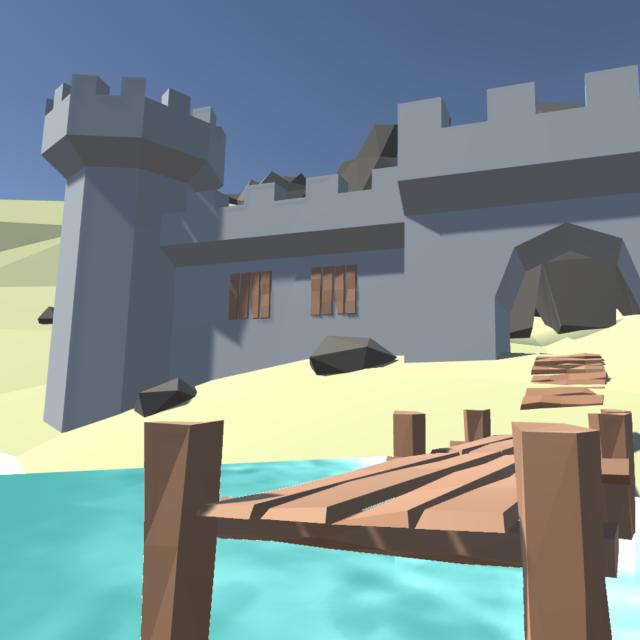
This course is aimed to give you the tools and knowledge you need to start creating simple 3D art for video games made in the Unity game engine. Through the aesthetic of pixel art we will explore artistic principals like shape language, color theory, and composition as well as show you a step by step workflow for creating assets that you can use to make your own games.

Class Deals by MOOC List - Click here and see Coursera's Active Discounts, Deals, and Promo Codes.

The course is broken into 4 main modules, props, environments, characters, and animation. Each of these courses will have a series of video lessons alternating between artistic and technical skills culminating in a peer-reviewed project based assignment. The last module will challenge you to take the knowledge learned in the previous 4 and use it to create your own pixel art asset pack.
This course is aimed at art novices who are interested in creating art for their own games or contributing to game projects. If you are a game designer or programmer, you will find this course helps give you a glimpse into the world of game art. You will be able to better work with artists, or create your own prototype or final artwork. If you are an artist or visual designer who is interested in bringing your style to the world of video game development, this course will give you the workflow to properly interface with a game engine and help contextualize how your artistic sensibilities can enable gameplay.
If you have ever wanted to start making art for video games but have no idea how to start, this course is the perfect for giving you a solid foundation while teaching you usable practical skills. Our goal is to give you a sense of the whole pipeline from creation to setting up in a game engine.
Course 2 of 4 in the Art for Games Specialization.

Syllabus

WEEK 1
Intro to Low Poly Art
In this first week we will talk about the basics of creating a game model in the low poly style. This will likely be the quickest of the 5 weeks, so take some time to check out the optional Maya LT intro to make sure you have a grasp of all the essential skills we will be covering in the course.

Week 2
Low Poly Environment Art
In this week we will move onto environments. The goal is to create a set of simple models that can be used to create scenes in maya. Depending on the number of models and their complexity this might be a more time consuming than the previous week.

Week 3
Low Poly Character Art

Week 4
Animating Low Poly Art
In this week we will be taking our character from week 3 and animating a few simple animations for it. Rigging can be tricky at first, so make sure you check out the rigging and animation primer if you need to. The goal here is to quickly get a character that we can animate, then create a few simple and expressive animations for use in a 3d game.

Week 5
Low Poly Art Project
For the final week, take the project assets you have made so far and improve them based on the feedback you received. Take this week to go back and redo anything you would have like to tackle in a different way. The goal here is to finish with a series of low poly assets you could use in a simple 3d game.
Go to Class
MOOC List is learner-supported. When you buy through links on our site, we may earn an affiliate commission.

Related Courses

3D Printing Capstone Coursera
University of Illinois at Urbana-Champaign

3D Printing Capstone

The capstone will integrate the learning acquired from the four courses in the 3D Printing Specialization through a hands-on project. This project will enable you to turn an idea into an object using the knowledge and skills acquired through the other courses. Specifically, you will be guided through a step-by-step process in which you imagine, design, make, and share a 3D printed object. Thus, through this capstone, you will be able to put course concepts into action and utilize the skills that you have acquired throughout the Specialization.

Aug 3rd 2026
4 Weeks
Shooters and Game Engines in Level Design (edX) EdX
LaSalle College,LaSalleX

Shooters and Game Engines in Level Design (edX)

Shooter games have been and continue to be the dominant genre in video games. Learn about this important genre in game design. Do you want to learn more about game genres and subgenres? This course continues your exploration of level design by introducing you to an important genre: the shooter. The shooter genre is huge in the game world, containing a wide variety of subgenres with their own gameplay needs.

Self Paced
Self-Paced
The Basics of Level Design (edX) EdX
LaSalle College,LaSalleX

The Basics of Level Design (edX)

Discover how to create captivating video games with not just your visuals and gameplay, but level design as well. This course introduces you to the fundamentals of game level design—a crucial aspect of video game design that centers around the creation of playable spaces. As a level designer, you will be required to create well-designed levels that direct the movement of the player(s) through the game—often without the player consciously recognizing they’re being directed.

Self Paced
Self-Paced
Introduction to Solid Edge (Coursera) Coursera
Siemens

Introduction to Solid Edge (Coursera)

The Introduction to Siemens Solid Edge software will enable you to learn basic design concepts in both 2D and 3D environments using Computer-Aided Design (CAD) software. The concepts include 2D sketches, basic shapes, 3D models, and simple assemblies. You’ll gain experience using commands such as extrude, revolve, rounds, blend, and thinwall to more efficiently design solid models. Additionally, you’ll learn about drafting concepts such as detailing, drawing view, section cuts, and design intent.

Aug 3rd 2026
5-12 Weeks
World Design for Video Games (Coursera) Coursera
California Institute of the Arts

World Design for Video Games (Coursera)

Start creating your world. A game world is not just a backdrop for your game—be it minimal or detailed, contained or part of a much bigger universe, it provides the context for your player. Ultimately, a game world should feel alive and wholly unique to any player who will experience it. In this course, we will explore game worlds in existing games and study the art and influences that inform their themes and styles. We will also investigate key components of environment and level design as well as strategies designers use to define gameplay or advance it. We’ll also look at navigation and the elements that make your world as real (or unreal) as you want it to be.

Jul 27th 2026
4 Weeks
Pixel Art for Video Games (Coursera) Coursera
Michigan State University

Pixel Art for Video Games (Coursera)

This course is aimed to give you the tools and knowledge you need to start creating simple art for video games made in the Unity game engine. Through the aesthetic of pixel art we will explore artistic principals like shape language, color theory, and composition as well as show you a step by step workflow for creating assets that you can use to make your own games.

Aug 10th 2026
5-12 Weeks
Current Gen 3D Game Prop Production (Coursera) Coursera
Michigan State University

Current Gen 3D Game Prop Production (Coursera)

In this course you will learn to create a photo-real game prop using modern game art production techniques. You will gather reference, generate a base model, create a high polygon model, bake details onto a low poly model, and then texture and present a final portfolio piece. This course is aimed at students who have some knowledge in 3d and game art and would like to learn more advanced techniques employed in the creation of modern game assets.

Jul 27th 2026
5-12 Weeks
Building Interactive 3D Characters and Social VR (Coursera) Coursera
University of London,Goldsmiths, University of London

Building Interactive 3D Characters and Social VR (Coursera)

Meeting another person is one of the most amazing experiences you can have in Virtual Reality. It is quite unlike communicating through any other medium except a real life face-to-face conversation. Because the other person is life size and shares a virtual space with you, body language works in a way that cannot be done on a flat screen. This course will enable you to create realistic social interactions in VR.

Aug 3rd 2026
4 Weeks
Introduction to Videogame Law: A Russian Perspective (Coursera) Coursera
Saint Petersburg State University

Introduction to Videogame Law: A Russian Perspective (Coursera)

This course focuses on basic approaches to those legal issues that relate to the unique features of computer games that have legal significance and the social relationships that arise around them. The history of the development of computer games is, at the same time, the history of the cutting-edge technologies, from multiplayer network interaction in a persistent environment, to artificial intelligence and VR / AR. As a consequence, an analysis of the legal issues of the computer games industry is at the same time an analysis of the legal issues of these technologies.

Jul 25th 2022
5-12 Weeks
Videojuegos: ¿de qué hablamos? (Coursera) Coursera
Universitat Autònoma de Barcelona

Videojuegos: ¿de qué hablamos? (Coursera)

Probablemente, todos hemos jugado a algún videojuego, pero ¿qué hay detrás de él? Podemos decir que - con independencia del videojuego - hay un árduo trabajo multidisciplinar que incluye desde aspectos de diseño hasta la programación como tal del videojuego. Este curso pretende ser un curso introductorio que muestre qué aspectos hay que considerar en el videojuego, y que permita con posterioridad abordar individualmente los temas que se consideran nucleares: diseño, arte, motor del videojuego y 'game play'.

Jul 27th 2026
5-12 Weeks