Hydrogen for Mobility (IFP School)

Offered by IFP School,
Hydrogen for Mobility (IFP School)

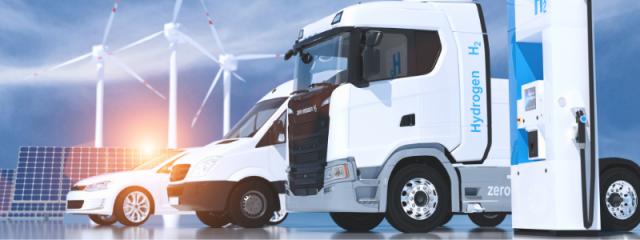
Hydrogen is a hot topic nowadays. Why? Because society must find solutions to reduce its impact on climate change and because there is now a political will (in Europe) to develop a hydrogen economy. The mobility sector, and in particular the heavy mobility, is concerned by this transformation. After some general information about hydrogen production and the hydrogen economy, you will gain a deep understanding of the hydrogen solution for mobility. We will explore both the fuel cells and the hydrogen thermal engine solutions as a mean to reduce the environmental footprint of heavy mobility.

Our focus is mostly technical and aims at three objectives. At the end of this module, you will be able to:

  • describe the working principle of a fuel cell, from the reaction to the fuel stack and the fuel cell vehicle.
  • explain the chemical characteristics of hydrogen that influence combustion, how they impact performances and the technical developments needed to improve hydrogen combustion engines
  • compare solutions and identify the main development constraints.

Chapters:

  1. General Hydrogen & Hydrogen for mobility context
  2. Hydrogen Internal combustion engine
  3. Fuel Cell Vehicles
Go to Class
MOOC List is learner-supported. When you buy through links on our site, we may earn an affiliate commission.
Related Courses

Quantitative Formal Modeling and Worst-Case Performance Analysis (Coursera) Coursera
EIT Digital

Quantitative Formal Modeling and Worst-Case Performance Analysis (Coursera)

Welcome to Quantitative Formal Modeling and Worst-Case Performance Analysis. In this course, you will learn about modeling and solving performance problems in a fashion popular in theoretical computer science, and generally train your abstract thinking skills. After finishing this course, you have learned to think about the behavior of systems in terms of token production and consumption, and you are able to formalize this thinking mathematically in terms of prefix orders and counting functions. You have learned about Petri-nets, about timing, and about scheduling of token consumption/production systems, and for the special class of Petri-nets known as single-rate dataflow graphs, you will know how to perform a worst-case analysis of basic performance metrics, like throughput, latency and buffering.

Jul 27th 2026
4 Weeks
Energy Transition Selection (IFP School) Other Providers
IFP School

Energy Transition Selection (IFP School)

This module is intended either for students and professionals interested in the energy transition challenges and innovative solutions to reduce CO2 emissions. But more specifically it is intended for those willing to gain knowledge about developing a decarbonized energy mix based on both renewables and natural gas, underground CO2 and energy storage, energy efficiency and CO2 abatements in processes, biofuels. In general, for those who are convinced that climate change is really a challenge that can also be sustained through concrete solutions and societal awareness. **ENERGY TRANSITION SELECTION WILL BE AVAILABLE UNTIL MARCH 31ST.**

Available Now
1 Week
Ferrous Technology I (Coursera) Coursera
Pohang University of Science and Technology - POSTECH

Ferrous Technology I (Coursera)

Steel, ever-evolving material, has been the most preeminent of all materials since it can provide wide range of properties that can meet ever-changing requirements. In this course, we explore both fundamental and technical issues related to steels, including iron and steelmaking, microstructure and phase transformation, and their properties and applications.

Aug 3rd 2026
5-12 Weeks
Migrations internationales : un enjeu mondial (Coursera) Coursera
Sciences Po

Migrations internationales : un enjeu mondial (Coursera)

Le monde bouge, mais les opinions et les gouvernements ne sont pas tous prêts à accepter cette réalité mal connue. La question affecte à la fois les Etats, mais aussi la planète, dans un processus de mondialisation et de régionalisation des migrations, et pose de nouvelles questions aux relations internationales, en y incluant le sud. Ce cours cherche à la fois à parfaire la connaissance sur le sujet, à traiter les thèmes essentiels induits par les migrations internationales et à dresser les tendances de demain.

Jul 27th 2026
5-12 Weeks
Microwave engineering and antennas (Coursera) Coursera
Eindhoven University of Technology

Microwave engineering and antennas (Coursera)

This unique Master-level course provides you with in-depth know-how of microwave engineering and antennas. The course combines both passive and active microwave circuits as well as antenna systems. Future applications, like millimeter-wave 5G/beyond-5G wireless communications or automotive radar, require experts that can co-design highly integrated antenna systems that include both antennas and microwave electronics. We will provide you with the required theoretical foundation as well as hands-on experience using state-of-the-art design tools. The web lectures are supported by many on-line quizzes in which you can practice the background theory.

Aug 3rd 2026
5-12 Weeks
Materials Science: 10 Things Every Engineer Should Know (Coursera) Coursera
University of California, Davis

Materials Science: 10 Things Every Engineer Should Know (Coursera)

We explore “10 things” that range from the menu of materials available to engineers in their profession to the many mechanical and electrical properties of materials important to their use in various engineering fields. We also discuss the principles behind the manufacturing of those materials. By the end of the course, you will be able to: recognize the important aspects of the materials used in modern engineering applications; explain the underlying principle of materials science: “structure leads to properties,”; identify the role of thermally activated processes in many of these important “things” – as illustrated by the Arrhenius relationship; relate each of these topics to issues that have arisen (or potentially could arise) in your life and work.

Aug 3rd 2026
5-12 Weeks
Industrial Biotechnology (Coursera) Coursera
University of Manchester

Industrial Biotechnology (Coursera)

Fossil fuels have been the primary energy source for society since the Industrial Revolution. They provide the raw material for the manufacture of many everyday products that we take for granted, including pharmaceuticals, food and drink, materials, plastics and personal care. As the 21st century progresses we need solutions for the manufacture of chemicals that are smarter, more predictable and more sustainable.

Aug 10th 2026
5-12 Weeks
Image and video processing: From Mars to Hollywood with a stop at the hospital (Coursera) Coursera
Duke University

Image and video processing: From Mars to Hollywood with a stop at the hospital (Coursera)

In this course, you will learn the science behind how digital images and video are made, altered, stored, and used. We will look at the vast world of digital imaging, from how computers and digital cameras form images to how digital special effects are used in Hollywood movies to how the Mars Rover was able to send photographs across millions of miles of space.

Aug 10th 2026
5-12 Weeks
Applications in Engineering Mechanics (Coursera) Coursera
Georgia Institute of Technology

Applications in Engineering Mechanics (Coursera)

This course applies principles learned in my course “Introduction to Engineering Mechanics” to analyze real world engineering structures. You will need to have mastered the engineering fundamentals from that class in order to be successful in this course offering. This course addresses the modeling and analysis of static equilibrium problems with an emphasis on real world engineering systems and problem solving.

Aug 10th 2026
5-12 Weeks
Quantum Optics 1 : Single Photons (Coursera) Coursera
École Polytechnique

Quantum Optics 1 : Single Photons (Coursera)

This course gives you access to basic tools and concepts to understand research articles and books on modern quantum optics. You will learn about quantization of light, formalism to describe quantum states of light without any classical analogue, and observables allowing one to demonstrate typical quantum properties of these states. These tools will be applied to the emblematic case of a one-photon wave packet, which behaves both as a particle and a wave.

Aug 10th 2026
5-12 Weeks