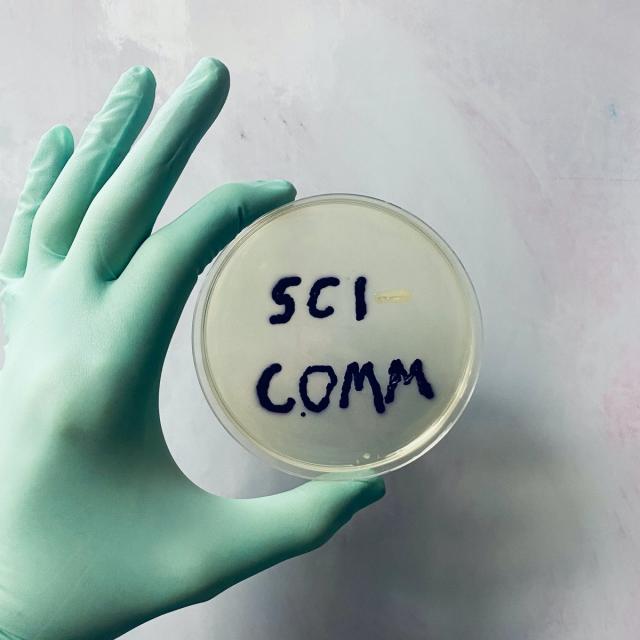
Designing Effective Science Communication (Coursera)

Designing Effective Science Communication (Coursera)

Although many would prefer to leave science in the past and no longer engage with it once completing compulsory science classes in school, the reality is that engaging with science is an integral part of our daily lives. Moreover, for the safety and wellness of human society, it is necessary to engage with scientific information. We are faced with the necessity of examining scientific evidence on topics ranging from conservation to public health and make decisions that impact not only our families but those around us.

Class Deals by MOOC List - Click here and see Coursera's Active Discounts, Deals, and Promo Codes.

However, in spite of decades of science education reform and dedicated efforts to improving science literacy, many members of the general public lack the confidence, skills, or interest in engaging with scientific issues, instead choosing to align their scientific decisions with non-scientific stakeholders, such as political or pop culture figures. These problems are ongoing and destructive. How do we communicate science more effectively with the general public? With other scientists?
This course is designed for scientists, science educators, and science communicators who are interested in re-thinking how we communicate science to diverse audiences, particularly to the general public. Topics include evidence-based considerations of human learning as well as effective communication through a variety of modalities, including oral presentations, written forms of communication, technology, and artistic media. The objective of this course is to equip learners with the skills needed to design and implement effective methods of science communication. Learners will be able to identify key principles of human learning that undergird science communication, describe pitfalls in “popular” avenues for science outreach, and apply best practices to science communication in a variety of media.

What You Will Learn

  • Describe principles of human learning that are important to consider when designing science outreach activities.
  • Compare and contrast modalities for science communication/outreach.
  • Identify common pitfalls in science communication/outreach.
  • Design a science communication/outreach activity based on principles learned in this course.

Syllabus

WEEK 1
Connecting the Science of Learning to Science Communication
In this module, you will learn the basics of human learning, including an overview of the cognitive processes that underlie learning (e.g. perception, attention, motivation, memory), major educational psychology theories (e.g socioculturalism, constructivism, behaviorism) and aspect of human cognition that can lead to difficulties with outreach (e.g. bias, motivated reasoning, epistemic cognition). We will also discuss use of evidence in designing outreach, how to evaluate types of evidence, and principles behind effective design of outreach.

WEEK 2
Speaking of Science: Oral Presentation
In this module, you will learn important considerations for effective oral presentations, including best practices for giving live, recorded, and virtual presentations. In addition, we will also cover best practices for creating visual supports (poster, PowerPoint slides) to help communicate your message during an oral presentation. We will also discuss best practices for media interviews.

WEEK 3
Writing Science: Written Communication
In this module, you will learn best practices for writing as a vehicle for science communication. Rather than focusing on grammar and general writing mechanics, this section will focus on how to effectively use the written form as a tool for science outreach, including how formal scientific writing varies from pieces for the general public.

WEEK 4
Decoding Science: Technology Based Communication
In this module, you will learn about technological forms of science communication outside traditional media (e.g. written or oral communication). In this module, we will discuss how science is communicated through various forms of educational technologies, including computer games, simulations, and social media. We will also briefly discuss learning analytics and their utility in understanding learning in technology-based environments.

WEEK 5
Creating Science: Artistic Forms of Communication
In this module, you will learn about the importance of artistic forms of science communication. The arts can serve as an important gateway between scientists and the rest of society making difficult or abstract concepts feel more personal and less intimidating. Here, we will talk about use of art, such as photography as well as music to help feel others connected to science topics.
Go to Class
MOOC List is learner-supported. When you buy through links on our site, we may earn an affiliate commission.

Related Courses

Quantum Optics 1 : Single Photons (Coursera) Coursera
École Polytechnique

Quantum Optics 1 : Single Photons (Coursera)

This course gives you access to basic tools and concepts to understand research articles and books on modern quantum optics. You will learn about quantization of light, formalism to describe quantum states of light without any classical analogue, and observables allowing one to demonstrate typical quantum properties of these states. These tools will be applied to the emblematic case of a one-photon wave packet, which behaves both as a particle and a wave.

Aug 10th 2026
5-12 Weeks
The Finite Element Method for Problems in Physics (Coursera) Coursera
University of Michigan

The Finite Element Method for Problems in Physics (Coursera)

This course is an introduction to the finite element method as applicable to a range of problems in physics and engineering sciences. The treatment is mathematical, but only for the purpose of clarifying the formulation. The emphasis is on coding up the formulations in a modern, open-source environment that can be expanded to other applications, subsequently.

Aug 10th 2026
13-24 Weeks
Fundamentals of Engineering Exam Review (Coursera) Coursera
Georgia Institute of Technology

Fundamentals of Engineering Exam Review (Coursera)

The purpose of this course is to review the material covered in the Fundamentals of Engineering (FE) exam to enable the student to pass it. It will be presented in modules corresponding to the FE topics, particularly those in Civil and Mechanical Engineering. Each module will review main concepts, illustrate them with examples, and provide extensive practice problems.

Aug 10th 2026
5-12 Weeks
Exploring Light: Hands-on Activities and Strategies for Teachers (Coursera) Coursera
Exploratorium

Exploring Light: Hands-on Activities and Strategies for Teachers (Coursera)

This is an Exploratorium teacher professional development course taught by Teacher Institute staff, open to any science teacher (particularly middle or high school level) and science enthusiast. This is a hands-on workshop that explores topics and strategies teachers can use to help their students become active investigators of light.

Aug 9th 2026
4 Weeks
Control of Nonlinear Spacecraft Attitude Motion (Coursera) Coursera
University of Colorado Boulder

Control of Nonlinear Spacecraft Attitude Motion (Coursera)

This course trains you in the skills needed to program specific orientation and achieve precise aiming goals for spacecraft moving through three dimensional space. First, we cover stability definitions of nonlinear dynamical systems, covering the difference between local and global stability. We then analyze and apply Lyapunov's Direct Method to prove these stability properties, and develop a nonlinear 3-axis attitude pointing control law using Lyapunov theory. Finally, we look at alternate feedback control laws and closed loop dynamics.

Aug 3rd 2026
4 Weeks
Spacecraft Dynamics Capstone: Mars Mission (Coursera) Coursera
University of Colorado Boulder

Spacecraft Dynamics Capstone: Mars Mission (Coursera)

The goal of this capstone spacecraft dynamics project is to employ the skills developed in the rigid body Kinematics, Kinetics and Control courses. An exciting two-spacecraft mission to Mars is considered where a primary mother craft is in communication with a daughter vehicle in another orbit. The challenges include determining the kinematics of the orbit frame and several desired reference frames, numerically simulating the attitude dynamics of the spacecraft in orbit, and implementing a feedback control that then drives different spacecraft body frames to a range of mission modes including sun pointing for power generation, nadir pointing for science gathering, mother spacecraft pointing for communication and data transfer. Finally, an integrated mission simulation is developed that implements these attitude modes and explores the resulting autonomous closed-loop performance.

Aug 3rd 2026
5-12 Weeks
Writing Skills for Engineering Leaders (Coursera) Coursera
Rice University

Writing Skills for Engineering Leaders (Coursera)

Engineering leaders must write extensively for their jobs, and their writing needs to be professional, reader-focused, and error-free. What leaders write in particular can affect productivity and the bottom line, so the written communication that leaders create must be clear and concise. In this course, you’ll learn essential writing skills that you can apply in your daily activities on the job as an engineering leader.

Aug 17th 2026
4 Weeks
Promote your Scientific Results (Coursera) Coursera
Institut Mines-Telecom

Promote your Scientific Results (Coursera)

Whether you are a member of the natural or human science community, if you are a PhD student, professor, part of an academic department or international research team, or self-employed and you wish to showcase your work to a wider audience then this is the perfect course for you. You will learn how to promote your work to professional peers, the general public, as well as the media.

Aug 10th 2026
5-12 Weeks
The Harder Side of Science Communication (Coursera) Coursera
University of Colorado Boulder

The Harder Side of Science Communication (Coursera)

In this course, you will explore how to develop and implement evidence-based methods for science communication. We’ll discuss major theories of human learning, cognitive phenomena like bias and motivated reasoning that can undermine even the best activities, and the science behind why mis/disinformation spreads so quickly. We’ll end with motivational interviewing and a discussion of how to use learning engineering to design educational activities.

Aug 3rd 2026
4 Weeks
Materials Data Sciences and Informatics (Coursera) Coursera
Georgia Institute of Technology

Materials Data Sciences and Informatics (Coursera)

This course aims to provide a succinct overview of the emerging discipline of Materials Informatics at the intersection of materials science, computational science, and information science. Attention is drawn to specific opportunities afforded by this new field in accelerating materials development and deployment efforts.

Aug 10th 2026
5-12 Weeks
Engineering Maintainable Android Apps (Coursera) Coursera
Vanderbilt University

Engineering Maintainable Android Apps (Coursera)

Engineering Maintainable Android Apps, which is a 4 week MOOC that shows by example various methods for engineering maintainable Android apps, including test-driven development methods and how to develop/run unit tests using JUnit and Robotium (or equivalent automated testing frameworks for Android), as well as how to successfully apply common Java/Android software patterns to improve the extensibility and clarity of Android apps.

Aug 3rd 2026
4 Weeks
Interpersonal Communication for Engineering Leaders (Coursera) Coursera
Rice University

Interpersonal Communication for Engineering Leaders (Coursera)

This course covers communication skills that engineering leaders use every day to motivate, inspire, and support the people in their organizations. Speaking and writing are basic leadership communication skills. (We covered these topics in the Specialization course 1 and 3.) However, leaders also need to be skillful interpersonal communicators.

Aug 17th 2026
4 Weeks