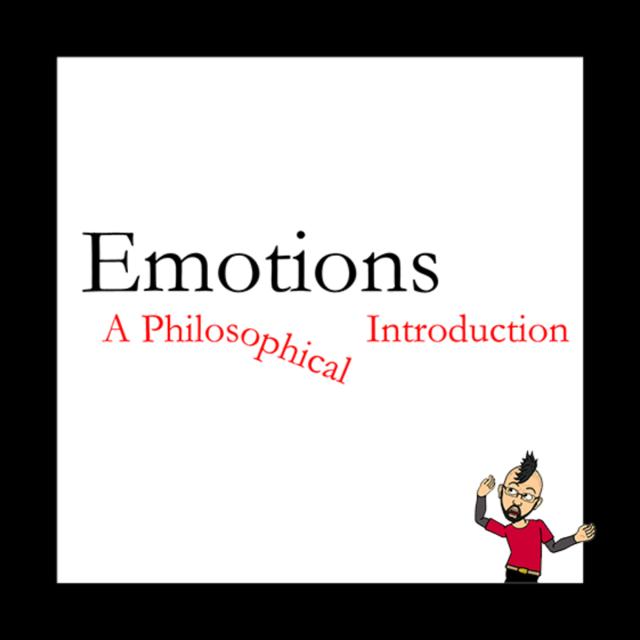
Emotions: a Philosophical Introduction (Coursera)

Emotions: a Philosophical Introduction (Coursera)

Philosophy is like sex: sure you can get some interesting results, but that's not why we do it. Going one step beyond…why do you FEEL pain or pleasure? Do plants have emotions? How is possible that some people do not understand other’s emotions? Emotions seem to be everywhere, giving meaning to all events of our lives. They are the backbone of social activities as well as they drive the cognitive processes of several living entities. Several animals, including humans, have emotions but…what about machines?...Do machine can have emotions?

Class Deals by MOOC List - Click here and see Coursera's Active Discounts, Deals, and Promo Codes.

This course will help you to understand and to identify most important philosophical ideas and debates about emotions, as well as it will provide you a rich source of data about neurological, psychological or anthropological analysis of emotions.
In a nutshell: this is a course to feel and think about.

Syllabus

WEEK 1
Welcome!
Welcome to this amazing course on the nature of emotions. You’ll see that emotions are everywhere. They are the true meaning of our lives and guide us all throughout our daily actions. There is a lot to discuss, to think about, to discover about them! Six weeks for a Course, one Course for new Knowledge!
Where do emotions come from?
At the very beginning of this course we will look at the basic definitions and concepts related to the emotional events. At the same time we will introduce basic philosophical ideas in order to make possible the understanding of the nature of emotional values.

WEEK 2
How many emotions do exist?
After the clarification about the different aspects we can find in emotional analysis, we will look at the number and type of different emotions. There are several theories about their number, and all of them also contain a way to understand how emotions emerged and evolved. The debate will be fun!

WEEK 3
What does a plant feel?
Not only humans do have emotions. Other mammals have also them. And even insects. But do plants have emotions? Even bacteria, a so small entity, have also these emotional mechanisms. An evolutionary reconstruction will understand to understand how emotions are spread among living entities.

WEEK 4
A neuroanthropological approach to emotions: from neurons to societies
Emotions regulate several key aspects of our life. But they are fundamental for social cohesion. Cooperation or altruism are fundamental aspects of human socialization that must be understood from an emotional perspective. Neurons will show the path to the creation of societies.

WEEK 5
The philosophies on emotions
There are plenty of historical debates on the nature and role of emotions into philosophical spaces. Usually, this approach is made studying at Western thinkers, but we will also include Eastern ones. Therefore, we will analyse how most important philosophical traditions have understood and explain the role of emotions. [Spoiler: they always said they were BAD!].

WEEK 6
21st Century & emotions: affective computing and sociable robots
At the end of this course we will look on how emotions are displayed into new technological frameworks: social networks, mass media,…but we will think about how emotions are implemented into robots or computers. A new technological era come to us, with the same necessities of all previous ones: emotional. Machines will be emotional, if we want they be really smart, autonomous, and efficient.

Go to Class
MOOC List is learner-supported. When you buy through links on our site, we may earn an affiliate commission.

Related Courses

Positive Psychology: Applications and Interventions (Coursera) Coursera
University of Pennsylvania

Positive Psychology: Applications and Interventions (Coursera)

Positive interventions are one of the building blocks for the application of positive psychology in our day-to-day lives. In this course taught by Dr. James Pawelski, we explore positive interventions through theory, research and practice. We provide learners the basic tools for using and measuring positive psychology in professional or personal contexts. Suggested prerequisite: Positive Psychology: Martin E. P. Seligman’s Visionary Science.

Jul 6th 2026
4 Weeks
Feelings and Interpersonal Relationships (UNINETTUNO) UNINETTUNO OpenupEd
International Telematic University UNINETTUNO

Feelings and Interpersonal Relationships (UNINETTUNO)

Il corso si propone di offrire allo studente una panoramica dei percorsi della ricerca psicodinamica nel campo degli affetti e delle relazioni interpersonali attraverso un approfondimento delle aree teoriche, cliniche ed evolutive che hanno caratterizzato la recente ricerca in questo ambito.

Self Paced Course - Start anytime
Self-Paced
AP® Psychology - Course 4: How Behavior Works (edX) EdX
The University of British Columbia,UBCx

AP® Psychology - Course 4: How Behavior Works (edX)

Learn about the theories of motivation and emotions and obtain an in-depth look at intelligence testing and personality development. This psychology course is all about how behavior works. You will learn the theories of motivation, hunger, eating, the obesity epidemic, and sexual behavior. We will also examine theories of emotion and observe how developmental psychologists study phenomena across a lifespan.

Self Paced
Self-Paced
Digital Communication and Emotion (Coursera) Coursera
Arizona State University

Digital Communication and Emotion (Coursera)

Communication online can be hard, especially when emotions get involved. Whether you’re facing someone’s sarcastic joke or a heated discussion, digital communication requires finesse. Even in normal situations, this communication can benefit from specific skills that let you get your message across clearly on any medium. However, you may still wonder about the best ways to go about online communication.

Jul 6th 2026
5-12 Weeks
Psychology and Mental Health: Beyond Nature and Nurture (FutureLearn) FutureLearn
University of Liverpool

Psychology and Mental Health: Beyond Nature and Nurture (FutureLearn)

How a psychological understanding of our emotions and behaviour can give us new ways to improve mental health and well-being. Psychological therapies and the work of clinical psychologists are now very popular. This free online course provides an introduction to how psychologists understand emotions, behaviours and thinking patterns, and how this helps clinical psychologists make sense of their clients’ problems.

No sessions available
5-12 Weeks
How to Manage your Emotions: Developing Coping Skills (Skillshare) Skillshare
Skillshare

How to Manage your Emotions: Developing Coping Skills (Skillshare)

Learn how to manage your emotions and discover new coping methods to try to get your brain back to clear and calm. Do you struggle with emotional overloads or feeling like your emotions can get the best of you? This class is for you. Jess has struggled with her own emotional imbalances and reoccurring depression and sadness but through therapy and compiling her own methods she has created classes to help herself and others manage their adult lives.

Self Paced
Self-Paced
Forgiveness is For You (Skillshare) Skillshare
Skillshare

Forgiveness is For You (Skillshare)

I want to share this information because Forgiveness was a HUGE part of my Spiritual Awakening. I know first hand how HEALING it is to truly let go of pain and resentment and MOVE ON with my life and be happy. I want others to know how BIG this is and how much it can improve their lives! I'm so glad you are taking this course and I hope it helps!

Self Paced
Self-Paced
Music Psychology: Why Does "Bohemian Rhapsody" Feel so Good? (FutureLearn) FutureLearn
Griffith University

Music Psychology: Why Does "Bohemian Rhapsody" Feel so Good? (FutureLearn)

Explore music psychology and find out why music can make us feel, by analysing Queen's famous song, "Bohemian Rhapsody". Toe-tapping and hair-raising: discover the power of music. Some songs make us laugh and some songs make us cry, but why does music have the ability to affect us emotionally? On this course, you’ll learn about music psychology and how our emotions work, by analysing Queen’s famous song, “Bohemian Rhapsody”.

Available now
2 Weeks
Love as a Force for Social Justice (Coursera) Coursera
Stanford University

Love as a Force for Social Justice (Coursera)

This course will explore the concept of agape love (compassion/kindness) as a force for social justice and action and as the inspiration for service and the application of knowledge to positive social change. Biological, psychological, religious, and social perspectives of love will be discussed, drawing on the expertise of people from a variety of disciplines.

Jun 29th 2026
5-12 Weeks
Arts and Heritage Management (Coursera) Coursera
Università Bocconi

Arts and Heritage Management (Coursera)

Today cultural institutions are facing important dilemmas in many aspects of their management. Over the past decades, a new figure has emerged that of the art manager. Imagine you went to work every day to connect artists with audiences, vision with reality, and money with a mission. That is what managers in the arts do, they play an essential role in transforming the minds, lives, and communities through creative expression. This course has been conceptualized to address the need of skills and techniques to help professionals and managers in running art and cultural institutions.

Jun 15th 2026
5-12 Weeks
Mentaliser : de la théorie à l’intervention clinique (Coursera) Coursera
University of Geneva

Mentaliser : de la théorie à l’intervention clinique (Coursera)

Que signifie « Mentaliser » ? Comment cette faculté se développe-t-elle ? En quoi cette notion est incontournable pour comprendre les interactions humaines ? Qu’apporte-t-elle aux pratiques en santé mentale ? Toutes ces questions seront abordées dans notre MOOC « Mentaliser : de la théorie à l’intervention clinique ».

Jun 15th 2026
5-12 Weeks