EdX

Basic 3D Modeling using Blender (edX)

Offered by IIT Bombay, IITBombayX,
Basic 3D Modeling using Blender (edX)

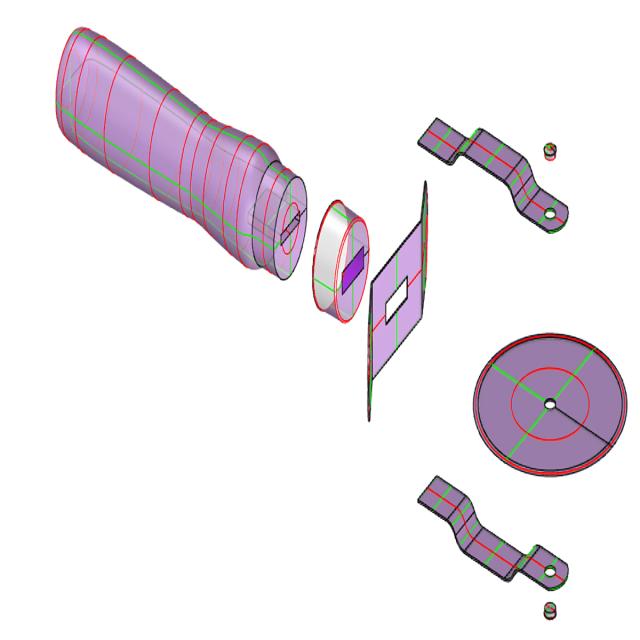
Learn basic 3D modeling skills, including modeling, texturing, and lighting, using free and open source tool: Blender. Animation is an emerging medium of communication, especially in education and entertainment domains. More and more learners are aspiring to make a career in animation. However, the animation training is expensive. One of the reasons is the high cost of proprietary software used for animation.

Class Deals by MOOC List - Click here and see EdX's Active Discounts, Deals, and Promo Codes.

This course uses open-source 3D animation tool Blender, to create a sustainable solution for animation skill development. Individuals interested in developing skill sets for 3D animation should take this course in order to learn the nuances of 3D modeling and Blender. The course has 4 weeks of content, which cover the basics of modelling, texturing, and lighting.
The course comprises slow paced video tutorials, quizzes, activities, and hands-on assignments. During the course learners will create 3D models of simple objects. The course uses video tutorials to explain the concepts and the software process required to create these objects. Course tutorials enable the learners to apply these concepts and create similar/new objects.
This course focuses only on modeling of non-organic objects (not covering character modeling).
This course is a prerequisite for Basic 3D animation using Blender.

What you'll learn

  • Explore 3D visualization concepts
  • Enhance your 3D modelling, texturing, and lighting skills
  • Apply the concept of the third dimension to create realistic 3D models
  • Learn the intricacies of a free and open source 3D animation tool: Blender
  • Collaborate online with students, teachers, and professionals all over the world
Go to Class
MOOC List is learner-supported. When you buy through links on our site, we may earn an affiliate commission.

Related Courses

Introduction to 3D Modeling (Coursera) Coursera
University of Michigan

Introduction to 3D Modeling (Coursera)

On this four-week practical course from the University of Michigan, you’ll not only learn how to use the Rhino software to create your 3D models, but you’ll also gain basic design skills to help bring your imagination to life. This course will guide you through 3D modeling within Rhino, so you’ll cover the fundamentals of the software as well as 3D modeling in general. You’ll first look at how to navigate the user interface and the different tools that you’ll be using to create models throughout this course. You’ll familiarize yourself with the 3D space and 3D objects before jumping straight in to create your own objects and building blocks.

Aug 10th 2026
4 Weeks
Data Science: Inference and Modeling (edX) EdX
HarvardX,Harvard University

Data Science: Inference and Modeling (edX)

Learn inference and modeling, two of the most widely used statistical tools in data analysis. Statistical inference and modeling are indispensable for analyzing data affected by chance, and thus essential for data scientists. In this course, you will learn these key concepts through a motivating case study on election forecasting.

Self Paced
Self-Paced
The 3D Printing Revolution (Coursera) Coursera
University of Illinois at Urbana-Champaign

The 3D Printing Revolution (Coursera)

This course will demonstrate how 3D printers work, show what people make with them, and examine the 3D printing ecosystem. It will also explore the future of 3D printing and discuss how this technology will revolutionize our world. Learners who complete this introductory course will have a solid understanding of 3D printing and its revolutionary potential, and will be able to print and customize 3D designs.

Aug 3rd 2026
2 Weeks
Basic Modeling for Discrete Optimization (Coursera) Coursera
University of Melbourne,The Chinese University of Hong Kong

Basic Modeling for Discrete Optimization (Coursera)

Optimization is a common form of decision making, and is ubiquitous in our society. Its applications range from solving Sudoku puzzles to arranging seating in a wedding banquet. The same technology can schedule planes and their crews, coordinate the production of steel, and organize the transportation of iron ore from the mines to the ports. Good decisions in manpower and material resources management also allow corporations to improve profit by millions of dollars.

Aug 17th 2026
4 Weeks
Groundwater Cycle (edX) EdX
Purdue University,PurdueX

Groundwater Cycle (edX)

The Earth is blue for its oceans but green for the blankets of groundwater under our feet. This course explores the water cycle from under the ground. How much groundwater do we use and what for? How much do the trees? How do we model water fluxes? This course explores the water cycle from an underground perspective. We start with the description of groundwater as a resource: How much is there? Where is it? How do we use it? How much groundwater do plants and trees use every year? How much water do aquifers lose during droughts? How much do they gain during rain events or in a typical year?

Jan 10th 2022
5-12 Weeks
Statistical Inference and Modeling for High-throughput Experiments (edX) EdX
HarvardX,Harvard University

Statistical Inference and Modeling for High-throughput Experiments (edX)

A focus on the techniques commonly used to perform statistical inference on high throughput data. In this course you’ll learn various statistics topics including multiple testing problem, error rates, error rate controlling procedures, false discovery rates, q-values and exploratory data analysis. We then introduce statistical modeling and how it is applied to high-throughput data. In particular, we will discuss parametric distributions, including binomial, exponential, and gamma, and describe maximum likelihood estimation.

Self Paced
Self-Paced
Procedural Modelling (edX) EdX
National University of Singapore,NUS

Procedural Modelling (edX)

This course will focus on the fundamentals of procedural programming for generating spatial models. You will learn how to code, using functions, data structures and control-flow statements. You will create procedures to generate geometric models with attribute data. By the end of the course, you will be able to write your own procedures for generating spatial information models.

Self Paced
Self-Paced
Foundations of Data Analysis - Part 1: Statistics Using R (edX) EdX
University of Texas at Austin,UTAustinX

Foundations of Data Analysis - Part 1: Statistics Using R (edX)

This is a hands on course with a data lab to teach fundamental statistical topics such as descriptive statistics, inferential testing, and modeling. In this first part of a two part course, we’ll walk through the basics of statistical thinking – starting with an interesting question. Then, we’ll learn the correct statistical tool to help answer our question of interest – using R and hands-on Labs.

No sessions available
5-12 Weeks
Principles of Modeling, Simulations, and Control for Electric Energy Systems (edX) EdX
MIT,MITx

Principles of Modeling, Simulations, and Control for Electric Energy Systems (edX)

Apply a dynamic systems-level approach and engage emerging research on efficient, sustainable, and physically and economically feasible electric power systems of the future. As global energy demand grows, to mitigate climate change we must drive a swift transition to clean energy resources and enhanced electric power grid infrastructure. In this course, you will explore systemic principles of future electric power system management, such as the role of smart grids, data-enabled machine learning, power electronics-control, and data-driven decision-making.

No session available
5-12 Weeks
Revit for Structural Engineers (edX) EdX
University System of Maryland - USM,USMx

Revit for Structural Engineers (edX)

Learn how to model basic building structural systems in Autodesk Revit. Building Information Modeling (BIM) has initiated a sea change in the way that buildings are designed and constructed. Old methods rooted in two-dimensional thinking have been pushed aside to make way for new three-dimensional approaches that leverage the latest advancements in computing technology.

Self Paced
Self-Paced