Applications of Software Architecture for Big Data (Coursera)

Applications of Software Architecture for Big Data (Coursera)

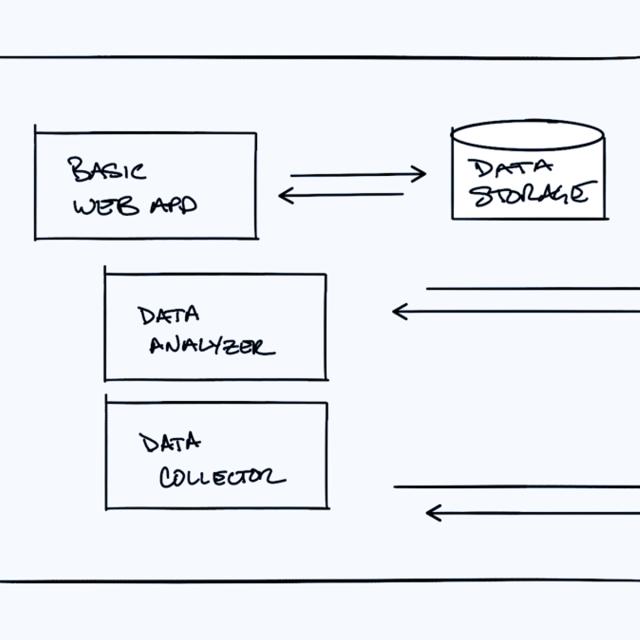
The course is intended for individuals who want to build a production-quality software system that leverages big data. You will apply the basics of software engineering and architecture to create a production-ready distributed system that handles big data. You will build data intensive, distributed system, composed of loosely coupled, highly cohesive applications.

Class Deals by MOOC List - Click here and see Coursera's Active Discounts, Deals, and Promo Codes.

Applications of Software Architecture for Big Data can be taken for academic credit as part of CU Boulder’s Master of Science in Data Science (MS-DS) degree offered on the Coursera platform. The MS-DS is an interdisciplinary degree that brings together faculty from CU Boulder’s departments of Applied Mathematics, Computer Science, Information Science, and others. With performance-based admissions and no application process, the MS-DS is ideal for individuals with a broad range of undergraduate education and/or professional experience in computer science, information science, mathematics, and statistics.
Course 3 of 3 in the Software Architecture for Big Data Specialization.

What You Will Learn

  • Practice software engineering fundamentals; test first development, refactoring, continuous integration, and continuous delivery.
  • Architect and create a big data or distributed system using rest collaboration, event collaboration, and batch processing.
  • Create a performant, scalable distributed system that handles big data.

Syllabus

WEEK 1
Project Overview
In this module, we will introduce a project where you can apply some of the concepts from Fundamentals of Software Architecture for Big Data. You will learn about the expectations for the project as well as how to establish features for the project.

WEEK 2
MVP & Development Environment
In this module you will learn about the concept of a Minimum Viable Product (MVP), how to incrementally add features to the MVP. Additionally, we will show you how to get going with a development environment and set up appropriate tests.

WEEK 3
Affixing Features
This module builds upon an MVP created in the previous module. Here we show you how to create a database, populate the database as well as analyze the data in the database. The module ends by elaborating on testing.

WEEK 4
Scaling your MVP & Wrapping Up
Here we add more features to the project inclusive of collaborative messaging. We end things off by building a simple health check for production monitoring and discussing acceptance testing.
Go to Class
MOOC List is learner-supported. When you buy through links on our site, we may earn an affiliate commission.

Related Courses

Python Scripting: Dates, Classes and Collections (Coursera) Coursera
LearnQuest

Python Scripting: Dates, Classes and Collections (Coursera)

This course is the second course in a series that aims to prepare you for a role working as a programmer. In this course, you will be introduced to the four main concepts in programming: Advanced String Operations and Dates, Modeling Classes, Development of Classes and Collections. Labs will allow the students to apply the material in the lectures in simple computer programs designed to re-enforce the material in the lesson.

Sep 28th 2026
4 Weeks
Relational Database Support for Data Warehouses (Coursera) Coursera
University of Colorado System

Relational Database Support for Data Warehouses (Coursera)

Relational Database Support for Data Warehouses is the third course in the Data Warehousing for Business Intelligence specialization. In this course, you'll use analytical elements of SQL for answering business intelligence questions. You'll learn features of relational database management systems for managing summary data commonly used in business intelligence reporting. Because of the importance and difficulty of managing implementations of data warehouses, we'll also delve into storage architectures, scalable parallel processing, data governance, and big data impacts. In the assignments in this course, you can use either Oracle or PostgreSQL.

Sep 28th 2026
5-12 Weeks
Cloud Computing Applications, Part 2: Big Data and Applications in the Cloud (Coursera) Coursera
University of Illinois at Urbana-Champaign

Cloud Computing Applications, Part 2: Big Data and Applications in the Cloud (Coursera)

Welcome to the Cloud Computing Applications course, the second part of a two-course series designed to give you a comprehensive view on the world of Cloud Computing and Big Data! In this second course we continue Cloud Computing Applications by exploring how the Cloud opens up data analytics of huge volumes of data that are static or streamed at high velocity and represent an enormous variety of information. Cloud applications and data analytics represent a disruptive change in the ways that society is informed by, and uses information.

Sep 28th 2026
4 Weeks
Infonomics I: Business Information Economics and Data Monetization (Coursera) Coursera
University of Illinois at Urbana-Champaign

Infonomics I: Business Information Economics and Data Monetization (Coursera)

Thriving in the Information Age compels organizations to deploy information as an actual business asset, not as an IT asset or merely as a business byproduct. This demands creativity in conceiving and implementing new ways to generate economic benefits from the wide array of information assets available to an organization. Unfortunately, information too frequently is underappreciated and therefore underutilized.

Oct 12th 2026
4 Weeks
Scalable Machine Learning on Big Data using Apache Spark (Coursera) Coursera
IBM

Scalable Machine Learning on Big Data using Apache Spark (Coursera)

This course will empower you with the skills to scale data science and machine learning (ML) tasks on Big Data sets using Apache Spark. Most real world machine learning work involves very large data sets that go beyond the CPU, memory and storage limitations of a single computer. Apache Spark is an open source framework that leverages cluster computing and distributed storage to process extremely large data sets in an efficient and cost effective manner. Therefore an applied knowledge of working with Apache Spark is a great asset and potential differentiator for a Machine Learning engineer.

Sep 28th 2026
4 Weeks
Deploying Machine Learning Models (Coursera) Coursera
University of California, San Diego

Deploying Machine Learning Models (Coursera)

In this course we will learn about Recommender Systems (which we will study for the Capstone project), and also look at deployment issues for data products. By the end of this course, you should be able to implement a working recommender system (e.g. to predict ratings, or generate lists of related products), and you should understand the tools and techniques required to deploy such a working system on real-world, large-scale datasets.

Sep 28th 2026
4 Weeks
Engineering Practices for Building Quality Software (Coursera) Coursera
University of Minnesota

Engineering Practices for Building Quality Software (Coursera)

Agile embraces change which means that team should be able to effectively make changes to the system as team learns about users and market. To be good at effectively making changes to the system, teams need to have engineering rigor and excellence else embracing change becomes very painful and expensive. In this course, you will learn about engineering practices and processes that agile and traditional teams use to make sure the team is prepared for change. In additional, you will also learn about practices, techniques and processes that can help team build high quality software. You will also learn how to calculate a variety of quantitative metrics related to software quality.

Sep 28th 2026
4 Weeks
Engineering Maintainable Android Apps (Coursera) Coursera
Vanderbilt University

Engineering Maintainable Android Apps (Coursera)

Engineering Maintainable Android Apps, which is a 4 week MOOC that shows by example various methods for engineering maintainable Android apps, including test-driven development methods and how to develop/run unit tests using JUnit and Robotium (or equivalent automated testing frameworks for Android), as well as how to successfully apply common Java/Android software patterns to improve the extensibility and clarity of Android apps.

Sep 28th 2026
4 Weeks
Big Data Analysis with Scala and Spark (Coursera) Coursera
École Polytechnique Fédérale de Lausanne

Big Data Analysis with Scala and Spark (Coursera)

Manipulating big data distributed over a cluster using functional concepts is rampant in industry, and is arguably one of the first widespread industrial uses of functional ideas. This is evidenced by the popularity of MapReduce and Hadoop, and most recently Apache Spark, a fast, in-memory distributed collections framework written in Scala. In this course, we'll see how the data parallel paradigm can be extended to the distributed case, using Spark throughout.

Oct 12th 2026
4 Weeks
Fundamentals of Big Data (Coursera) Coursera
LearnQuest

Fundamentals of Big Data (Coursera)

Welcome to Fundamentals of Big Data, the fourth course of the Key Technologies of Data Analytics specialization. By enrolling in this course, you are taking the next step in your career in data analytics. This course is the fourth of a series that aims to prepare you for a role working in data analytics. In this course, you will be introduced to many of the core concepts of big data.

Sep 28th 2026
3 Weeks