EdX

AI for Teachers (edX)

AI for Teachers (edX)

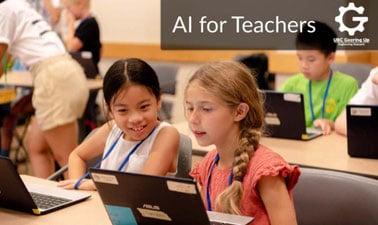
AI for Teachers is an activity focused, self-paced course designed to help educators prepare themselves and their students for a future which is becoming increasingly automated. Technology and computers are becoming more and more capable every day. Moving forward, computers will become increasingly good at solving problems. That means humans will become the problem finders and definers , translating the world into terms a computer can understand. This course is designed to teach you how to "speak" to computers, preparing you for a future in which computers are increasingly powerful and prevalent.

Class Deals by MOOC List - Click here and see EdX's Active Discounts, Deals, and Promo Codes.

What you'll learn

Intro & Welcome
Instructor Introduction
Overview of course
Content
Structure and Navigation
Module 1: Minds and Machines
Core Idea: Empathy, understanding differences between humans and computers
Imagining how the world “looks” to a computer
Allows for richer understanding of potential engineering problems
Developing respect and understanding for diverse perspectives on problems
How our assumptions can affect generated solutions
Module 2: Algorithms
Core Idea: Understanding and developing algorithms
Defining what is an algorithm
Developing computational thinking skills
Practice understanding and developing your own algorithms
Module 3: AI & Machine Learning
Core Idea: Data can be used to train and change the behaviour of an algorithm
Practicing training an algorithm by providing labeled data
Understanding how data can be created from the real world
Unpacking the process of how an algorithm is trained
Module 4: Creative AI
Core Idea: AI can be used to enhance human creative abilities **
Creating a story by using AI assisted tools to generate text, image and sound.
Learning about the future potential of AI
Module 5: AI and Society
Core Idea: Discussing the positive and negative impacts AI is having on society
Discuss potential pitfalls
Helps you become a better engineer
Protecting yourself and others from harmful effects
Emphasizing the influence humans have on the development of new technolog
Topics Include: Social Media, Bias, Automation
Module 6: Designing an App
Core Idea: Using what has been learned in the course to brainstorm and pitch an app idea. Optionally turn into a working prototype.
**
Learning the engineering design cycle and how to apply it
Generating solutions to real world problems by looking at the UN sustainable development goals


Go to Class
MOOC List is learner-supported. When you buy through links on our site, we may earn an affiliate commission.

Related Courses

CS50's Introduction to Artificial Intelligence with Python (edX) EdX
HarvardX,Harvard University

CS50's Introduction to Artificial Intelligence with Python (edX)

Learn to use machine learning in Python in this introductory course on artificial intelligence. AI is transforming how we live, work, and play. By enabling new technologies like self-driving cars and recommendation systems or improving old ones like medical diagnostics and search engines, the demand for expertise in AI and machine learning is growing rapidly. This course will enable you to take the first step toward solving important real-world problems and future-proofing your career.

Self Paced
Self-Paced
Dynamic Programming: Applications In Machine Learning and Genomics (edX) EdX
University of California, San Diego,UC San DiegoX

Dynamic Programming: Applications In Machine Learning and Genomics (edX)

Learn how dynamic programming and Hidden Markov Models can be used to compare genetic strings and uncover evolution. If you look at two genes that serve the same purpose in two different species, how can you rigorously compare these genes in order to see how they have evolved away from each other?

Self Paced
Self-Paced
Conceptual Change: How New Ideas Take Root (edX) EdX
Smithsonian,SmithsonianX

Conceptual Change: How New Ideas Take Root (edX)

Conceptual Change: How New Ideas Take Root — explores the ways students learn and develop new conceptual understandings, and shows how student misconceptions can be uncovered and addressed as a part of effective learning. This online workshop: Conceptual Change: How New Ideas Take Root? is based on ideas presented in Good Thinking! an original animated series developed by the Smithsonian Science Education Center (SSEC) and FableVision Studios as a professional development resource for K-12 science educators.

Self Paced
Self-Paced
Classroom Strategies for Inquiry-Based Learning (edX) EdX
University of Texas at Austin,UTAustinX

Classroom Strategies for Inquiry-Based Learning (edX)

Learn inquiry-based classroom practices to engage students in education through exploration. Inquiry-based learning aims to increase student engagement by helping learners develop hands-on, minds-on skills. This education and teacher training course explores the 5E instructional model and its uses in the classroom. You will have the opportunity to learn from videos of classroom teachers modeling a 5E lesson and access teacher commentary as they use inquiry-based strategies with their students. As a result, you will develop the skills and strategies needed to implement inquiry-based instruction in your own classroom.

Self Paced
Self-Paced
Probability and Statistics in Data Science using Python (edX) EdX
University of California, San Diego,UC San DiegoX

Probability and Statistics in Data Science using Python (edX)

Using Python, learn statistical and probabilistic approaches to understand and gain insights from data. The job of a data scientist is to glean knowledge from complex and noisy datasets. Reasoning about uncertainty is inherent in the analysis of noisy data. Probability and Statistics provide the mathematical foundation for such reasoning.

Self Paced
Self-Paced
Fundamentals of TinyML (edX) EdX
HarvardX,Harvard University

Fundamentals of TinyML (edX)

Focusing on the basics of machine learning and embedded systems, such as smartphones, this course will introduce you to the “language” of TinyML. What do you know about TinyML? Tiny Machine Learning (TinyML) is one of the fastest-growing areas of Deep Learning and is rapidly becoming more accessible. This course provides a foundation for you to understand this emerging field.

Self Paced
Self-Paced
Sign Language Science: Factors Contributing to Natural Learning (edX) EdX
Georgetown University,GeorgetownX

Sign Language Science: Factors Contributing to Natural Learning (edX)

This course promotes a better understanding of the factors that may affect how people learn signed language. In this course, we will look at how multiple, varying factors can account for language-learning patterns. Age, for example, is a key factor that predicts fluency. Another topic of particular importance to signed languages is the mind.

Self Paced
Self-Paced
Psicologia dell'apprendimento (edX) EdX
University of Naples Federico II,FedericaX

Psicologia dell'apprendimento (edX)

Un’analisi delle diverse forme dell’apprendimento per comprendere come operiamo le nostre scelte, la natura profondamente esperienziale dei processi di apprendimento e lo stretto legame che questi hanno con il contesto in cui l’individuo è inserito.

Self Paced
Self-Paced
Applications of TinyML (edX) EdX
HarvardX,Harvard University

Applications of TinyML (edX)

Get the opportunity to see TinyML in practice. You will see examples of TinyML applications, and learn first-hand how to train these models for tiny applications such as keyword spotting, visual wake words, and gesture recognition. Do you know what happens when you say “OK Google” to a Google device? Is your Google Home always listening? Following on the Foundations of Tiny ML course, Applications of TinyML will give you the opportunity to see tiny machine learning applications in practice. This course features real-world case studies, guided by industry leaders, that examine deployment challenges on tiny or deeply embedded devices.

Self Paced
Self-Paced