EdX

Teaching Critical Thinking through Art with the National Gallery of Art (edX)

Offered by Smithsonian, SmithsonianX,
Teaching Critical Thinking through Art with the National Gallery of Art (edX)

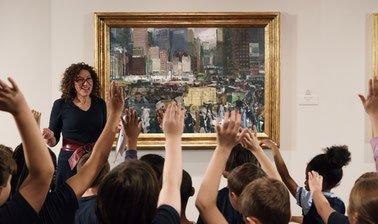
Learn how to integrate works of art using Artful Thinking routines, effective strategies from Project Zero at Harvard University, in this online course for teachers of all levels and subjects. Based on the National Gallery of Art’s popular Art Around the Corner professional development program for teachers in Washington, D.C., this five-part online course provides everything you need to begin creating a culture of critical thinking and collaboration for any classroom, subject, or level.

Class Deals by MOOC List - Click here and see EdX's Active Discounts, Deals, and Promo Codes.

You do not need an art background or museum access to successfully integrate the “Artful Thinking” course materials into your teaching. Your focused attention, willingness to experiment, and commitment to trying new discussion practices with your students is all that is required.

The strategies presented in this course are adapted from Artful Thinking pedagogy, developed by Project Zero at the Harvard Graduate School of Education. You will explore three thinking dispositions, using eight thinking routines that are easy to understand and implement. Starting with the disposition of observing and describing, you will learn how to guide your students in using their senses and communicating impressions of what they see in a work of art. The routines used in the second disposition, reasoning with evidence, ask students to make hypotheses about the art and support their arguments with observations. The questioning and investigating disposition challenges students to hone their natural curiosity by expressing their wonderings, formulating open-ended questions, and imagining implications. Throughout, you will discover the power of art to develop your students’ inclination to think deeply.
When you enroll, all the resources you need to strengthen critical thinking skills by using art for your classroom will be immediately available. We recommend that you spend a few hours learning and practicing each section before progressing to the next. The online course environment features over 20 videos and interactive tools: including a zoom tool to examine works of art at full resolution, polls to compare your thoughts with those of other participants, and discussion boards where teachers around the world will share ideas, plans, and results. Authentic lesson demonstration videos model routines led by real classroom and museum educators with students of varying ages. Interview videos provide focal points for teachers on topics like using thinking routines with emerging language learners and making accommodations for all learners. Having access to a global network of educators who, just like you, want to hone their abilities to teach critical thinking skills will be an added and enduring bonus to your course experience.

What you'll learn

  • How to use Artful Thinking Routines to strengthen thinking.
  • How to facilitate meaningful conversations in your classroom using art for artful learning and artful teaching.
  • How to help learners of all levels develop more discerning descriptions, evidence-based reasoning, and meaningful questioning habits.
  • Key strategies for using content information to push original thinking deeper.
  • Exciting, immersive activities for any type of classroom.
  • How to use learning resources from the National Gallery of Art, including downloadable artful thinking lesson plans

Syllabus

The course contains an introductory unit and four content units listed below. It will take approximately 14-20 hours to complete this self-paced course. Those who audit have access for 16 weeks. Those who register for the verified certificate have access of a full year.
Unit 0: Welcome (2 hours)
Unit 1: Diving into Thinking Routines (3-4 hours)
Unit 2: Observing and Describing (3-4 hours)
Unit 3: Reasoning with Evidence (3-4 hours)
Unit 4: Questioning and Investigating (3-4 hours)

Go to Class
MOOC List is learner-supported. When you buy through links on our site, we may earn an affiliate commission.

Related Courses

Hollywood: History, Industry, Art (edX) EdX
University of Pennsylvania

Hollywood: History, Industry, Art (edX)

Explore the history of Hollywood, from Edison and the birth of film to the rise of the internet. In this course you will learn about Hollywood and how it came to be the global powerhouse of today. We will discuss the complex Hollywood industry and how business and politics translate into the art of film, TV, and new media.

Self Paced
Self-Paced
Introduction to Family Engagement in Education (edX) EdX
HarvardX,Harvard University

Introduction to Family Engagement in Education (edX)

Learn about successful collaborations between families and educators and why they lead to improved outcomes for students and schools. In this education course, you will learn what family engagement is and why it matters to the success of students and schools. We will explore the research linking family engagement to better educational outcomes and speak directly with researchers, educators, students, and families about promising practices in the field.

Self Paced
Self-Paced
Critical Thinking & Problem Solving (edX) EdX
Rochester Institute of Technology,RITx

Critical Thinking & Problem Solving (edX)

The most successful professionals are able to assess the environment, analyze a situation, design a solution, and ultimately win in a competitive scenario. In today’s business environment, organizations have identified critical thinking and problem-solving as skills that are integral to an employee’s—and their organization’s—success.

Self Paced
Self-Paced
Introduction to Data Wise: A Collaborative Process to Improve Learning & Teaching (edX) EdX
HarvardX,Harvard University

Introduction to Data Wise: A Collaborative Process to Improve Learning & Teaching (edX)

Learn what is involved in using data wisely to build a culture of collaborative inquiry. Educators have an ever-increasing stream of data at their fingertips, but knowing how to use this data to improve learning and teaching — how to make it less overwhelming, more useful, and part of an effective collaborative process — can be challenging.

Self Paced
Self-Paced
Classroom Strategies for Inquiry-Based Learning (edX) EdX
University of Texas at Austin,UTAustinX

Classroom Strategies for Inquiry-Based Learning (edX)

Learn inquiry-based classroom practices to engage students in education through exploration. Inquiry-based learning aims to increase student engagement by helping learners develop hands-on, minds-on skills. This education and teacher training course explores the 5E instructional model and its uses in the classroom. You will have the opportunity to learn from videos of classroom teachers modeling a 5E lesson and access teacher commentary as they use inquiry-based strategies with their students. As a result, you will develop the skills and strategies needed to implement inquiry-based instruction in your own classroom.

Self Paced
Self-Paced
What Works in Education: Evidence-Based Education Policies (edX) EdX
Inter-American Development Bank - IDB,IDBx

What Works in Education: Evidence-Based Education Policies (edX)

Learn what works in education and how to identify, analyze and implement evidence-based education policies that improve learning. This course summarizes the main theoretical and practical research surrounding evidence-based education policies and delves into the key improvements and challenges observed in education systems in Latin America and the Caribbean.

Self Paced
Self-Paced
Cosmopolitan Tang: Aristocratic Culture in China (edX) EdX
HarvardX,Harvard University

Cosmopolitan Tang: Aristocratic Culture in China (edX)

Explore the reunification of China under the Tang with a focus on aristocratic culture — from poetry to calligraphy to literature. By the Tang period, China was divided into northern and southern dynasties with different rulers and political systems. The north was conquered by relatively unsophisticated barbarians, but in the south, the aristocratic families established a refined appreciation of writing and literature.

Self Paced
Self-Paced
Psicologia dell'apprendimento (edX) EdX
University of Naples Federico II,FedericaX

Psicologia dell'apprendimento (edX)

Un’analisi delle diverse forme dell’apprendimento per comprendere come operiamo le nostre scelte, la natura profondamente esperienziale dei processi di apprendimento e lo stretto legame che questi hanno con il contesto in cui l’individuo è inserito.

Self Paced
Self-Paced
Critical thinking: reasoned decision making (edX) EdX
Tecnológico de Monterrey,TecdeMonterreyX

Critical thinking: reasoned decision making (edX)

Learn to analyze events with intellectual rigor. Identify how reasoned decisions help cope with change. Making decisions in today's world, a world increasing in complexity, with broad changes and uncertainty, creates the need of approaches that allow us to discern the real problems and the causes that create them. Identifying these problems, in most cases, requires challenging the assumptions on which we base our judgments, regarding the world and its realities.

Self Paced
Self-Paced