Wheels of Metals: Urban Mining for a Circular Economy (Coursera)

Offered by Leiden University,
Wheels of Metals: Urban Mining for a Circular Economy (Coursera)

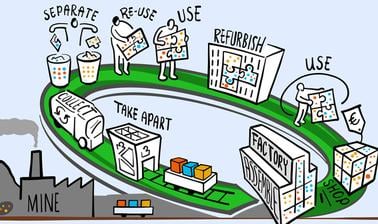
Population and welfare are growing. Providing the world with metals is becoming a major challenge. Only by closing the loop will metals be available in sufficient quantities, not just now but also in the future: urban mining, the substantial re-use and recycling of metals. In this MOOC we will explore the challenges related to metals supply, both scarcity and environmental impacts, and the conditions and consequences of a circular economy for metals, based on the reports of UNEP's International Resource Panel.

Class Deals by MOOC List - Click here and see Coursera's Active Discounts, Deals, and Promo Codes.

Metals are ubiquitous – they are all around us – and provide a foundation upon which our economies are built. Economic development is deeply coupled with the use of metals. During the 20th century the production has increased exponentially, and the variety of metal applications in society has grown rapidly. In addition to mass applications such as steel in buildings, copper in wires and aluminium in airplanes, more and more metals are required for innovative technologies such as the use of rare earth elements in renewable energy systems.
Worldwide, and in particular in emerging economies, the demand for metals is rapidly increasing. The continued increase in metals demand and use over the 20th century has led to substantial social, economic and environmental challenges. Mining activities expand but easily accessible deposits are becoming scarce. As a result, the supply of critical metals is under an increasing pressure. This implies recycling, also referred to as “urban mining”, is of growing importance in generating raw materials. In the end, the only really effective solution to the metals challenge may be to move towards a circular economy.
To be able to do that, information is needed on metal stocks in society, their size and residence time, as well as on the technologies that are available to recover these metals when the stocks become obsolete. This course, based on the reports of the Global Metals Flows Working Group of UNEP’s International Resource Panel (IRP), investigates the nature of the metals challenge and the conditions and the consequences of the way out: a circular economy for metals.
Note: This course is currently not available.

Related Courses

Design for Recycling of Electronics in a Circular Economy (edX) EdX
Delft University of Technology,DelftX

Design for Recycling of Electronics in a Circular Economy (edX)

Discover the latest developments in Design for Recycling (DfR) of electrical and electronic equipment (EEE) and the application of recycled plastics into new products. Electronic products bring countless benefits to society, but their production and waste treatment also lead to numerous negative environmental and economic impacts. Since E-waste is the world’s fastest growing waste stream, governments are setting ambitious targets to help this industry transition towards a circular economy.

Nov 10th 2021
4 Weeks
Wind Energy (Coursera) Coursera
Technical University of Denmark - DTU

Wind Energy (Coursera)

How tall is a modern wind turbine and how can it possibly generate power from the wind? This course gives an overview of key aspects in wind energy engineering. Whether you are looking for general insight in this green technology or your ambition is to pursue a career in wind energy engineering, 'Wind Energy' is an excellent starting point. Experts located in the wind pioneering country of Denmark will take you on a tour through the most fundamental disciplines of wind energy research such as wind measurements and resource assessment, aerodynamics, wind turbine technology, structural mechanics, materials, financial and electrical systems.

Jul 1st 2026
5-12 Weeks
Engineering Design for a Circular Economy (edX) EdX
Delft University of Technology,DelftX

Engineering Design for a Circular Economy (edX)

Discover and develop sustainable design and engineering methods to improve the reuse, repair, remanufacturing, and recycling of products for a circular economy. Products and equipment all around us are made of materials: look around you and you will see phones, computers, cars, and buildings. We face challenges in securing the supply of materials and the impact this has on the planet. Innovative product design can help us find solutions to these challenges. This course will explore new ways of designing products.

Self Paced
Self-Paced
Collage Workshop for Beginners - Using what you have at home (Skillshare) Skillshare
Skillshare

Collage Workshop for Beginners - Using what you have at home (Skillshare)

In this workshop you will learn the basic techniques for creating stunning collage art for you home. Using what you have in your home already. This class is for anyone who loves being creative, and for both adults and children. All you need is paper, glue and scissors. I will show you the easy steps to creating something beautiful and artistic, and I will give you my secret tips on how to do this easily.

Self Paced
Self-Paced
Advanced Inorganic Chemistry (saylor.org) Saylor Academy
Saylor.org

Advanced Inorganic Chemistry (saylor.org)

Advanced Inorganic Chemistry is designed to give you the knowledge to explain everyday phenomena of inorganic complexes. You will study the various aspects of their physical and chemical properties and learn how to determine the practical applications that these complexes can have in industrial, analytical, and medicinal chemistry.

Legacy Course
Self-Paced
The E-waste Challenge MOOC (Climate-KIC) Other Providers
United Nations Environment Programme - UNEP,KU Leuven University,Climate-KIC,World Resources Forum

The E-waste Challenge MOOC (Climate-KIC)

With our growing appetite for electrical and electronic products, combined with rapid innovation and ever-shorter product lifespans, e-waste has now become one of the fast growing waste streams. This course will help the participant to understand why and how we must manage e-waste in an environmentally sound manner and how we can take action on e-waste in their own life, business, or organization.

No sessions available
No Information
Entreprendre dans l'économie circulaire (FUN) FUN
Phenix

Entreprendre dans l'économie circulaire (FUN)

Dans un contexte de raréfaction des ressources naturelles et de prise de conscience de l’impact des activités humaines sur l’environnement, l’engagement dans une démarche écologique est souvent perçue comme un frein à la performance économique. A travers ce MOOC, nous présentons l’économie circulaire comme un levier d’innovation et de création de valeur économique à fort impact positif.

Oct 15th 2021
4 Weeks
The E-waste Challenge (EMMA) EMMA
Climate-KIC

The E-waste Challenge (EMMA)

E-waste can be a threat to our planet: Illegal and poorly managed e-waste is polluting our environment, harming human health, and contributing to human-made climate change. The worst impacts are often in the countries that are least equipped to manage it. Or it can be a valuable resource: By recycling materials contained in e-waste, we can save on greenhouse gas (GHG) emissions from primary mining, we can create green jobs, and we can create economic opportunities.

No sessions available
5-12 Weeks
Metal and Metalloids of the Main Groups: Basis and Their Role in the Daily Life (URJC) URJCx
Universidad Rey Juan Carlos

Metal and Metalloids of the Main Groups: Basis and Their Role in the Daily Life (URJC)

This course deals with the study of the basis in the metal and metalloid elements of the so-called Main Groups in the Periodic Table and their important role in Our Daily Life. During the course, students will address the dissemination of the most relevant physical and chemical properties of these elements, which are commonly treated in a specific inorganic chemistry course, through the assistance of spectacular lab videos.

No sessions available
5-12 Weeks