Teaching the Violin and Viola: Creating a Healthy Foundation (Coursera)

Teaching the Violin and Viola: Creating a Healthy Foundation (Coursera)

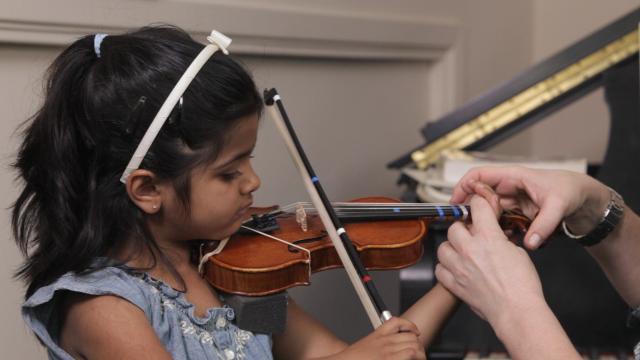
Join us as we explore the fundamental principles and early stages of teaching violin and viola through a series of engaging video lectures and lesson demonstrations, including: 1) Master classes with some of the world’s top string pedagogues, 2) Individual lesson demos of teaching violin/viola set up, left and right hand technique and pieces from the early violin/viola repertoire, 3) Group lesson demos of teaching music theory, ear training and fun activities that encourage good playing habits, and 4) A “field trip” to the violin shop, where we will outfit a new beginning student with a proper instrument and bow.

Class Deals by MOOC List - Click here and see Coursera's Active Discounts, Deals, and Promo Codes.

You’ll also engage in a series of discussions and reflections with colleagues and peers across the globe. Upon completion of this course, we hope you’ll return to your studio with confidence, a new curriculum, and a renewed approach to sharing with your students the joyful experience of making beautiful music.

Syllabus

WEEK 1
Beginning Stages
Welcome to Teaching the Violin and Viola: Creating a Healthy Foundation! We will begin by covering leading philosophies and pedagogical theories about teaching children the violin and viola. The beginning stages will cover the child’s setup, posture and first left hand techniques.

WEEK 2
Bow Arm and Hand
To introduce the use of the right hand, we start by creating a “pinky house” for the child’s bow. We delve further into the violin setup and positioning through various creative exercises.

WEEK 3
Putting It All Together
Now we get to put it all together by slowly incorporating the different movements of the right and left hand through four different pieces.

WEEK 4
Pieces in the Key of A Major
After good setup and posture have been established, we start teaching the fundamentals through elementary pieces in the key of A Major. We also get to learn our first scale!

WEEK 5
Playing with the Whole Bow
To transition to using the full bow, we introduce the “adult “ bow hold and a series of exercises to extend the bow stroke. Pieces include Long, Long Ago, O Come, Little Children, and Butterfly, Flutterby.

WEEK 6
Pieces in the Key of D Major
We can now introduce the key of D Major. Students learn the D major scale along with pieces such as Bach Musette and Hushabye Lullaby.

WEEK 7
Pieces in the Key of G Major
When we progress to the G Major scale and arpeggio, we start adding etudes and more advanced technical concepts. Pieces covered include Minuet and Happy Farmer.

WEEK 8
Note Reading, Vibrato, and the Group Class
To teach note reading, we will cover the best-practice teaching techniques for note reading and vibrato. We will also explore group teaching, group games, and group dynamics.

WEEK 9
Favorite Exercises for the Older Student
Now that our students are getting more advanced, we can begin to cover our favorite exercises for the older student. Exercises include "Poof Bow" and the "Invisible Violin."

WEEK 10
The Master Class
In our final segment, we will learn from top pedagogues Mimi Zweig and Roland and Almita Vamos in a master class setting.

Go to Class
MOOC List is learner-supported. When you buy through links on our site, we may earn an affiliate commission.

Related Courses

The Cycle: Management of Successful Arts and Cultural Organizations (Coursera) Coursera
University of Maryland, College Park

The Cycle: Management of Successful Arts and Cultural Organizations (Coursera)

What makes a successful arts and cultural organization? Led by DeVos Institute Chairman Michael M. Kaiser and President Brett Egan, this course will introduce you to a management theory called the Cycle which supports thriving arts and cultural organizations. Learning from our work with managers from over 80 countries around the world, the DeVos Institute developed the Cycle as a simple, but powerful tool to assist managers in their effort to respond to an increasingly complex environment and propel their institutions to excellence.

Aug 10th 2026
5-12 Weeks
ART of the MOOC: Activismo y Movimientos Sociales (Coursera) Coursera
Duke University,Creative Time

ART of the MOOC: Activismo y Movimientos Sociales (Coursera)

Este curso es para activistas, artistas y pensadores que deseen entender mejor el cambio social y participar en él. El contenido del curso enfoca en la coincidencia prolífica y emocionante entre el arte socialmente comprometido y prácticas culturales generadas por recientes movimientos sociales en todo el mundo. Más que evaluar la eficacia política de actividades como el luto, la escucha, la organización, el baile, o la fiesta, las conferencias examinan tales actividades culturales al lado y dentro de la práctica artística contemporánea.

Aug 17th 2026
5-12 Weeks
Music for Wellness (Coursera) Coursera
Berklee College of Music

Music for Wellness (Coursera)

You love music. You listen to music all the time. Maybe you sing, play an instrument, or compose music. You don’t need to have musical talent to use music to enhance your well being, and even your health. Learn simple techniques to enrich your mind, body, and spirit through music. The methods can be applied in your daily life, particularly when you are feeling down or stressed out.

Aug 17th 2026
4 Weeks
Composición de canciones (Coursera) Coursera
Berklee College of Music,Inter-American Development Bank - IDB

Composición de canciones (Coursera)

Aprende un proceso eficiente y efectivo para escribir canciones que expresen tus ideas y emociones, incluyendo una gama de herramientas que giren alrededor del concepto de prosodia; la adecuación de letra y música para apoyar tu mensaje subyacente.

Aug 17th 2026
5-12 Weeks
Jazz Improvisation (Coursera) Coursera
Berklee College of Music

Jazz Improvisation (Coursera)

Learn the basic concepts of improvisation from Gary Burton, one of the most renowned improvisers in the jazz world, including the mental, melodic, and harmonic processes that contribute to the instinctive skills that an improviser puts to use when taking a solo. While many people are fans of jazz and understand that musicians are often “making up” the notes they are playing during a performance, most people—often including musicians, themselves, who are beginning to learn improvising—aren’t clear about what exact processes take place to enable this to happen. The purpose of this course is to introduce the basic concepts of modern improvisation and how to go about mastering the different musical and mental skills involved.

Aug 10th 2026
5-12 Weeks
Pro Tools Basics (Coursera) Coursera
Berklee College of Music

Pro Tools Basics (Coursera)

Producing music is an incredibly creative process, and knowing the tools of the trade is essential in order to transmit the musical ideas in your head into the DAW in a creative and uninhibited way. Whether you have used a computer to create music before, or you have been curious about production for years, this 4-week course will give you an introductory look into the world of Avid Pro Tools and Pro Tools First.

Aug 17th 2026
4 Weeks
ART of the MOOC: Public Art and Pedagogy (Coursera) Coursera
Duke University,Creative Time

ART of the MOOC: Public Art and Pedagogy (Coursera)

Students of this course may try their hand at their own public art interventions, or simply focus on learning from the theory of public practice and its recent history. Designed by artist and Duke professor, Pedro Lasch, and co-taught by Creative Time artistic director, Nato Thompson, this course presents public culture and art in their radically reinenvented contemporary forms. The lectures link major developments of recent decades to wider topics like spatial politics, everyday social structures, and experimental education.

Aug 17th 2026
5-12 Weeks
Building Your Career as a Professional Singer (Coursera) Coursera
Berklee College of Music

Building Your Career as a Professional Singer (Coursera)

Are you looking to earn money on your singing ability? Have you been wondering how to lead a band, secure a gig, or identify the skills you need to stand out onstage? Becoming a professional singer today requires a variety of skills: from basic musicianship skills, arranging songs to best fit your style, recording demos, and even knowing how to manage your finances and book gigs. This course is designed to give singers insight on the tools you’ll need to start building a career as a professional singer.

Aug 17th 2026
4 Weeks
Guitar Scales and Chord Progressions (Coursera) Coursera
Berklee College of Music

Guitar Scales and Chord Progressions (Coursera)

You’ve got the guitar basics down: You can strum your guitar and play a few of your favorite songs, but you’re ready to take the tunes to the next level. In Guitar Scales and Chord Progressions you’ll expand your knowledge of scales, chord fingerings, and common chord progressions. You’ll also learn important skills for soloing, creating melodies, and adding depth and dimension to your guitar playing. This course is not only for the aspiring guitarist who has taken Berklee’s Guitar for Beginners, but also for guitarists who have let their six-string gather dust for too long, and want to brush up on techniques.

Aug 17th 2026
4 Weeks