What do paintings tell us about sex? How is art gendered? In this course we will study some of the world’s most beloved pictures guided by expert curators and art historians who step outside of the square, bringing a gendered reading to the masterpieces contained in the magnificent collections that we have been lucky enough to bring to the Coursera platform.
Class Deals by MOOC List - Click here and see Coursera's Active Discounts, Deals, and Promo Codes.
In this course you will learn how:
- Gender and sexuality is an integral part of the production and reception of works of art
- To increase your understanding of paintings through theories of gender and sexuality
- To understand key terms from gender-related theories of art history and museology
- To recognise the operation of what is termed ‘the gaze’ and how it works in relation to paintings
- Ideas about gender and sexuality can productively be employed in theorising art curatorial practices
- To take the initiative in relating theoretical ideas about gender and sexuality to the reading and display of art and visual cultures.
Syllabus
WEEK 1
Tiepolo’s Cleopatra
We begin this MOOC by introducing you to some of the theories about gender and sexuality that we will be calling upon throughout this course. We will look at the tradition of the representation of women in art and the operation of the 'male gaze', which renders most female subjects passive in pictures. We will focus, in this unit, on an unusual exception to this tradition, Tiepolo's Banquet of Cleopatra at the National Gallery of Victoria, in which we see Cleopatra depicted as a powerful regent. How does Tiepolo break the rules in this painting, emphasising Cleopatra’s agency? How did Tiepolo’s facility with paint work to produce this gendered narrative? And who exactly was Cleopatra?
WEEK 2
The Culture of Sensibility and the ‘Man of Feeling’
This week we examine in detail Thomas Gainsborough’s much loved Portrait of an officer of the Fourth Regiment of Foot, the portrait of Richard St George Mansergh-St George in the collection of the National Gallery of Victoria. Here we consider how Gainsborough produced his portrait of the young soldier through the ideals associated with the culture of sensibility, so much a part of late eighteenth century ruling class culture. How is the concept of the ‘man of feeling’ utilised in Gainsborough’s enigmatic portrait? What is the relevance of Gainsborough’s focus upon the soldier’s hound? What does the picture tell us about masculinity and the way the culture of sensibility was gendered in eighteenth century Britain?
WEEK 3
Gainsborough at the Huntington
We consider five pictures by Thomas Gainsborough in week three of this course that are held in the collection of the Huntington Gallery in California, through an explication of how the artist represented his subjects in the context of the culture of sensibility. Beginning with Gainsborough’s painting of Karl Friedrich Abel, we consider how the artist produced his portrait of masculinity through references to music, science and the senses. We then move to Gainsborough’s pendant portraits of Lord and Lady Ligonier, and The Blue Boy, focussing upon boundaries of gender and sexuality, including debates around effeminacy and passion between the sexes. We conclude with the Huntington’s Cottage Door, considering how this staged scene calls the viewer to look with charity upon impoverished rural women and their children.
WEEK 4
Sexual Codes in Eighteenth Century French Courtly Painting
This week Jennifer Milam, Professor of Art History at the University of Sydney, reveals the sexual codes and symbols of art in eighteenth century French painting. Professor Milam uncovers the erotic references imbedded in the courtly art of François Boucher and Jean-Honoré Fragonard. Two pastoral paintings by François Boucher form the centrepiece of this discussion of the playful and provocative representation of gender in the Ancien Régime. In addition, Professor Milam provides an in depth account of how these codes operated in some famous prints and drawings of the period.
WEEK 5
Orientalism, Gender and Display - Painting in Morocco
This week Dr Caroline Wallace and I present a study of two artists working in Morocco in the early twentieth century; the British Royal Academy painter John Lavery and the Australian modernist Hilda Rix Nicholas. They examine how these artists used orientalist conventions to represent a European point of view of life in Morocco. In this unit we consider how colonialism, orientalism and gender relate to each other, impacting upon academic and modernist art in a variety of ways that are not immediately apparent. We discuss how orientalist art is gendered, investigating why Rix Nicholas’ practice has been described as counter-orientalist.
WEEK 6
Henri Rousseau: Challenging the Myth of the Passive Woman
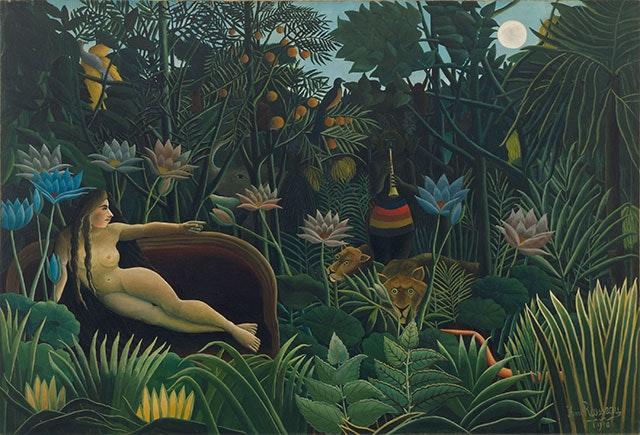
This week Professor Barbara Creed explores the way Henri Rousseau challenged the myth of the passive woman and relocates women as a vital source of creativity and mystery in art. In The Dream woman is represented as the new Eve living in harmony with nature in a jungle paradise, while in The Sleeping Gypsy woman is on an inner journey into the realms of the unconscious. Professor Creed explores the spiritual dimensions of this painting and offers a new and exciting interpretation of its historical significance.
WEEK 7
Henri Matisse, Paul Cezanne and Max Dupain - Modernism, Gender and the Science of Movement
Scientific advances in the nineteenth and early twentieth century created new ideas about male and female bodies. In a unique reading of Henri Matisse's Dance and Paul Cezanne's The Bather, we consider how Darwinian theory and science impacted upon the work of these French modernists and how modernism itself undercut erotic codes in art. Dr Isobel Crombie, Senior Curator of Photography at the National Gallery of Victoria, interprets the representation of gender in the work of the Australian photographer Max Dupain as an expression of the twentieth century movement of vitalism.
WEEK 8
Frida Kahlo, Glyn Philpot and the Struggle to Paint
This week we begin by looking at Frida Kahlo’s Fulang-Chang and I as well as her Self-Portrait with Cropped Hair Canvas. These lectures on Frida Kahlo's pictures at MOMA finish with a discussion between myself and Redmond Barry Distinguished Professor Barbara Creed in which we consider WJT Mitchell 's famous question 'what do pictures want? This is followed by a video on Glyn Philpot’s Oedipus presented by Dr Ted Gott, Senior Curator of International Art at the National Gallery of Victoria.
WEEK 9
What is Women’s Business? Indigenous Art and the Dreaming
National Gallery of Victoria Senior Curator of Indigenous Art, Judith Ryan, takes us deep into the Dreaming of the Australian Indigenous tradition. She examines in detail the making of two masterpieces by women artists from the Australian outback; Emily Kam Kngwarray's Big Yam Dreaming and Martumili artists’ Ngayartu Kujarra. In this unit we look at these iconic works in the context of ‘women's business’ and the gendered stories of indigenous Australia.