Patient Safety and Quality Improvement: Developing a Systems View (Patient Safety I) (Coursera)

Patient Safety and Quality Improvement: Developing a Systems View (Patient Safety I) (Coursera)

In this course, you will be able develop a systems view for patient safety and quality improvement in healthcare. By then end of this course, you will be able to: 1) Describe a minimum of four key events in the history of patient safety and quality improvement, 2) define the key characteristics of high reliability organizations, and 3) explain the benefits of having strategies for both proactive and reactive systems thinking.

Class Deals by MOOC List - Click here and see Coursera's Active Discounts, Deals, and Promo Codes.

What You Will Learn

  • Describe a minimum of four key events in the history of patient safety and quality improvement.
  • Define the key characteristics of high reliability organizations.
  • Explain the benefits of having strategies for both proactive and reactive systems thinking.

Course 1 of 7 in the Patient Safety Specialization.

Syllabus

WEEK 1
The History of Patient Safety and Quality Improvement
In this module, you will review the history of patient safety and quality improvement in healthcare. You will start with defining the scope of the problem of preventable harm in healthcare which leads into the history of the work that has been done to date that has helped to define, measure and improve preventable harm. You review three landmark reports to ensure you have a deep understanding of this work. At the end of this module, you will be able to: 1) identify a minimum of four key events in the history of patient safety an quality improvement, 2) describe the key characteristics of each of the three landmark patient safety publications and 3) summarize the impact of preventable harm on patients, communities and society.

WEEK 2
Definitions in Patient Safety and Quality Improvement: An Overview
In this module, you will be reviewing several key terms and tools that are used in patient safety and quality improvement. This will allow you to begin to develop the common language used among patient safety and quality improvement experts and practitioners. By the end of this module you will be able to: 1) differentiate between the terms harm, hazard, error and risk within a patient safety and quality improvement framework, 2) describe how quality and safety overlap and how they are different and 3) differentiate between root cause analysis and a failure mode and effects analysis.

WEEK 3
High Reliability Organizing and Why it Matters
In this module, you will learn the fundamental principles of high reliability organizing. At the end of this lesson, you will also be able to: 1) describe the socio-cultural characteristics of high reliability organizations (HROs), 2) compare and contrast healthcare with high reliability organizations and 3) identify three improvement tools for high reliability organizing.

WEEK 4
Applying a Systems Lens to Healthcare
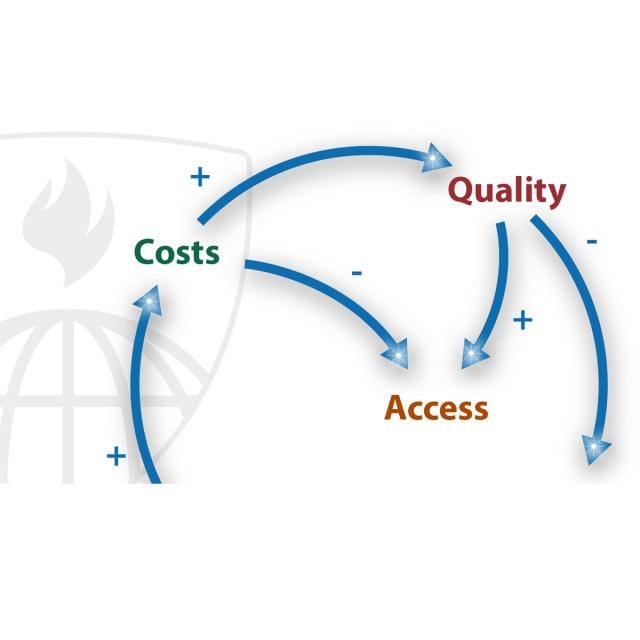
In this module, you will learn the basics of systems thinking and then apply these to a healthcare setting. At the end of this module, you will be able to 1) explain the basic components of a system, 2) differentiate first order problem solving and second order problem solving, 3) explain the benefits of having strategies for both proactive and reactive systems thinking.


Go to Class
MOOC List is learner-supported. When you buy through links on our site, we may earn an affiliate commission.

Related Courses

Understanding Clinical Research: Behind the Statistics (Coursera) Coursera
University of Cape Town

Understanding Clinical Research: Behind the Statistics (Coursera)

If you’ve ever skipped over`the results section of a medical paper because terms like “confidence interval” or “p-value” go over your head, then you’re in the right place. You may be a clinical practitioner reading research articles to keep up-to-date with developments in your field or a medical student wondering how to approach your own research. Greater confidence in understanding statistical analysis and the results can benefit both working professionals and those undertaking research themselves.

Jun 8th 2026
5-12 Weeks
Primeros Auxilios Psicológicos (PAP) (Coursera) Coursera
Universitat Autònoma de Barcelona

Primeros Auxilios Psicológicos (PAP) (Coursera)

Este curso on-demand (ABIERTO, se puede cursar en cualquier momento), impartido en castellano por la Universidad Autónoma de Barcelona y el Centro de Crisis de Barcelona, está destinado a entrenar en la aplicación de primeros auxilios psicológicos (PAP) a personas afectadas por situaciones altamente estresantes, abarcando tanto emergencias cotidianas (incidentes críticos estadísticamente frecuentes que afectan de manera muy intensa: un accidente de tráfico, una hospitalización, una agresión o la muerte traumática o repentina de una persona, etc.) como emergencias comunitarias y/o masivas (sucesos infrecuentes, que afectan a muchas personas o a una comunidad entera y que sobrepasan con mucho lo que sucede habitualmente en ella: una catástrofe natural, un accidente ferroviario o aéreo o un atentado).

Jun 8th 2026
5-12 Weeks
HI-FIVE: Health Informatics For Innovation, Value & Enrichment (Clinical Perspective) (Coursera) Coursera
Columbia University

HI-FIVE: Health Informatics For Innovation, Value & Enrichment (Clinical Perspective) (Coursera)

HI-FIVE (Health Informatics For Innovation, Value & Enrichment) Training is a 12-hour online course designed by Columbia University in 2016, with sponsorship from the Office of the National Coordinator for Health Information Technology (ONC). The training is role-based and uses case scenarios. Also, it has additional, optional modules on other topics of interest or relevance. Although we suggest to complete the course within a month's timeframe, the course is self-paced and so you can start and finish the course at anytime during a month's time period. No additional hardware or software are required for this course.

Jun 8th 2026
4 Weeks
Diagnosing Health Behaviors for Global Health Programs (Coursera) Coursera
Johns Hopkins University

Diagnosing Health Behaviors for Global Health Programs (Coursera)

Health behavior lies at the core of any successful public health intervention. While we will examine the behavior of individual in depth in this course, we also recognize by way of the Ecological Model that individual behavior is encouraged or constrained by the behavior of families, social groups, communities, organizations and policy makers. We recognize that behavior change is not a simplistic process but requires an understanding of dimensions like frequency, complexity and cultural congruity. Such behavioral analysis is strengthened through the use of a toolkit of theoretical models and practical frameworks.

Jun 8th 2026
4 Weeks
Positive Psychology: Resilience Skills (Coursera) Coursera
University of Pennsylvania

Positive Psychology: Resilience Skills (Coursera)

Learn how to incorporate resilience interventions into your personal and professional life with Dr. Karen Reivich. In this course, you are exposed to the foundational research in resilience, including protective factors such as mental agility and optimism. Several types of resilience interventions are explored including cognitive strategies; strategies to manage anxiety and increase positive emotions such as gratitude; and a critical relationship enhancement skill.

Jun 8th 2026
4 Weeks
Take the Lead on Healthcare Quality Improvement (Coursera) Coursera
Case Western Reserve University

Take the Lead on Healthcare Quality Improvement (Coursera)

In this course you will learn about the importance of quality in healthcare and how you can contribute by implementing a quality improvement (QI) project to improve processes of care and patient outcomes. You will learn about powerful tools to add to your QI ‘toolbox’ during short lectures and reflective exercises. You will apply these tools to the implementation of a QI project in your own practice setting or an area of personal improvement. At the completion of the course, you will have a storyboard that captures your QI project success to share with others.

Jun 8th 2026
5-12 Weeks
Introduction to the Biology of Cancer (Coursera) Coursera
Johns Hopkins University

Introduction to the Biology of Cancer (Coursera)

Over 500,000 people in the United States and over 8 million people worldwide are dying every year from cancer. As people live longer, the incidence of cancer is rising worldwide and the disease is expected to strike over 20 million people annually by 2030. This open course is designed for people who would like to develop an understanding of cancer and how it is prevented, diagnosed, and treated.

Jun 8th 2026
5-12 Weeks
Understanding Cancer Metastasis (Coursera) Coursera
Johns Hopkins University

Understanding Cancer Metastasis (Coursera)

Over 500,000 people in the United States and over 8 million people worldwide are dying from cancer every year. As people live longer, the incidence of cancer is rising worldwide, and the disease is expected to strike over 20 million people annually by 2030. Everyone has been, or will be touched by cancer in some way during their lifetime. Thanks to years of dedication and commitment to research we’ve made enormous advances in the prevention and treatment of cancer, But there is still a lot of work to be done. In this course, physicians and scientists at the Johns Hopkins School of Medicine explain how cancer spreads or metastasizes.

Jun 8th 2026
3 Weeks
Paleontology: Early Vertebrate Evolution (Coursera) Coursera
University of Alberta

Paleontology: Early Vertebrate Evolution (Coursera)

Paleontology: Early Vertebrate Evolution is a four-lesson course teaching a comprehensive overview of the origin of vertebrates. Students will explore the diversity of Palaeozoic lineages within a phylogenetic and evolutionary framework .This course examines the evolution of major vertebrate novelties including the origin of fins, jaws, and tetrapod limbs. Students also explore key Canadian fossil localities, including the Burgess Shale (British Columbia), Miguasha (Quebec), and Man On The Hill (Northwest Territories).

Jun 10th 2026
4 Weeks
Health Across the Gender Spectrum (Coursera) Coursera
Stanford University

Health Across the Gender Spectrum (Coursera)

This course offers an intimate, story-based introduction to the experiences of six transgender children and their families. Through illustrated stories and short teaching videos, learners will gain a better understanding of gender identity and the gender spectrum. Stanford physicians, K-12 educators, and transgender faculty members offer practical tips for parents, teachers, healthcare providers and anyone who wants to help create a more gender-expansive environment - one in which all people can live authentically. As a global community of unique individuals, we can begin to build a world that is ready to nurture and love each and every child.

Jun 8th 2026
3 Weeks