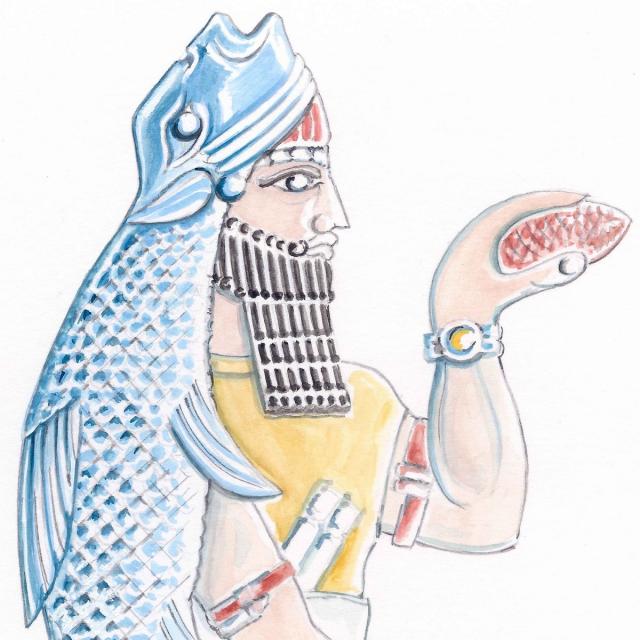
Organising an Empire: The Assyrian Way (Coursera)

Organising an Empire: The Assyrian Way (Coursera)

Discover the mighty kingdom of Assyria, which came to be the world’s first great empire three thousand years ago. From the 9th to the 7th centuries BC, during the imperial phase of Assyria’s long history, modern day northern Iraq was the central region of a state reaching from the Mediterranean Sea to the Persian Gulf, and incorporating what is now Iraq, Syria, and Lebanon, as well as half of Israel, and wide parts of south-eastern Turkey, and Western Iran.

Class Deals by MOOC List - Click here and see Coursera's Active Discounts, Deals, and Promo Codes.

In its geographical extent, this state was unprecedentedly large, and the distinct geography of the Middle East, with deserts and high mountain ranges, posed challenges to communication and cohesion. What were the mechanisms that kept the Empire running? This course explores the methods the Assyrian government employed to ensure unity and maintain loyalty across vast distances, using traditional as well as innovative strategies. Some of these imperial techniques have marked parallels in the ways modern multi-national corporations are operating, others will strike you as profoundly alien.
This course focusses on how the Assyrians organised their empire by analysing key aspects, namely:
· The CEO – the king, a religious, political and military leader, who is charged to govern by his master, the god Assur;
· Home Office – the royal palace in the central region and the royal court that form the administrative centre of the state;
· The Regional Managers – the governors and client-rulers to whom local power is delegated;
· Human Resources – the Empire’s people are its most precious assets, its consumers and its key product, as the goal of the imperial project was to create “Assyrians”; an approach with lasting repercussions that still reverberate in the Middle East today; and finally
· The Fruits of Empire – it takes a lot of effort, so what are the rewards?
When we explore these topics we will contextualise them with information about the lives led by ordinary Assyrian families.
Taking this course will provide you with an overview of the political, social, religious, and military history of the world’s first superpower. It will give you insight into the geography and climatic conditions of the Middle East and contribute to your understanding of the opportunities and challenges of that region. It will present you with a vision of the Middle East at a time when its political and religious structures were very different from today.

Syllabus

WEEK 1: Introducing Ancient Assyria
WEEK 2: Meet the CEO: The Assyrian King
WEEK 3: A Visit to the Head Office: The Royal Capital and Court
WEEK 4: Regional Managers: Outsourcing Power
WEEK 5: Human Resources: Commodities, Consumers, and Product
WEEK 6: The Fruits of Empire: Expenses and Revenue
Go to Class
MOOC List is learner-supported. When you buy through links on our site, we may earn an affiliate commission.

Related Courses

History of Rock, Part Two (Coursera) Coursera
University of Rochester

History of Rock, Part Two (Coursera)

This course, part 2 of a 2-course sequence, examines the history of rock, primarily as it unfolded in the United States, from the early 1970s to the early 1990s. This course covers the music of Led Zeppelin, the Allman Brothers, Carole King, Bob Marley, the Sex Pistols, Donna Summer, Michael Jackson, Madonna, Prince, Metallica, Run-DMC, and Nirvana, and many more artists, with an emphasis both on cultural context and on the music itself. We will also explore how developments in the music business and in technology helped shape the ways in which styles developed.

Aug 3rd 2026
5-12 Weeks
The Modern and the Postmodern (Part 2) (Coursera) Coursera
Wesleyan University

The Modern and the Postmodern (Part 2) (Coursera)

This course examines how the idea of "the modern" develops at the end of the 18th century in European philosophy and literature, and how being modern (or progressive, or hip) became one of the crucial criteria for understanding and evaluating cultural change. Are we still in modernity, or have we moved beyond the modern to the postmodern?

Aug 10th 2026
5-12 Weeks
William Shakespeare's Twelfth Night: Comedy, Conflict, and Community (Coursera) Coursera
University of Colorado Boulder

William Shakespeare's Twelfth Night: Comedy, Conflict, and Community (Coursera)

This course introduces and explores William Shakespeare’s classic comedy, Twelfth Night. Interviews with actors who appeared in the Colorado Shakespeare Festival’s 2019 production of Twelfth Night, as well as lectures by scholars and theater professionals who work and teach at the University of Colorado Boulder, offer students insight into Shakespeare’s artistic vision and its applications.

Aug 17th 2026
5-12 Weeks
The Mediterranean, a Space of Exchange (from the Renaissance to Enlightenment) (Coursera) Coursera
University of Barcelona

The Mediterranean, a Space of Exchange (from the Renaissance to Enlightenment) (Coursera)

The course The Mediterranean, a Space of Exchange (from Renaissance to Enlightenment) aims to explain the Mediterranean, using history and the analysis of the past, as a space generated by routes and circulation. We consider it crucial to disclose mobility as a historical factor: a mobility comprised of four major elements, namely people, objects, ideas and practices.

Aug 14th 2026
5-12 Weeks
What Is Contemporary Art? (Coursera) Coursera
The Museum of Modern Art

What Is Contemporary Art? (Coursera)

What is contemporary art? In this course, you’ll consider this question through more than 70 works of art made between 1980 and the present, with a focus on art from the past decade. You’ll hear directly from artists, architects, and designers from around the globe about their creative processes, materials, and inspiration.

Aug 17th 2026
5-12 Weeks
Miracles of Human Language: An Introduction to Linguistics (Coursera) Coursera
Leiden University,Meertens Instituut - KNAW

Miracles of Human Language: An Introduction to Linguistics (Coursera)

Everywhere, every day, everybody uses language. There is no human society, no matter how small or how isolated, which does not employ a language that is rich and diverse. This course introduces you to linguistics, featuring interviews with well-known linguists and with speakers of many different languages. Join us to explore the miracles of human language!

Aug 17th 2026
5-12 Weeks
Structuring Values in Modern China (Coursera) Coursera
The Chinese University of Hong Kong

Structuring Values in Modern China (Coursera)

This sequence of four courses will propose a multi-disciplinary approach to the study of Chinese cultural history conceived of as a succession of modes of rationality (philosophical, bureaucratic, and economic). The focus will be on the moments of paradigm shift from one mode of rationality to another. For each of these moments, cultural facts and artifacts—thought, literature, ritual—will be examined in relationship to changing social, political, and economic systems.

Aug 17th 2026
5-12 Weeks
Reimagining Blackness and Architecture (Coursera) Coursera
The Museum of Modern Art

Reimagining Blackness and Architecture (Coursera)

Architecture structures our daily lives. It shapes our homes, streets, neighborhoods, cities and more. But who gets to create and occupy these spaces? In the United States, a long history of anti-Black racism has created spatial inequalities that are built into the physical environment and erased the stories of Black architects and communities. Reimagining Blackness and Architecture explores the relationship between architecture and Blackness as an identity and a lived experience.

Aug 10th 2026
5-12 Weeks