Introduction to Public Health Engineering in Humanitarian Contexts (Coursera)

Introduction to Public Health Engineering in Humanitarian Contexts (Coursera)

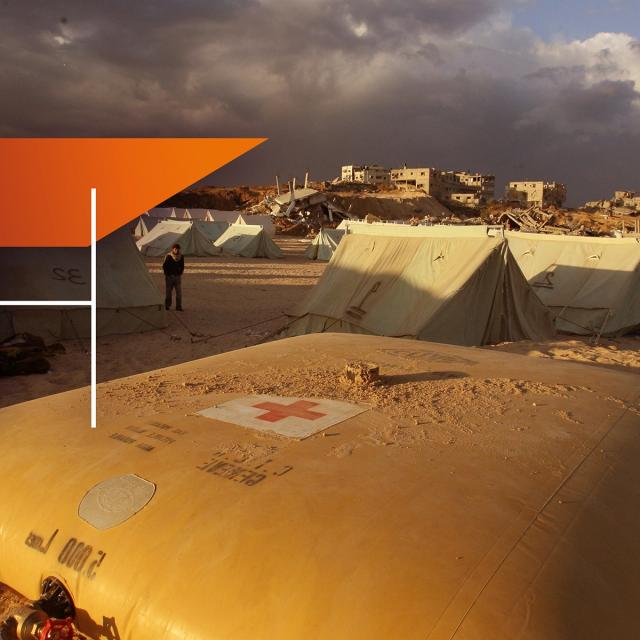
The world is facing unprecedented humanitarian needs. Today’s humanitarian crisis tend to be greater in number, often in urban settings, longer in duration and broader in regional impact. They generate human sufferings on a greater scale, disrupt essential services, such as water supply or sanitation and put health of large population at risk. Engineers and technical specialists in water, sanitation, energy, environment, and in other related fields play a vital role to respond to these challenges and growing needs.

Class Deals by MOOC List - Click here and see Coursera's Active Discounts, Deals, and Promo Codes.

In the humanitarian sector, they are called the public health engineers and today they are increasingly needed! Why public health engineering matters so much in humanitarian crises? And how its related activities are carrying out in such complex environment? This is what this MOOC is all about! The EPFL, EAWAG-SANDEC and ICRC have decided to partner to guide you through this introduction to the fascinating field of public health engineering in humanitarian contexts.

Syllabus

WEEK 1
Public Health Engineering
The first week introduces the topic of public health engineering and see how engineers can have a significant impact to reduce the mortality and morbidity encountered in many humanitarian contexts. In order to do so, engineers should have a good understanding on how infectious diseases are transmitted. This is why you will be introduced to different environmental transmission pathways of diseases and you will see some measures to be taken to prevent the spread of some diseases. Real study case examples will be introduced to support the understanding.

WEEK 2
Humanitarian contexts
During this week, the humanitarian context in which public health engineering activities take place is presented. We will see how protracted conflicts affect urban essential services, such as water supply and sanitation, resulting in public health issues.

WEEK 3
WATER SUPPLY SYSTEMS
The week does a review of water technologies commonly used from the source to the distribution point. We discuss some pros and cons of different water systems that may be encountered in humanitarian contexts.

WEEK 4
Sanitation
The fourth week does a review of sanitation technologies and excreta management. Case studies illustrate some challenges and practices in humanitarian sector.

WEEK 5
Waste management & Hygiene promotion
We focus on a type of solid waste that public health engineers often encounter in humanitarian crises: medical waste. Finally, we discuss the critical issue of behavior change and hygiene promotion in humanitarian crises.


Go to Class
MOOC List is learner-supported. When you buy through links on our site, we may earn an affiliate commission.

Related Courses

Cybersecurity Policy for Water and Electricity Infrastructures (Coursera) Coursera
University of Colorado System

Cybersecurity Policy for Water and Electricity Infrastructures (Coursera)

This course will examine the drinking water and electricity infrastructures, and various policies that have been developed to help guide and strengthen their cybersecurity programs. The drinking water and electricity infrastructures are two of fourteen subsectors comprising what are known as "lifeline infrastructure". The 2013 National Infrastructure Protection Plan identifies four lifeline infrastructure sectors: 1) water, 2) energy, 3) transportation, and 4) communications. These sectors are designated "lifeline" because many other infrastructures depend upon them.

Jun 1st 2026
4 Weeks
Our Energy Future (Coursera) Coursera
University of California, San Diego

Our Energy Future (Coursera)

This course is designed to introduce students to the issues of energy in the 21st century – including food and fuels – which are inseparably linked – and will discuss energy production and utilization from the biology, engineering, economics, climate science, and social science perspectives. This course will cover the current production and utilization of energy, as well as the consequences of this use, examining finite fossil energy reserves, how food and energy are linked, impacts on the environment and climate, and the social and economic impacts of our present energy and food production and use.

Jun 1st 2026
5-12 Weeks
Electric Industry Operations and Markets (Coursera) Coursera
Duke University

Electric Industry Operations and Markets (Coursera)

This is a two week course. In the first week you will learn about the core activities that the Industry executes to bring electricity to customers. We will review what electricity is, how it is generated, how it is transmitted, how it comes into buildings, and how consumption of electricity instantly feeds back on the transmission and generation of electricity.

Jun 1st 2026
2 Weeks
Global Warming I: The Science and Modeling of Climate Change (Coursera) Coursera
University of Chicago

Global Warming I: The Science and Modeling of Climate Change (Coursera)

This class describes the science of global warming and the forecast for humans’ impact on Earth’s climate. Intended for an audience without much scientific background but a healthy sense of curiosity, the class brings together insights and perspectives from physics, chemistry, biology, earth and atmospheric sciences, and even some economics—all based on a foundation of simple mathematics (algebra).

Jun 1st 2026
5-12 Weeks
Global Energy and Climate Policy (Coursera) Coursera
University of London,SOAS University of London

Global Energy and Climate Policy (Coursera)

The Global Energy and Climate Policy course offers an introduction to the theoretical and practical understanding of how energy and climate change policies are designed, shaped, advocated and implemented. As energy markets go truly global, domestic energy policies are becoming more and more entangled with wider issues of international governance. Concurrently, the urgent need to mitigate and adapt to climate change and transition to a low-carbon future is adding a further layer of complexity.

Jun 1st 2026
5-12 Weeks
Sustainable Business: Big Issues, Big Changes (Coursera) Coursera
University of Colorado System

Sustainable Business: Big Issues, Big Changes (Coursera)

This is class 3 in the MOOC specialization, Become a Sustainable Business Change Agent. This class looks at the big issues companies are fixing - climate change, water, worker satisfaction and supply chain issues. You will learn tools to help your company address these issues intelligently. The class ends with an assignment to set a science-based carbon reduction target for a small company. Tis is absolutely cutting edge material. Only about 300 companies in the whole world are doing this as of July 2017. You could put your company in the elite group!

Jun 1st 2026
5-12 Weeks
Introduction to the Arctic: Climate (Coursera) Coursera
University of Alberta

Introduction to the Arctic: Climate (Coursera)

The University of Alberta, the University of Tromso and the University of the Arctic invite you to explore this four week course that examines the environment and climate of the circumpolar North. This course is the result of an international collaboration and provides you with an insight into our planet's North. Following an overview of regional geography, we will focus on the cryosphere (ice), as well as the atmosphere and ocean of the region.

Jun 1st 2026
4 Weeks
Systems Science and Obesity (Coursera) Coursera
Johns Hopkins University

Systems Science and Obesity (Coursera)

Systems science has been instrumental in breaking new scientific ground in diverse fields such as meteorology, engineering and decision analysis. However, it is just beginning to impact public health. This seminar is designed to introduce students to basic tools of theory building and data analysis in systems science and to apply those tools to better understand the obesity epidemic in human populations.

Jun 1st 2026
4 Weeks
General Chemistry: Concept Development and Application (Coursera) Coursera
Rice University

General Chemistry: Concept Development and Application (Coursera)

This course will cover the topics of a full year, two semester General Chemistry course. We will use a free on-line textbook, Concept Development Studies in Chemistry, available via Rice’s Connexions project. The fundamental concepts in the course will be introduced via the Concept Development Approach developed at Rice University. In this approach, we will develop the concepts you need to know from experimental observations and scientific reasoning rather than simply telling you the concepts and then asking you to simply memorize or apply them.

Jun 1st 2026
5-12 Weeks
Public Involvement in Research (Coursera) Coursera
Imperial College London

Public Involvement in Research (Coursera)

This course focuses on participatory approaches in research, known as 'public involvement' in the UK. You'll specifically, consider why citizens and patients would be involved in research and explore participatory approaches across and within the research cycle in more detail, diving into questions such as: What kinds of participation can be undertaken at each of the 7 stages of the cycle? How can you utilise participation in research? What examples of using participatory approaches exist in research?

Jun 3rd 2026
4 Weeks