Introduction to Mechanical Engineering Design and Manufacturing with Fusion 360 (Coursera)

Offered by Autodesk,
Introduction to Mechanical Engineering Design and Manufacturing with Fusion 360 (Coursera)

Design for manufacturing is the process of designing parts, components, or products with the understanding surrounding design requirements for a specific manufacturing method. This course explores the design for manufacture workflow and shows how to validate models and create the G code, the programming language needed to instruct the CNC machine on how to move.

Class Deals by MOOC List - Click here and see Coursera's Active Discounts, Deals, and Promo Codes.

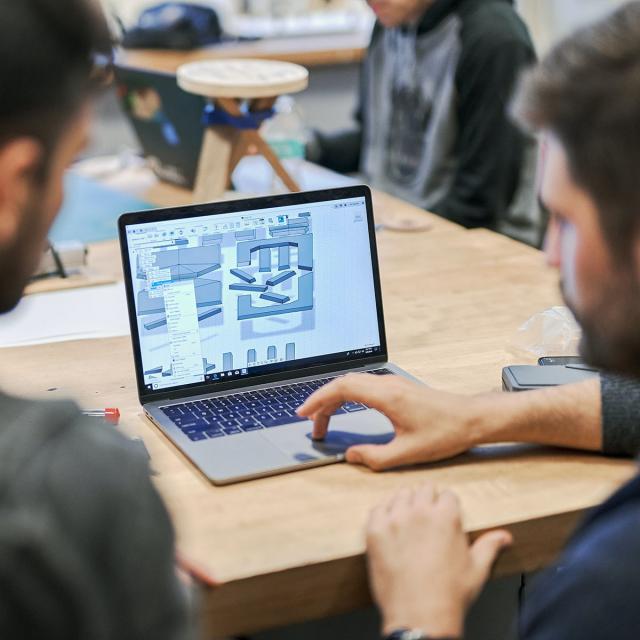
We practice the basics of part and assembly design, and tools such as animation, rendering, and simulations using Autodesk Fusion 360. We learn the basics in each of these areas which are to be fully developed in later courses that apply these principles and Fusion 360 skills.
After taking this course, you'll be able to:

  • Explain the design to manufacturing process used to take a digital model to a physical part through CNC programming.
  • Summarize the toolset available in Fusion 360.
  • Demonstrate knowledge and skills in Fusion 360 applying design and manufacturing workflows to take digital parts to physical prototypes.

Course 1 of 4 in the Autodesk CAD/CAM/CAE for Mechanical Engineering Specialization.
What You Will Learn

  • Explain the design to manufacturing process used to take a digital model to a physical part through CNC programming.
  • Summarize the toolset available in Fusion 360.
  • Demonstrate knowledge and skills in Fusion 360 applying design and manufacturing workflows to take digital parts to physical prototypes.

Syllabus

WEEK 1
The future of manufacturing and innovation
In Week 1, we’ll review how Fusion 360 relates to current trends in the industry. By identifying career skills required for mechanical engineers, we can better understand the toolset needed and how Fusion 360 can help.

WEEK 2
Fusion 360 Foundational Concepts
In Week 2, we’ll gain a better understanding of Fusion 360 by learning the basics of file storage and management and also learn how to transition into Fusion 360 from another CAD application.

WEEK 3
Introduction to CAD Modeling
In Week 3, we’ll explore the design aspects of Fusion 360 including sketching, modeling, assembly creation, animation, rendering, and detailed drawings. These various skills make up the core of CAD functionality in Fusion 360. We'll apply these skills as part of our design for manufacturing design approach.

WEEK 4
Introduction to CAM and CAE
In Week 4, we’ll explore how to use Fusion 360 to create simulations and G-code for CNC machining. These integrated tools help complete the design for manufacturing process using the design, engineering and manufacturing tools in Fusion 360.


Go to Class
MOOC List is learner-supported. When you buy through links on our site, we may earn an affiliate commission.

Related Courses

Materials Science: 10 Things Every Engineer Should Know (Coursera) Coursera
University of California, Davis

Materials Science: 10 Things Every Engineer Should Know (Coursera)

We explore “10 things” that range from the menu of materials available to engineers in their profession to the many mechanical and electrical properties of materials important to their use in various engineering fields. We also discuss the principles behind the manufacturing of those materials. By the end of the course, you will be able to: recognize the important aspects of the materials used in modern engineering applications; explain the underlying principle of materials science: “structure leads to properties,”; identify the role of thermally activated processes in many of these important “things” – as illustrated by the Arrhenius relationship; relate each of these topics to issues that have arisen (or potentially could arise) in your life and work.

Sep 28th 2026
5-12 Weeks
The Finite Element Method for Problems in Physics (Coursera) Coursera
University of Michigan

The Finite Element Method for Problems in Physics (Coursera)

This course is an introduction to the finite element method as applicable to a range of problems in physics and engineering sciences. The treatment is mathematical, but only for the purpose of clarifying the formulation. The emphasis is on coding up the formulations in a modern, open-source environment that can be expanded to other applications, subsequently.

Oct 5th 2026
13-24 Weeks
Self Awareness and the Effective Leader (Coursera) Coursera
Rice University

Self Awareness and the Effective Leader (Coursera)

Part of being an effective leader is learning how to play to your strengths and overcome characteristics that don't lend to good leadership practices. During the course, you will examine your own strengths and learn ways to use them in a leadership role. Learn to manage stress and solve problems creatively. Throughout the course, you will also build a tool kit of useful techniques that you can begin using right away in your engineering career.

Sep 28th 2026
5-12 Weeks
Chemical Engineering Thermodynamics 1 (Coursera) Coursera
Korea Advanced Institute of Science and Technology - KAIST

Chemical Engineering Thermodynamics 1 (Coursera)

An appreciation of thermodynamics is required to become a chemical and biomolecular engineer. Thermodynamics can assess the viability of a process and is one of the curriculum's most essential topics. The principles are utilized in following engineering courses (kinetics, mass transfer, design, materials) and are applicable to numerous engineering disciplines. The increased emphasis on energy usage and transformation as a result of rising demand, diminishing supply, and global warming necessitates that the engineers who will tackle these issues have a firm grasp of thermodynamics.

Sep 28th 2026
5-12 Weeks
Financing and Initiating Major Engineering Projects (Coursera) Coursera
University of Leeds

Financing and Initiating Major Engineering Projects (Coursera)

To successfully lead major projects you have to understand typical investor and project financing approaches. In this course, you’ll learn to interpret some key contractual instruments that are relevant for the financing of major engineering projects so that you are in a position to ensure the financially secure delivery of your project. You’ll explore the concept of “time value of money” and be able to compute key indicators such as “Pay-back time”, “Net Present value” and “Internal Rate of Return”.

Sep 28th 2026
5-12 Weeks
Ferrous Technology I (Coursera) Coursera
Pohang University of Science and Technology - POSTECH

Ferrous Technology I (Coursera)

Steel, ever-evolving material, has been the most preeminent of all materials since it can provide wide range of properties that can meet ever-changing requirements. In this course, we explore both fundamental and technical issues related to steels, including iron and steelmaking, microstructure and phase transformation, and their properties and applications.

Sep 28th 2026
5-12 Weeks
Material Behavior (Coursera) Coursera
Georgia Institute of Technology

Material Behavior (Coursera)

Have you ever wondered why ceramics are hard and brittle while metals tend to be ductile? Why some materials conduct heat or electricity while others are insulators? Why adding just a small amount of carbon to iron results in an alloy that is so much stronger than the base metal? In this course, you will learn how a material’s properties are determined by the microstructure of the material, which is in turn determined by composition and the processing that the material has undergone.

Oct 5th 2026
5-12 Weeks
Ferrous Technology II (Coursera) Coursera
Pohang University of Science and Technology - POSTECH

Ferrous Technology II (Coursera)

Steel, ever-evolving material, has been the most preeminent of all materials since it can provide wide range of properties that can meet ever-changing requirements. In this course, we explore both fundamental and technical issues related to steels, including iron and steelmaking, microstructure and phase transformation, and their properties and applications.

Sep 28th 2026
5-12 Weeks
Nanotechnology: A Maker’s Course (Coursera) Coursera
Duke University,University of North Carolina,North Carolina State University

Nanotechnology: A Maker’s Course (Coursera)

How can we create nano-structures that are 10,000 times smaller than the diameter of a human hair? How can we “see” at the nano-scale? Through instruction and lab demonstrations, in this course you will obtain a rich understanding of the capabilities of nanotechnology tools, and how to use this equipment for nano-scale fabrication and characterization.

Oct 5th 2026
5-12 Weeks
3D Printing Capstone Coursera
University of Illinois at Urbana-Champaign

3D Printing Capstone

The capstone will integrate the learning acquired from the four courses in the 3D Printing Specialization through a hands-on project. This project will enable you to turn an idea into an object using the knowledge and skills acquired through the other courses. Specifically, you will be guided through a step-by-step process in which you imagine, design, make, and share a 3D printed object. Thus, through this capstone, you will be able to put course concepts into action and utilize the skills that you have acquired throughout the Specialization.

Sep 28th 2026
4 Weeks
Chemical Engineering Thermodynamics 2 (Coursera) Coursera
Korea Advanced Institute of Science and Technology - KAIST

Chemical Engineering Thermodynamics 2 (Coursera)

An appreciation of thermodynamics is required to become a chemical and biomolecular engineer. Thermodynamics can assess the viability of a process and is one of the curriculum's most essential topics. The principles are utilized in following engineering courses (kinetics, mass transfer, design, materials) and are applicable to numerous engineering disciplines. The increased emphasis on energy usage and transformation as a result of rising demand, diminishing supply, and global warming necessitates that the engineers who will tackle these issues have a firm grasp of thermodynamics.

Sep 28th 2026
5-12 Weeks