Perspectives in Digital Transformation: Manufacturing (Coursera)

Perspectives in Digital Transformation: Manufacturing (Coursera)

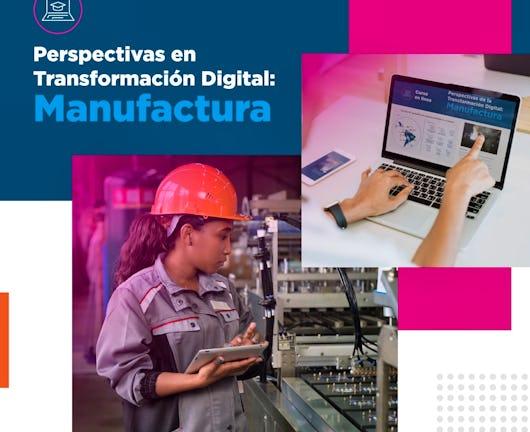
Are you interested in learning how Digital Transformation is driving the manufacturing sector in Latin America and the Caribbean? This course will help you identify challenges and opportunities that digitalization can offer in the industry. Along with specialists from BID Invest and the private sector, you will learn firsthand about the tools and best practices that illustrate the potential of digital solutions, with a cross-cutting focus on sustainability.

Class Deals by MOOC List - Click here and see Coursera's Active Discounts, Deals, and Promo Codes.

By the end of the course, you will understand the potential of digitalization for Latin American manufacturing companies and how this transformation can help overcome the major challenges they face.

What you'll learn

  • Identify good practices and the level of digital transformation maturity in the manufacturing sector.
  • Identify the challenges that prevent the digital transformation of organizations in the sector and possible solutions to overcome them.
  • Identify technologies and digital solutions necessary for digital transformation according to their work and the problem they face.
  • Assess your current situation in relation to digitalization through a diagnostic tool developed by IDB Invest.

Syllabus

Start here
In this section you will identify the course objectives, structure, assessments and orientation material. The welcome video will give you an overview of the course, the learning objectives and the structure of each module. We will also share the link to the participant's guide, a document that we suggest you consult frequently because it will be your navigation guide throughout this learning experience. You will also learn how we will assess your learning in this course, and identify the instructors and course staff. Finally, we invite you to take an initial survey.

Module 1: Understanding the current reality of Manufacturing and Digital Transformation in LATAM
In this module, we will understand the importance of Digital Transformation in the manufacturing and retail sector based on the needs, challenges, and opportunities that it brings to Latin America and the Caribbean. To do this, we will review resources that detail the internal and external obstacles that the manufacturing sector faces today, the strategic focal points of Digital Transformation, and we will hear experts share their experiences.

Module 2: Identifying trends and solutions in Digital Transformation and Sustainability
In this module we will identify the current trends in Digital Transformation for manufacturing in order to facilitate and accelerate a digital change in the sector. To do so, you will learn about best practices in transformation and digital solutions that can help accelerate this transformation in the region, with a focus on sustainability.

Module 3: Roadmap to Digitalization
In this module, we will identify the key idas to consider when designing a roadmap for Digital Transformation in manufacturing and be a successful. You will focus on evaluating the level of digital maturity of your organization through a self-diagnostic tool developed by IDB Invest and we'll provide you with best practices for a successful path to digitalization.
Go to Class
MOOC List is learner-supported. When you buy through links on our site, we may earn an affiliate commission.

Related Courses

Digital Transformation (Coursera) Coursera
University of Virginia,Boston Consulting Group - BCG

Digital Transformation (Coursera)

Digital transformation is a hot topic--but what exactly is it and what does it mean for companies? In this course, we talk about digital transformation in two ways. First we discuss the pace of change and the imperative it creates for businesses. Next we provide the context for this transformation and what it takes to win in the digital age. Then we walk through BCG's proprietary framework, which helps you identify key areas to digitize, including strategy, core processes, and technology.

Aug 17th 2026
4 Weeks
Algae Biotechnology (Coursera) Coursera
University of California, San Diego

Algae Biotechnology (Coursera)

For decades, researchers have been studying microalgae to understand their biological functions and how we can use technology to harness algae’s power to create a wide range of commercial products. In this course, we will cover how synthetic biology, genetic engineering, and metabolic engineering is used in algae biotechnology, and also examine the current state of algae biotechnology research and tools. We’ll also explore some of the common bio-products we can make from algae, and take a look at some real-world algae companies that are using algae biotechnology to create products consumers can buy today.

Aug 17th 2026
5-12 Weeks
Our Earth's Future (Coursera) Coursera
American Museum of Natural History

Our Earth's Future (Coursera)

Our Earth’s Future is about the science of climate change and how to talk about it. You will learn from scientists in the fields of climatology, oceanography, Earth science, and anthropology who study how climate change is affecting people, populations, and ways of life. Explore the multiple lines of evidence for the human-induced climate change that is happening today, and consider what that means for the future of our planet. At the end of this course you will be able to understand key scientific principles, identify and address misconceptions, and contribute confidently to conversations about climate change.

Aug 10th 2026
5-12 Weeks
Management of Urban Infrastructures – part 1 (Coursera) Coursera
École Polytechnique Fédérale de Lausanne

Management of Urban Infrastructures – part 1 (Coursera)

Sustainability, Resilience and Efficiency are fundamental considerations for city managers in managing urban infrastructures. Today, more than 3.9 billion people, making up more than 54% of the global population, live in cities. Urbanization is expected to continue in the coming years, raising the urban population to 6.0 billion by 2045. This dramatic increase in urban populations will inevitably increase the demand for energy, mobility (transportation), water, and other urban services in every city around the world. Without functional governance and management structures that ensure efficient, resilient and sustainable performance in cities, the current urbanization growth might become a catastrophic risk threatening the quality of life of the humanity.

Aug 17th 2026
5-12 Weeks
Sustainable Food Production Through Livestock Health Management (Coursera) Coursera
University of Illinois at Urbana-Champaign

Sustainable Food Production Through Livestock Health Management (Coursera)

Learn about the impact of infectious disease on sustainable animal-based food production by understanding the science of growth, immunity, and infection and by learning the problem-solving skills needed to advance animal health and food production through optimal management practices. In this course we will explore the effect of infectious disease on sustainable animal-based food production. The content and learning outcomes of this new course will be designed to be relevant across different food production sectors (i.e., beef, dairy, poultry, and pigs).

Aug 10th 2026
5-12 Weeks
Greening the Economy: Lessons from Scandinavia (Coursera) Coursera
Lund University

Greening the Economy: Lessons from Scandinavia (Coursera)

How can we live a good life on one planet with over seven billion people? This course will explore greening the economy on four levels – individual, business, city, and nation. We will look at the relationships between these levels and give many practical examples of the complexities and solutions across the levels. Scandinavia, a pioneering place advancing sustainability and combating climate change, is a unique starting point for learning about greening the economy. We will learn from many initiatives attempted in Scandinavia since the 1970s, which are all potentially helpful and useful for other countries and contexts.

Aug 10th 2026
5-12 Weeks
Ressources minérales et transition (Coursera) Coursera
Institut Mines-Telecom

Ressources minérales et transition (Coursera)

Ce MOOC sur les ressources minérales et les transitions invite à se questionner sur la soutenabilité de nos choix technologiques. Les transitions énergétiques et numériques sont en effet confrontées aux enjeux d'approvisionnement des ressources minérales et aux impacts que leur cycle de vie génère sur l’environnement et la société.

Aug 17th 2026
4 Weeks
Advanced Functional Ceramics (Coursera) Coursera
Yonsei University

Advanced Functional Ceramics (Coursera)

To realize next-generation devices, novel ceramic materials with ultimate physical and chemical properties are required. For this purpose, a few intrinsic and extrinsic approaches for the development of new functional ceramics are proceeding. This course provides the fundamentals of functional ceramics and the materials design rules for developing advanced ceramics with ultimate physical and chemical properties.

Aug 17th 2026
5-12 Weeks
Sustainable high-end tourism (Coursera) Coursera
Universitat Autònoma de Barcelona

Sustainable high-end tourism (Coursera)

Welcome to the sustainable high-end tourism course. Why should you take this course? High-end tourism is a sector and industry that has grown in the last 50 years in an exponential way across the globe. The recent developments in our world -with globalization and sustainability- need to be addressed in this high-end industry. In this course we will have a look at what makes that high-end tourism, what is essential in high-end luxury tourism, and what is not.

Aug 17th 2026
5-12 Weeks
Sustainable Fashion (Coursera) Coursera
Copenhagen Business School

Sustainable Fashion (Coursera)

Sometimes when we say we work with sustainable fashion people look at us like... "Mmmm, is it really possible for something like fashion to be sustainable?" And let's face it, people are right being suspicious. If anything the fashion industry has become increasingly unsustainable over the last decades, using more and more natural resources and creating more and more waste.

Aug 17th 2026
5-12 Weeks