EdX

Human-Computer Interaction II: Cognition, Context & Culture (edX)

Human-Computer Interaction II: Cognition, Context & Culture (edX)

Get into the user’s mind and understand the role of mental models and representations, then investigate how to design interfaces that integrate with and influence the world around us. This course takes you through lessons 9 through 13 of CS6750: Human-Computer Interaction as taught in the Georgia Tech Online Master of Science in Computer Science program.

Class Deals by MOOC List - Click here and see EdX's Active Discounts, Deals, and Promo Codes.

In this course, you’ll expand the scope through which you view human-computer interaction. You’ll start by going further inside the user’s mind to understand the role of mental models in guiding a user’s interaction with your system. A good user interface designer understands the mental models of their users and how representations can be used to correct those mental models.
You’ll then learn methods for breaking down user behavior into more objective, discernible, and measurable chunks. Through the principles of task analysis and with artifacts like GOMS models, you’ll discover how to take the often-ethereal patterns of human interaction and distill them into externalizable, manipulable chunks. You’ll also learn how to use these artifacts to inform the design and improvement of interfaces.
You’ll then widen your view to look at the context in which your interfaces are deployed. You’ll begin by learning about distributed cognition, which includes the notion that humans may offload cognitive tasks onto interfaces, and that humans and interfaces together may be considered higher-level cognitive systems. You’ll also learn about theories for investigating interaction in context, such as activity theory and situated action, and the role that human improvisation plays in any interface we design. Through these lenses, you’ll be equipped to design not just user interfaces, but user experiences developed with an understanding of the context around the interaction.
You’ll conclude by expanding your view even further to investigate how interfaces interact with society itself: both how society guides the interfaces we create, and how the interfaces we create affect society. You’ll learn how interface design can be used to address societal issues, but also how it can have danger unintentional side effects.
By the end of the course, you’ll have a deeper understanding of how human cognition interacts with user interfaces, and how user interfaces in turn interact with the world. You’ll be able to design interfaces that consider what the user knows and what is going on around the user.
This course is part of the Human-Computer Interaction Professional Certificate.

What you'll learn

  • The role of mental models in guiding human interaction with user interfaces.
  • The role of representations in informing the development of accurate mental models.
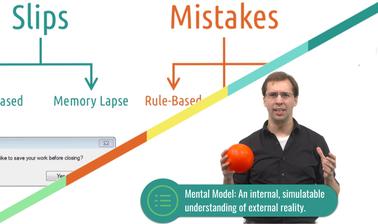
  • The sorts of errors, slips, and mistakes humans are prone to and how to address them.
  • Learned helplessness, and how to avoid it.
  • Methods for decomposing human interaction into manipulable chunks.
  • GOMS models for articulating user interaction with a system.
  • Hierarchical task analysis for understanding assumptions about human knowledge and ability.
  • Distributed cognition for designing larger systems comprised of humans and interfaces.
  • Situated action for investigating and anticipating human behavior in context.
  • An understanding of how society affects the designs we create.
  • A view of how design can be used to address societal problems.

Go to Class
MOOC List is learner-supported. When you buy through links on our site, we may earn an affiliate commission.

Related Courses

Principles of UX/UI Design (Coursera) Coursera
Meta

Principles of UX/UI Design (Coursera)

Learn the fundamentals of User Experience (UX) research and design. Become immersed in the UX process of identifying problems and iterating and testing designs to find appropriate solutions. You’ll learn how to empathize with users through best-practice research approaches, and create common UX artifacts such as user personas. And you’ll use UX insights to make appropriate design decisions.

Jun 8th 2026
5-12 Weeks
IT Fundamentals for Business Professionals: Software development (edX) EdX
Universitat Politècnica de València,UPValenciaX

IT Fundamentals for Business Professionals: Software development (edX)

Working with Information Technology (IT) without the necessary background? Learn the fundamentals of software development. This course is one of the 5 courses of an introductory business information systems series, designed to introduce you to the amazing world of Information Technology.

Self Paced
Self-Paced
Unreal Engine Interactive 3D: Sequencer-Cinematography, Interfaces, Visual Effects, Pipelines, and Production (edX) EdX
Rochester Institute of Technology,RITx

Unreal Engine Interactive 3D: Sequencer-Cinematography, Interfaces, Visual Effects, Pipelines, and Production (edX)

Learn techniques in cinematography, Interface design, visual effects, collaboration and organization, basic optimization and publishing, as well as exciting emerging connections. In this course, you will learn about the Unreal Sequencer as we focus on cinematography. We will set up cameras, lenses, track and jibs to frame shots and create cinematics. You will learn the Unreal Motion Graphics (UMG) for user interface design, and together we will build a Heads Up Display (HUD) as well as an “in-game” interface (useful for VR and AR).

Self Paced
Self-Paced
Le prototypage UX (edX) EdX
HECMontrealX,HEC Montréal

Le prototypage UX (edX)

Devenez un virtuose du prototypage! Propulsez votre équipe créative de l’étape des maquettes papier au développement de prototypes interactifs haute fidélité, en utilisant les méthodes et outils les plus récents. Le prototypage tient à la fois de l’art et de la science. Dans ce MOOC, vous apprendrez comment les critères ergonomiques (ancrés dans la psychologie cognitive) s’articulent au sein du design d'interface utilisateur (design UI).

Self Paced
Self-Paced
Introduction to UI Design (Coursera) Coursera
University of Minnesota

Introduction to UI Design (Coursera)

In this course, you will gain an understanding of the critical importance of user interface design. You will also learn industry-standard methods for how to approach the design of a user interface and key theories and frameworks that underlie the design of most interfaces you use today. Through a series of case studies on commercial systems - many of which you likely use on a regular basis - we will illustrate the benefits of good design.

Jun 8th 2026
4 Weeks
App Design and Development for iOS (Coursera) Coursera
University of Toronto

App Design and Development for iOS (Coursera)

In App Design and Development for iOS, the third course of the iOS App Development with Swift specialization, you will be developing foundational programming skills to support graphical element presentation and data manipulation from basic functions through to advanced processing. You will continue to build your skill set to use and apply core graphics, touch handling and gestures, animations and transitions, alerts and actions as well as advanced algorithms, threading and more. By the end of this course you will be able to develop a more advanced, fully functioning app.

Jun 8th 2026
5-12 Weeks
Introduction to C# Programming and Unity (Coursera) Coursera
University of Colorado System

Introduction to C# Programming and Unity (Coursera)

This course is all about starting to learn how to develop video games using the C# programming language and the Unity game engine on Windows or Mac. Why use C# and Unity instead of some other language and game engine? Well, C# is a really good language for learning how to program and then programming professionally. Also, the Unity game engine is very popular with indie game developers; Unity games were downloaded 16,000,000,000 times in 2016! Finally, C# is one of the programming languages you can use in the Unity environment.

Jun 8th 2026
4 Weeks
Full Stack Application Development Project (edX) EdX
IBM

Full Stack Application Development Project (edX)

For this project you will apply your knowledge of front end and back end development gained from previous courses and build and deploy a full stack real-world web application on the cloud. Your project will showcase your understanding of the user experience and user interface design process, and your skills and technologies with Django, Python, Node.JS and Containers.

Self Paced
Self-Paced