Global Systemic Risk (Coursera)

Offered by Princeton University,
Global Systemic Risk (Coursera)

What is globalization and how does it work? How can we understand the process as a whole? How are the parts of the world linked? What are the risks of living in a world where “no one is in charge”? This course introduces students to systems thinking, network theory, and risk analysis and uses these tools to better understand the process of globalization. Focusing on trade, finance, and epidemiology, it analyzes potential challenges to the current global order.

Class Deals by MOOC List - Click here and see Coursera's Active Discounts, Deals, and Promo Codes.

The course will be of interest to those studying global affairs, system dynamics, and world governance. It offers a set of heuristics that students can use to analyze contemporary global challenges. Linking the recording of Abbey Road to the COVID-19 pandemic provides new insights into the apparently chaotic world around us.
Complex systems form the backbone of our increasingly interconnected and interdependent society. What were once more localized economies, supply chains, and social-ecological systems are now rapidly globalizing, and interacting with one another across countless spatial and temporal scales as technologies expand at ever greater velocities. These tightly coupled systems deliver greater efficiency and prosperity, but at the cost of greater fragility and the threat of catastrophic failure. This “global systemic risk” has implications in all functional domains affecting our daily lives—from the global financial system to healthcare, to critical infrastructure networks.
Organized with 7-10 minute classes grouped together into longer modules, the course will have a linear “core” curriculum presented at the introductory level, with the potential for optional offshoots that give learners a more in-depth look into certain areas with more technical content.

What You Will Learn

  • We introduce several new analytical concepts and tools including globalization, complexity, networks, and risk analysis.
  • We use these to explore the contemporary world and the dynamics behind our modern life.

Syllabus

WEEK 1
Introduction, What is Globalization, Debating Globalization
Welcome to Week 1 in which we define and analyze what we mean by globalization. In these lectures, you will be introduced to the origins, benefits, and costs of globalization.

WEEK 2
Systems and Networks
In Week 2, we learn about the concept of systems analysis and the insights it provides into a complex world.

WEEK 3
Risk and GSR
Welcome to Week 3! At the end of this week, you will be better able to identify the sources of risk in our contemporary world and to integrate the concepts of globalization, systems, networks, and risk.

WEEK 4
Trade and Finance
Money and trade make the world go round, but the system is fragile.

WEEK 5
COVID-19 and Governance
In Week 5, we analyze COVID-19 through a GSR lens and discuss the challenge of governing a global system.

WEEK 6
Collapse
In this last unit, we finish with a discussion of what the worst that could happen is.


Go to Class
MOOC List is learner-supported. When you buy through links on our site, we may earn an affiliate commission.

Related Courses

Finance for Non-Finance Professionals (Coursera) Coursera
Rice University

Finance for Non-Finance Professionals (Coursera)

This short course surveys all the major topics covered in a full semester MBA level finance course, but with a more intuitive approach on a very high conceptual level. The goal here is give you a roadmap and framework for how financial professional make decisions. We will cover the basics of financial valuation, the time value of money, compounding returns, and discounting the future. You will understand discounted cash flow (DCF) valuation and how it compares to other methods. We also step inside the mind of a corporate financial manager and develop the basic tools of capital budgeting. We will survey the how, when, and where to spend money, make tradeoffs about investment, growth, dividends, and how to ensure sound fiscal discipline.

Sep 28th 2026
5-12 Weeks
Cities, Climate and Change: Pathways and Opportunities (Coursera) Coursera
Lund University

Cities, Climate and Change: Pathways and Opportunities (Coursera)

How can we develop transformative skills and capacities to achieve climate neutral and sustainable cities? This course explores how we can design, create and achieve climate neutral and sustainable cities. We embrace the “mission to the moon” approach for tackling greenhouse emissions from cities putting an emphasis on pathways and opportunities. We utilise insights and inspiration from Sweden, Europe and around the world.

Sep 28th 2026
5-12 Weeks
Principles of Sustainable Finance (Coursera) Coursera
Erasmus University Rotterdam

Principles of Sustainable Finance (Coursera)

Finance is widely seen as an obstacle to a better world. Principles of Sustainable Finance explains how the financial sector can be mobilized to counter this. Using finance as a means to achieve social goals we can divert the planet and its economy from its current path to a world that is sustainable for all. Throughout this course, you will learn about the UN Sustainable Development Goals, how social and environmental factors should not be regarded as externalities, you will learn more about sustainable banking and asset management, about effective engagement, sustainable scenario analysis and long-term value creation.

Sep 28th 2026
5-12 Weeks
Banking and Financial Institutions (Coursera) Coursera
University of Illinois at Urbana-Champaign

Banking and Financial Institutions (Coursera)

The purpose of this course is to provide you with a basic understanding of the connections between money, the financial system, and the broader macroeconomy. We will examine the economics of modern financial institutions (e.g. banks), including how they are organized, the products and financial services they offer, the risks they take, why and how they are regulated, and how this has changed over time.

Sep 28th 2026
4 Weeks
¿Cómo tomar decisiones financieras que agreguen valor? (Coursera) Coursera
Universidad de los Andes

¿Cómo tomar decisiones financieras que agreguen valor? (Coursera)

Los estudiantes al terminar este curso estarán en capacidad de seguir un proceso sistemático y ordenado para la toma de decisiones financieras. Este curso permitirá no solo exponer a los participantes a todos los detalles del proceso de decisión típicos del gerente de finanzas, sino aplicar sus conocimientos a un caso concreto. El proceso comienza con un análisis histórico de la información financiera que luego de usa para la construcción de una tabla de supuestos donde se resumen todas las estimaciones.

Sep 28th 2026
5-12 Weeks
Fundamentals of Finance (Coursera) Coursera
University of Pennsylvania

Fundamentals of Finance (Coursera)

In this course, you’ll learn the basic fundamentals of corporate finance. Based on the pre-term qualifying courses for Wharton MBA students, Professor Jessica Wachter has designed this course for learners who need a refresher in financial concepts, or for those who are learning about corporate finance for the first time. You’ll identify foundational concepts in corporate finance, such as NPV, Compound and Simple Interest, and Annuities versus Perpetuities.

Oct 5th 2026
5-12 Weeks
Introduction to Finance: The Basics (Coursera) Coursera
University of Illinois at Urbana-Champaign

Introduction to Finance: The Basics (Coursera)

In the Introduction to Finance I: The Basics course, you will be introduced to the basic concepts needed to understand the financial manager’s decision-making process. To achieve that, you will learn about the basic forms a business can take and the goal of the financial manager. You will also learn the fundamentals of financial statements and how to measure a company’s financial health using financial ratios.

Oct 5th 2026
4 Weeks
Systems Thinking In Public Health (Coursera) Coursera
Johns Hopkins University

Systems Thinking In Public Health (Coursera)

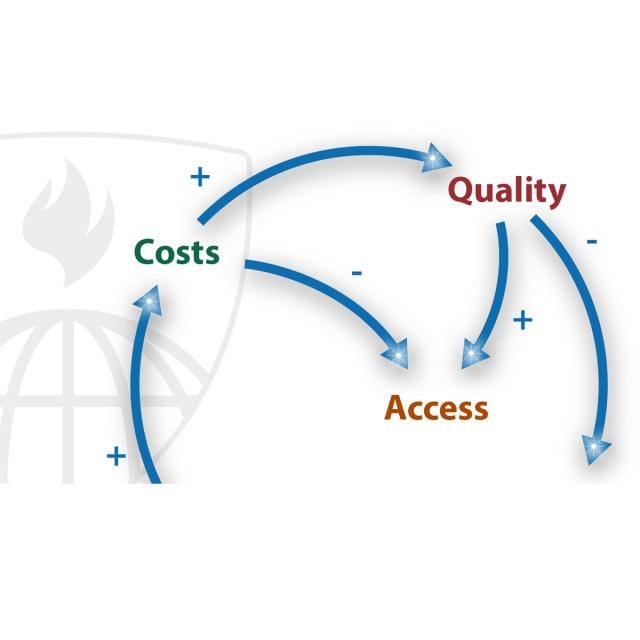
This course provides an introduction to systems thinking and systems models in public health. Problems in public health and health policy tend to be complex with many actors, institutions and risk factors involved. If an outcome depends on many interacting and adaptive parts and actors the outcome cannot be analyzed or predicted with traditional statistical methods. Systems thinking is a core skill in public health and helps health policymakers build programs and policies that are aware of and prepared for unintended consequences.

Oct 5th 2026
4 Weeks
Corporate Finance Essentials (Coursera) Coursera
IESE Business School

Corporate Finance Essentials (Coursera)

Corporate Finance Essentials will enable you to understand key financial issues related to companies, investors, and the interaction between them in the capital markets. By the end of this course you should be able to understand most of what you read in the financial press and use the essential financial vocabulary of companies and finance professionals.

Oct 5th 2026
5-12 Weeks
Private Equity and Venture Capital (Coursera) Coursera
Università Bocconi

Private Equity and Venture Capital (Coursera)

The course deals with the analysis of the private equity and venture capital business. Over the course, students will be provided with a deep understanding of the mechanism underpinning the creation and/or development of a firm and the financial support it can get from the financial system through venture capital investment. The course tries to discover how special financial intermediaries (called private equity investors) finance through equity companies belonging to different stages of their life-cycle, starting from the very beginning (startup and early stage) to a more mature phase (i.e. expansion, mature age, etc.) or also staying into crises and decline.

Oct 5th 2026
5-12 Weeks
Beyond the Financials: Insights, Analysis and Valuations (Coursera) Coursera
University of Illinois at Urbana-Champaign

Beyond the Financials: Insights, Analysis and Valuations (Coursera)

The objective of this course is to provide you with the knowledge and skills necessary to analyze, interpret, understand and use financial information to make informed decisions. We will discuss financial reporting from a user’s perspective, use a variety of tools to break apart financial reports into meaningful units for analysis, forecast financial statements, and value a firm. This course is intended to give you exposure to the issues facing users of financial statements. You will better understand your role in the financial reporting process if you know how the financial statements will ultimately be used.

Sep 28th 2026
5-12 Weeks