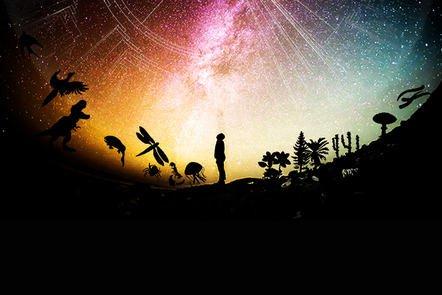
Extinctions: Past and Present (FutureLearn)

Extinctions: Past and Present (FutureLearn)

Discover the diversity of life on earth, the impacts of five past mass extinctions and the prospect of a sixth extinction today. This free online course explores how life on earth has been shaped by five mass extinction events in the distant past. At present, biodiversity is facing a crisis, with the prospect of a sixth extinction event today.

Class Deals by MOOC List - Click here and see FutureLearn's Active Discounts, Deals, and Promo Codes.

Explore the five mass extinctions of the past
Each week there are discussions with scientists about how their research informs us about the biodiversity of our planet including the very first life forms; fish and tetrapod diversification; the radiation of reptiles and dinosaurs; and the rise of mammals.
We focus on the five previous mass extinction events that have shaped the biodiversity of our planet. The fossil record reveals evidence of species that went extinct during these mass extinctions and the new opportunities created for the surviving biota to diversify.

The threat of a “sixth extinction” today
Turning to the present and the anthropocene period, we look at how human behaviour is now beginning to impact the Earth’s ecosystems.
We consider the threat of the so-called ‘sixth extinction’, finding out how our actions are reducing biodiversity and threatening the survival of many species.

Learn with one of the world’s leading paleontologists
‘Extinctions: Past and Present’ is created by the University of Cape Town, and filmed on location at South Africa’s Iziko Museum, West Coast Fossil Park, Kirstenbosch National Botanical Gardens, and the Table Mountain National Park.
You will learn with Professor Anusuya Chinsamy-Turan – an acclaimed paleobiologist, author of a range of academic and children’s books on fossils, and former South African Woman of the Year. In 2013 she was awarded The World Academy of Science’s Sub-Saharan Prize for the Public Understanding and Popularization of Science.

What topics will you cover?

  • The five past mass extinctions and their impact on life on earth
  • What we know about the past from the fossil record
  • The earliest forms of life
  • From simple to complex life forms
  • Extinction and radiation as drivers of change
  • Likely causes of mass extinctions throughout earth’s history
  • Current threats to biodiversity
  • What we can do to reduce the risk of a ‘sixth extinction’

What will you achieve?

  • identify the impacts of five past mass extinctions have had on life on earth
  • Debate the prospect of a sixth extinction today
  • Investigate how understanding the history of life on earth helps us deal with contemporary environmental problems

Who is the course for?
The course is suitable for anyone with an interest in science or environmental issues. No previous experience is required. While scientific names are used, to for example identify extinct life forms, knowing these is not required to follow the course. We do offer glossaries and explain terms as we go along so you will be able to follow the themes of the course.
Go to Class
MOOC List is learner-supported. When you buy through links on our site, we may earn an affiliate commission.

Related Courses

Introduction to Sustainability (Coursera) Coursera
University of Illinois at Urbana-Champaign

Introduction to Sustainability (Coursera)

This course introduces the academic approach of Sustainability and explores how today’s human societies can endure in the face of global change, ecosystem degradation and resource limitations. The course focuses on key knowledge areas of sustainability theory and practice, including population, ecosystems, global change, energy, agriculture, water, environmental economics and policy, ethics, and cultural history.

Sep 28th 2026
5-12 Weeks
Climate Change: Challenges and Solutions (FutureLearn) FutureLearn
University of Exeter

Climate Change: Challenges and Solutions (FutureLearn)

This course aims to explain the science of climate change, the risks it poses, and the solutions available to reduce those risks. The course is aimed at the level of students entering university, and seeks to provide an inter-disciplinary introduction to what is a broad field. It engages a number of experts from the University of Exeter and a number of partner organisations.

No sessions available
5-12 Weeks
Life Below Water: Conservation, Current Issues, Possible Solutions (FutureLearn) FutureLearn
University of the Sunshine Coast

Life Below Water: Conservation, Current Issues, Possible Solutions (FutureLearn)

Explore the human impact on underwater biodiversity, ecosystems, and animals, and solutions for preserving life below water. Develop knowledge and research skills in marine conservation. It is widely accepted that the phenomenal biodiversity within underwater ecosystems and habitats has been very negatively affected by human interaction. The exact nature and course of the damage, and what can be done about it, are not as clearly understood. This four-week course by the University of the Sunshine Coast aims to change that.

Jan 24th 2022
4 Weeks
Deep Time: Discovering an Ancient Earth (Coursera) Coursera
University of Colorado Boulder

Deep Time: Discovering an Ancient Earth (Coursera)

Ever since our ancestors ventured onto the African savanna, human beings have searched, explored, and wondered about the world. Nowadays, and certainly for most, science is the vehicle that takes us along a path towards understanding nature. It can bring us from sub-atomic realms to the most distant galaxies. Largely through the discipline of geology, science allows us to push back the mists of time and peer into a past measured in billions of years, and aptly referred to as “Deep Time.” Climb on board!

Sep 28th 2026
4 Weeks
Aeroecology: Exploring Biodiversity with Radar (Coursera) Coursera
University of Leeds

Aeroecology: Exploring Biodiversity with Radar (Coursera)

Learn how aeroecology, a discipline that studies airborne life forms, has been revolutionised with the use of radar with this unique course. This course is designed to help scientists, researchers as well as ecology enthusiasts to develop skills in using radar to explore biodiversity. You will explore the origins and evolution of radar from a military technology to a powerful tool with multiple scientific applications, including aeroecology. You will then be introduced to studying global biodiversity trends and learn how to evaluate traditional methods and emerging technologies used by scientists to monitor the natural world.

Oct 5th 2026
2 Weeks
The Worldview of Thomas Berry: The Flourishing of the Earth Community (Coursera) Coursera
Yale University

The Worldview of Thomas Berry: The Flourishing of the Earth Community (Coursera)

Thomas Berry (1914-2009) was a historian of world religions and an early voice awakening moral sensibilities to the environmental crisis. He is known for articulating a “new story” of the universe that explores the implications of the evolutionary sciences and cultural traditions for creating a flourishing future. This course investigates Berry’s life and thought in relation to the Journey of the Universe project.

Oct 12th 2026
5-12 Weeks
Comprendre l'écologie, pour une économie innovante (Coursera) Coursera
ESCP Europe

Comprendre l'écologie, pour une économie innovante (Coursera)

Conçu conjointement par le think-tank Ecolo-Ethik et ESCP Europe, ce MOOC se propose de vous aider à dépasser les idées reçues sur l’écologie, dans le souci d’une démarche ouverte et multiple. A ce titre, de grands experts reconnus interviendront pour illustrer, approfondir et enrichir les différentes thématiques.

Sep 28th 2026
5-12 Weeks
Our Earth's Future (Coursera) Coursera
American Museum of Natural History

Our Earth's Future (Coursera)

Our Earth’s Future is about the science of climate change and how to talk about it. You will learn from scientists in the fields of climatology, oceanography, Earth science, and anthropology who study how climate change is affecting people, populations, and ways of life. Explore the multiple lines of evidence for the human-induced climate change that is happening today, and consider what that means for the future of our planet. At the end of this course you will be able to understand key scientific principles, identify and address misconceptions, and contribute confidently to conversations about climate change.

Oct 5th 2026
5-12 Weeks
Using Systems Thinking to Tackle the Climate and Biodiversity Crisis (FutureLearn) FutureLearn
University of Reading

Using Systems Thinking to Tackle the Climate and Biodiversity Crisis (FutureLearn)

Discover how switching to a systems mindset could help overcome the global environmental challenges we face today. Take a big picture approach to the climate and biodiversity crisis. With crises as vast, complex, and interconnected as climate change and biodiversity loss, focusing on one aspect of the problem will never be enough. Systems thinking offers a new way of seeing and understanding environmental issues, which could radically change how we go about tackling them. On this two-week course from the University of Reading, you’ll learn what systems thinking is and how it could transform your approach to the climate and biodiversity crisis.

Self Paced
2 Weeks
Beneath the Blue: The Importance of Marine Sediments (FutureLearn) FutureLearn
University of Southampton

Beneath the Blue: The Importance of Marine Sediments (FutureLearn)

Understand the importance of our planet's seafloor and get an introduction to the exciting field of ocean science. Discover fascinating seafloor habitats and learn how humans affect them. Exactly what lies beneath our oceans? Why is the sea floor, and its marine sediments, so important? And how are humans affecting them? On this course you’ll answer these questions and more.

No sessions available
3 Weeks