Invisible Worlds: Understanding the Natural Environment (FutureLearn)

Invisible Worlds: Understanding the Natural Environment (FutureLearn)

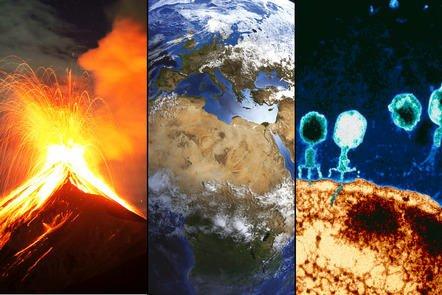
Explore the connection between life and the Earth's invisible systems and gain new insights into the natural environment. Discover Earth's invisible systems and transform your understanding of the world. Given the current climate emergency, it’s increasingly important that we have a good understanding of Earth’s life support systems. We rely on these systems for fresh air, clean water, fertile soil, rich biodiversity and a stable climate. On this course, you’ll explore the natural systems we can’t see or feel, from microscopic creatures to gases.

Class Deals by MOOC List - Click here and see FutureLearn's Active Discounts, Deals, and Promo Codes.

You’ll discover how life is shaped by and shapes these invisible worlds and explore the evolution of these systems and the impact humans have on it. As you explore the interconnectedness of everything, you’ll transform your understanding of the world.

What topics will you cover?

  • Past Invisible: A time so long ago it’s hard to imagine: the evolution of the Earth’s life support system; the products and processes that are necessary for maintaining life.
  • Vast Invisible: Natural systems and cycles (carbon, nitrogen, phosphate) so massive we can’t feel them: the bigger picture and you in the bigger picture.
  • Small Invisible: Creatures so small we can’t see them: minions or masters of the universe? See how the smallest things underpin the biggest things; the life support systems.
  • The Anthropocene era/effect: Since the small things have such a significant influence on the life support system, you won’t be surprised to see the huge effects we have had.
  • Interconnections: The interconnectedness between life and the Earth’s environments at all scales.

What will you achieve?
By the end of the course, you'll be able to...

  • Describe the fundamental science of the invisible worlds
  • Understand how everything on Earth is interconnected
  • Understand the past: the evolution of the planet and our life support system
  • See yourself within the vast: the planetary cycles that we depend on
  • Respect the small: the microbes that built and maintain the life support system
  • Discuss human effects, and how to work towards a positive future
  • Discuss the role played by art and exhibitions in science communication

Go to Class
MOOC List is learner-supported. When you buy through links on our site, we may earn an affiliate commission.

Related Courses

Environmental Challenges: Justice in Natural Resource Management (FutureLearn) FutureLearn
University of Leeds

Environmental Challenges: Justice in Natural Resource Management (FutureLearn)

How do we ensure that the difficult decisions about the management of natural resources are just and fair for all? When looking at different societies and cultures around the world, it is interesting how ubiquitous the principles of justice are. It is part of our human nature to think about equality, and consider fairness as something that we do naturally. However, in practical terms, equality is hard to achieve.

Self Paced
2 Weeks
The Science of Medicines (FutureLearn) FutureLearn
Monash University

The Science of Medicines (FutureLearn)

Learn the science behind how and why medicines work, and what can improve patient's treatment, with this online course. What do you know about the medicines you take? The world’s growing population faces major health issues, and medicines are a primary pillar to effect better health. Learn about the science of key medicines used to manage heart disease, depression, diabetes, pain control and smoking cessation.

Jan 17th 2022
5-12 Weeks
Humphry Davy: Laughing Gas, Literature, and the Lamp (FutureLearn) FutureLearn
Lancaster University,Royal Institution - RI

Humphry Davy: Laughing Gas, Literature, and the Lamp (FutureLearn)

Discover Humphry Davy and his contribution to science and the arts. Before culture was divided into the sciences and the arts there was a chemist who was also a poet. Sir Humphry Davy (1778-1829) is one of the best known men of science of the nineteenth century: he was the first person to inhale nitrous oxide; he isolated nine chemical elements; and he invented the miners’ safety lamp known as the Davy lamp. This course will consider Davy’s life and career using manuscript sources held at the Royal Institution of Great Britain.

Oct 9th 2023
4 Weeks
The Discovery of the Higgs Boson (FutureLearn) FutureLearn
University of Edinburgh

The Discovery of the Higgs Boson (FutureLearn)

Should we be excited about the Higgs boson? Find out more about particle physics and understanding the universe. The discovery of a new fundamental particle at the Large Hadron Collider (LHC), CERN is the latest step in a long quest seeking to answer one of physics’ most enduring questions: why do particles have mass? The experiments’ much anticipated success confirms predictions made decades earlier by Peter Higgs and others, and offers a glimpse into a universe of physics beyond the Standard Model.

Self Paced
5-12 Weeks
Environmental Challenges: Human Impact in the Natural Environment (FutureLearn) FutureLearn
University of Leeds

Environmental Challenges: Human Impact in the Natural Environment (FutureLearn)

Complexity in nature arises from a myriad of simple interactions. How can this lead to an unpredictable dynamism? Complex patterns in ecology are not always causal and predictable. Populations have their own dynamics that can be independent of external environmental conditions. In this course we look at the way that natural systems are organised; although living systems are complex, there are also some fairly constant patterns and relationships.

Self Paced
2 Weeks
Ecology and Wildlife Conservation (FutureLearn) FutureLearn
University of Leeds

Ecology and Wildlife Conservation (FutureLearn)

Discover ecology and how we can protect wildlife and conserve the natural world. Do you worry about the effects of climate change on nature? This course will show you how the work of conservation biologists and study of ecosystems can help with conserving the world’s biodiversity. You’ll explore the impact that the presence of wind farms on populations of seabirds and understand how the use of advanced techniques can be used to study different populations.

Self Paced
2 Weeks
The Many Faces of Dementia (FutureLearn) FutureLearn
University College London

The Many Faces of Dementia (FutureLearn)

Gain a unique insight into dementia through the stories, symptoms and science behind four less common diagnoses. Explore key issues in dementia care and research, through four less common forms. Dementia is one of the foremost priorities in global health and is estimated to affect over 44 million people worldwide.

Self Paced
4 Weeks
Snow: What It Is and Why It Matters (FutureLearn) FutureLearn
Luleå University of Technology

Snow: What It Is and Why It Matters (FutureLearn)

Explore the science of snow – how it forms, its different types, and how it can best be used. Learn all about snow from cold weather experts in Sweden. Snow can affect every aspect of life, from transport systems to business operations; that’s why it’s crucial to understand what exactly snow is, how it forms, and how we can manage it.

Oct 25th 2021
2 Weeks
Planet Partners: Tackling the Climate Crisis Together (FutureLearn) FutureLearn
University of Reading

Planet Partners: Tackling the Climate Crisis Together (FutureLearn)

Investigate the impact of climate change, the research being done to tackle it, and what you can do to take meaningful action. Explore the different areas affected by climate change. The impacts of climate change are being felt worldwide and across many areas of life. This includes our food, our physical and mental health, where and how we live, wildlife and environmental systems, and political direction.

Self Paced
2 Weeks
The Science Behind Forensic Science (FutureLearn) FutureLearn
King's College London

The Science Behind Forensic Science (FutureLearn)

Get an introduction to the science of forensic science and discover how it's applied in the real world. Discover the biology and chemistry behind forensic science. How does forensic science really work? How are scientific principles applied in crime scenes? Answer these questions and more with this course from the team who teach the longest-running forensic science programme of its type in England.

Self Paced
4 Weeks
Tackling Environmental Challenges for a Sustainable Future (FutureLearn) FutureLearn
University of York

Tackling Environmental Challenges for a Sustainable Future (FutureLearn)

Discover how environmental research can inform how we respond to and solve the major global environmental issues of today. Explore sustainable solutions to environmental issues like changing glaciers. Our energy use is unsustainable, we’re producing waste plastic that’s endangering oceans, and large parts of the natural world are disappearing. We know our planet is facing huge environmental challenges, but what are we doing to solve them?

Self Paced
4 Weeks