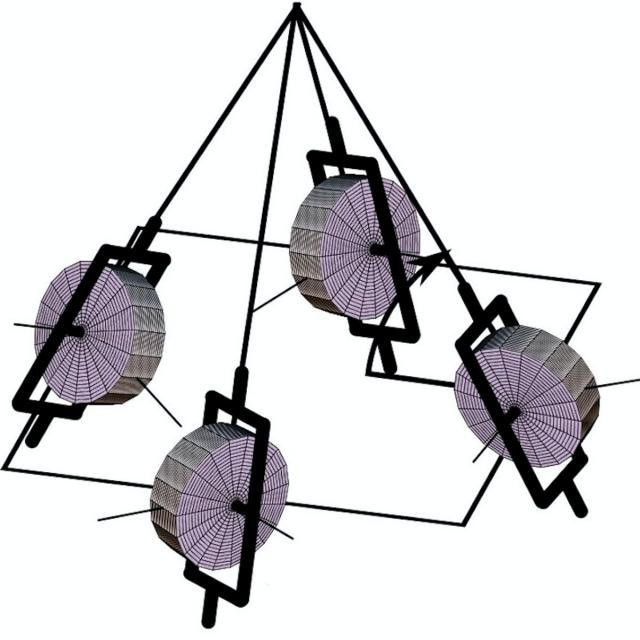
Advanced Capstone Spacecraft Dynamics and Control Project (Coursera)

Advanced Capstone Spacecraft Dynamics and Control Project (Coursera)

This capstone course is the 3rd and final course of the specialization Advanced Spacecraft Dynamics and Control. It assumes you have completed the prior courses on "Attitude Control with Momentum Exchange Devices" and "Analytical Mechanics for Spacecraft Dynamics". This project course investigates the dynamics of a complex spacecraft system where there is a rigid hub onto which a hinged panel is attached. This simulates a spacecraft with a time varying geometry.

Class Deals by MOOC List - Click here and see Coursera's Active Discounts, Deals, and Promo Codes.

First, the three-dimensional kinematics of this system are explored. Analytical relationships of the body and panel position and velocity states are derived, and the center of mass properties of this system are explored.
Next, a simplified system is used to use Lagrange's equations of motion to predict the dynamical response. With these differential equations we are then able to apply attitude control torques and investigate the rotational response if the spacecraft hub has a spring-hinged panel attached. Two open-loop control torque solutions are investigated. The classical minimum time bang-bang control solution is applied first, illustrating how such a control can yield unwanted panel oscillations. Finally, a filtered version of the bang-bang control is applied to illustrated how the panel oscillations can be significantly reduced at the cost of a slightly longer nominal maneuver time.

What You Will Learn

  • How to create and validate a simulation of a spacecraft with a hinged panel.
  • Investigate spacecraft dynamics with a time varying geometry.

Syllabus

WEEK 1
Introduction to the Capstone Project
Welcome to the capstone project of the course sequence on advanced spacecraft dynamics and control.

WEEK 2
3D Spacecraft Hub-Panel System
In this lesson we study a spacecraft system that contains a rigid hub with a hinged solar panel. Here the hub and panel center of mass locations are free to move relative to the spacecraft system center of mass. Fundamental properties of the dynamical description are derived.

WEEK 3
Planar Rotation Control using Bang-Bang and Filtered Control Solutions
In this module we develop the differential equations of motion of the hub-panel spacecraft system that is constrained to rotate about a single axis. Two different open-loop torque solutions are applied to reorient the spacecraft from rest to a new stationary attitude. The impact of filtering a classical bang-bang control solution is investigated by apply a first-order low-pass filter to the control input.

Go to Class
MOOC List is learner-supported. When you buy through links on our site, we may earn an affiliate commission.

Related Courses

Mécanique de Newton (Coursera) Coursera
École Polytechnique Fédérale de Lausanne

Mécanique de Newton (Coursera)

À l’École Polytechnique Fédérale de Lausanne, un cours de mécanique fait partie de la formation de tous les futurs ingénieurs et scientifiques. Il a pour but de leur apprendre à transcrire sous forme mathématique un phénomène physique, afin de pouvoir en formuler une analyse raisonnée. Cette partie couvrira notamment la cinématique du point matériel, la balistique dans le champ de la pesanteur et l’oscillateur harmonique.

Sep 7th 2026
5-12 Weeks
Engineering the Space Shuttle (edX) EdX
MIT,MITx

Engineering the Space Shuttle (edX)

Learn all about the world’s first reusable spacecraft - the Space Shuttle - from the very people who designed, built, and operated it for 30 years. This course examines how the Space Shuttle was designed and how its design was influenced by economics and politics. The course goes into detail on many of the Shuttle’s subsystems (e.g. rocket engines, thermal protection, aerodynamics, environmental control and life support, communications, etc.) and explains how the Shuttle was operated (launch, mission control, payloads, etc.). The course also uses the Space Shuttle to present the fundamentals of Systems Engineering.

Feb 16th 2022
5-12 Weeks
Control of Nonlinear Spacecraft Attitude Motion (Coursera) Coursera
University of Colorado Boulder

Control of Nonlinear Spacecraft Attitude Motion (Coursera)

This course trains you in the skills needed to program specific orientation and achieve precise aiming goals for spacecraft moving through three dimensional space. First, we cover stability definitions of nonlinear dynamical systems, covering the difference between local and global stability. We then analyze and apply Lyapunov's Direct Method to prove these stability properties, and develop a nonlinear 3-axis attitude pointing control law using Lyapunov theory. Finally, we look at alternate feedback control laws and closed loop dynamics.

Aug 17th 2026
4 Weeks
The Finite Element Method for Problems in Physics (Coursera) Coursera
University of Michigan

The Finite Element Method for Problems in Physics (Coursera)

This course is an introduction to the finite element method as applicable to a range of problems in physics and engineering sciences. The treatment is mathematical, but only for the purpose of clarifying the formulation. The emphasis is on coding up the formulations in a modern, open-source environment that can be expanded to other applications, subsequently.

Sep 7th 2026
13-24 Weeks
Foundation of Structural Dynamics (Coursera) Coursera
ISAE-SUPAERO

Foundation of Structural Dynamics (Coursera)

A course with variable geometry where everyone, we hope, will find personal benefits. The parts can be studied sequentially or independently; and inside each part, elementary learning items can be picked up. Globally, this course proposes a deep knowledge of fundamental dynamics, with possible explicit and implicit applications in structural dynamics, but also in physics and control of any dynamic system (automatics, …).

Sep 7th 2026
5-12 Weeks
Kinematics: Describing the Motions of Spacecraft (Coursera) Coursera
University of Colorado Boulder

Kinematics: Describing the Motions of Spacecraft (Coursera)

The movement of bodies in space (like spacecraft, satellites, and space stations) must be predicted and controlled with precision in order to ensure safety and efficacy. Kinematics is a field that develops descriptions and predictions of the motion of these bodies in 3D space. This course in Kinematics covers four major topic areas: an introduction to particle kinematics, a deep dive into rigid body kinematics in two parts (starting with classic descriptions of motion using the directional cosine matrix and Euler angles, and concluding with a review of modern descriptors like quaternions and Classical and Modified Rodrigues parameters).

Sep 7th 2026
4 Weeks
Material Behavior (Coursera) Coursera
Georgia Institute of Technology

Material Behavior (Coursera)

Have you ever wondered why ceramics are hard and brittle while metals tend to be ductile? Why some materials conduct heat or electricity while others are insulators? Why adding just a small amount of carbon to iron results in an alloy that is so much stronger than the base metal? In this course, you will learn how a material’s properties are determined by the microstructure of the material, which is in turn determined by composition and the processing that the material has undergone.

Sep 7th 2026
5-12 Weeks
Fundamentals of Fluid-Solid Interactions (Coursera) Coursera
École Polytechnique

Fundamentals of Fluid-Solid Interactions (Coursera)

What is fluid-solid interactions ? It is what happens when the motions of a fluid and of a solid are somehow coupled. This happens all the time, around you when leaves flutter in the wind, inside you when your heart beats, above you when wings of a plane vibrate, under the sea... The idea behind this MOOC is to give you the basic tools to be able to predict and eventually mitigate things called flutter, galloping, sloshing, vortex-induced vibrations, added mass, to cite a few. We are going to consider any possible domains of applications such as civil engineering, aerospace engineering, nuclear engineering , ocean engineering, biomechanics and even food processing !

Sep 7th 2026
5-12 Weeks
Spacecraft Relative Motion Control (Coursera) Coursera
University of Colorado Boulder

Spacecraft Relative Motion Control (Coursera)

Spacecraft relative motion control solutions stabilize the spacecraft relative to another spacecraft. This is useful control the approach prior to docking, to circumnavigate while inspect the target object, or to remain in a bounded vicinity about the target. This course covers the basics of nonlinear control theory to apply Lyapunov's direct method to the relative motion control problem.

Aug 17th 2026
2 Weeks
RF and millimeter-Wave Circuit Design (Coursera) Coursera
Eindhoven University of Technology

RF and millimeter-Wave Circuit Design (Coursera)

This unique Master-level course offered by the Center for Wireless Technology Eindhoven (CWT/e) of the Eindhoven University of Technology, The Netherlands, provides students with in-depth knowledge and hands-on experience on RF and mmWave circuit design. The course covers the topics on how to derive the RF wireless systems specifications, and how to design the main building blocks of a transceiver, i.e., low noise amplifier, power amplifier, RF mixers, oscillators, and PLL frequency synthesizers. It is divided into two parts: (1) theoretical lectures will cover the basis of RF and mmWave Circuit Design; and (2) design labs will include simulation and implementation of these circuits.

Sep 7th 2026
5-12 Weeks