Attitude Control with Momentum Exchange Devices (Coursera)

Attitude Control with Momentum Exchange Devices (Coursera)

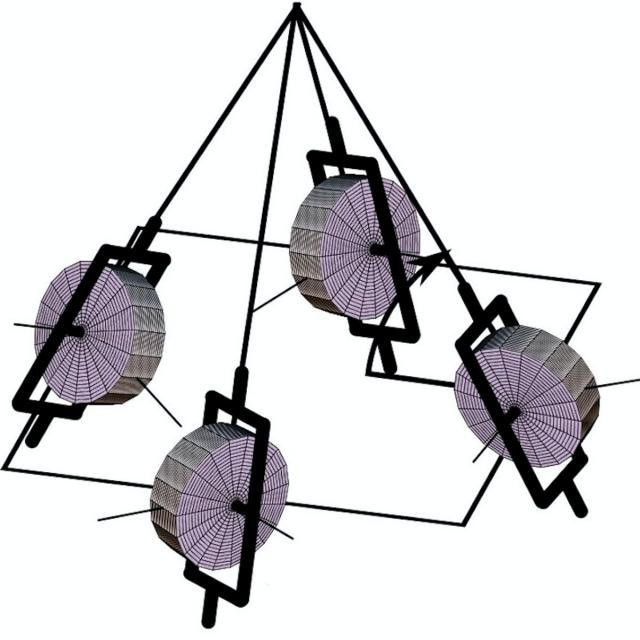
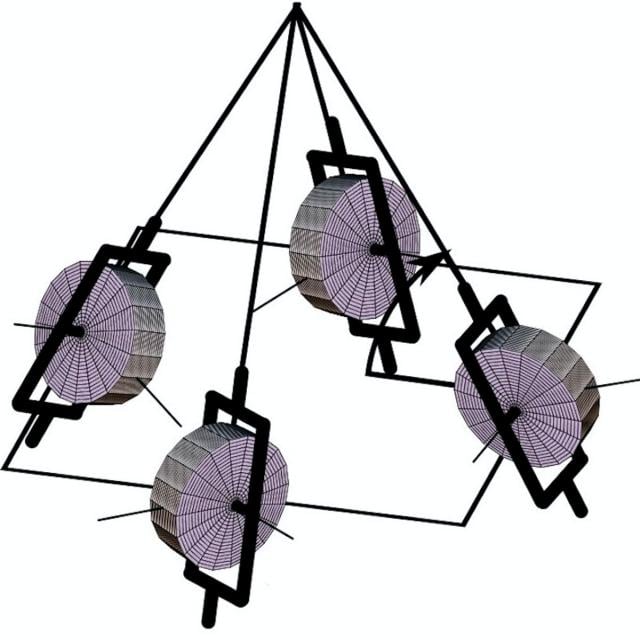
This course is part 1 of the specialization Advanced Spacecraft Dynamics and Control. It is a direct continuation of the Coursera specialization Spacecraft Dynamics and Control. This first course focuses on nonlinear attitude feedback control using a range of angular momentum devices. The course provides a comprehensive review of prerequisite material. Next it develops equations of motion of a spacecraft with momentum exchange devices such as reaction wheels (RWs), control momentum gyroscopes (CMGs) and variable speed control moment gyroscopes (VSCMGs).

Class Deals by MOOC List - Click here and see Coursera's Active Discounts, Deals, and Promo Codes.

The course discusses developing a complex spacecraft simulation with a number VSCMGs and how to approach debugging such complex software. The use of the work/energy theorem is discussed to assist with debugging the simulation by validating angular momentum, energy, changes in momentum and mechanical power.
Further, the use of null motion is explored to reconfigure the attitude control devices to avoid singularities and gimbal lock. The redundancy is exploited to seek control solutions that avoid classical CMG singularities.
What You Will Learn

  • Developing spacecraft equations of motion with momentum exchange devices
  • Writing and validating complex spacecraft simulations
  • Exploiting momentum device nullmotion to avoid singularities.

Syllabus

WEEK 1
Revisiting Basics of Spacecraft Kinematics
The prerequisite topics of spacecraft kinematics are reviewed in this module. This sequence is intended to ramp up the student on the mathematical tools and concepts required for this course. For each topic we also dig a little deeper into the subject matter.

WEEK 2
Revisiting Basics of Spacecraft Kinetics
Review of fundamental properties of a closed dynamical system leading to the development of the equations of motion.

WEEK 3
Revisiting the Basics of Nonlinear Spacecraft Control
Review of the fundamental nonlinear stability definitions, using Lyapunov's direct method, as well as discussing stability proof modifications if the system is time dependent.

WEEK 4
VSCMG Dynamics
Develop the kinematics and kinetics of the variable speed CMG devices.

WEEK 5
Momentum Based 3-Axis Attitude Control
Learn how to achieve 3-axis attitude feedback control using a series of momentum exchange devices such as reaction wheels, control moment gyroscopes (CMGs) and variable speed CMGs
Go to Class
MOOC List is learner-supported. When you buy through links on our site, we may earn an affiliate commission.

Related Courses

Kinetics: Studying Spacecraft Motion (Coursera) Coursera
University of Colorado Boulder

Kinetics: Studying Spacecraft Motion (Coursera)

As they tumble through space, objects like spacecraft move in dynamical ways. Understanding and predicting the equations that represent that motion is critical to the safety and efficacy of spacecraft mission development. Kinetics: Modeling the Motions of Spacecraft trains your skills in topics like rigid body angular momentum and kinetic energy expression shown in a coordinate frame agnostic manner, single and dual rigid body systems tumbling without the forces of external torque, how differential gravity across a rigid body is approximated to the first order to study disturbances in both the attitude and orbital motion, and how these systems change when general momentum exchange devices are introduced.

Jun 8th 2026
4 Weeks
Spacecraft Dynamics Capstone: Mars Mission (Coursera) Coursera
University of Colorado Boulder

Spacecraft Dynamics Capstone: Mars Mission (Coursera)

The goal of this capstone spacecraft dynamics project is to employ the skills developed in the rigid body Kinematics, Kinetics and Control courses. An exciting two-spacecraft mission to Mars is considered where a primary mother craft is in communication with a daughter vehicle in another orbit. The challenges include determining the kinematics of the orbit frame and several desired reference frames, numerically simulating the attitude dynamics of the spacecraft in orbit, and implementing a feedback control that then drives different spacecraft body frames to a range of mission modes including sun pointing for power generation, nadir pointing for science gathering, mother spacecraft pointing for communication and data transfer. Finally, an integrated mission simulation is developed that implements these attitude modes and explores the resulting autonomous closed-loop performance.

Jun 8th 2026
5-12 Weeks
Analyzing the Universe (Coursera) Coursera
Rutgers University

Analyzing the Universe (Coursera)

Using publicly available data from NASA of actual satellite observations of astronomical x-ray sources, we explore some of the mysteries of the cosmos, including neutron stars, black holes, quasars and supernovae. We will analyze energy spectra and time series data to understand how these incredible objects work. We utilize an imaging tool called DS9 to explore the amazing diversity of astronomical observations that have made x-ray astronomy one of the most active and exciting fields of scientific investigation in the past 50 years.

Jun 8th 2026
5-12 Weeks
Getting There and Going Beyond (Coursera) Coursera
University of Colorado Boulder

Getting There and Going Beyond (Coursera)

Welcome to Course 2 - Getting There and Going Beyond. If you are here, you have successfully completed Course 1 (Our Place in the Cosmos) and are ready for more. There is so much more to learn in Course 2 with 40 learning objectives spread out over 5 weeks and 12 lessons. We will cover all the ways we explore space and near space from planes to rockets to satellites and humans.

Jun 8th 2026
5-12 Weeks
Thermodynamique : applications (Coursera) Coursera
École Polytechnique Fédérale de Lausanne

Thermodynamique : applications (Coursera)

Ce cours complète le MOOC « Thermodynamique : fondements » qui vous permettra de mettre en application les concepts fondamentaux de la thermodynamique. Pour atteindre cet objectif, le Professeur J.-Ph. Ansermet de l’Ecole Polytechnique Fédérale de Lausanne s’est entouré d’experts et de spécialistes des différents domaines d’application provenant de diverses institutions partenaires du réseau RESCIF. Vous pourrez ainsi voir l’usage de la thermodynamique en chimie, en ingénierie et en physique.

Jun 8th 2026
5-12 Weeks